


 Francais
 Deutsch
 Italiano

Refine Your Search
+"Europe" +1918 stock footage and images
- Showing 13 to 18 of 72 results more
 Hide
Training film for U.S. troops with the Army of occupation in Germany after world War II
Opens with bell tolling Victory against Germany in World War II. Next, a slate reads: "Victory Leads to Peace," and a farmer is seen with cattle pulling a plow. But narrator says "the problem now is future peace," and a map of Germany is shown overlaid with "Your Job in Germany." A cartoon of a soldier is superimposed on the map, along with one of a World War 1 American soldier and a figure of possible future soldier with similar mission. Camera focuses on parts of German aircraft in a jumbled heap. Closeups of weary defeated German soldiers at end ot World War II. Glimpse of Adolf Hitler speaking and haranguing an audience from a podium in an animated and forceful way. Swastika flags displayed from houses in a quaint German town. Joseph Goebbels, Nazi Reich Minister of Propaganda, at a microphone. Glimpse of a German concentration camp. But as they appear, each of the Nazi elements promptly disappears, showing the scenes without such Nazi symbols and persons. Skeleton remains of bombed buildings. Flower displays. Bucolic German rural countryside and quaint old villages in peaceful settings. Camera focuses on a book titled "German History." Chapter I, titled "Blood and Iron," shows Image of Otto von Bismarck. German troops march in a parade. Narrator states that "under Bismarck, the German empire was built." (He formed the German Empire in 1871, unifying Germany with himself as Imperial Chancellor, while retaining control of Prussia at the same time.) The film shows mounted German lancers as it alludes to Bismarck's campaigns against Denmark in 1867; Austria in 1866; and France, in 1870. Germany's leaders celebrating its status, in 1871, as the mightiest power in Europe. Troops marching and girls dancing nearby. Farmers plowing field with a horse and cow. Classic peaceful rural alpine scenes with local people in agricultural pursuits. A group of local German musicians playing folk music as village people dance outdoors. Back to the book, Kaiser Wilhelm II is shown on Chapter 2, entitled: "Deutschland über Alles." Gathering of German soldiers in Pickelhaube (spiked helmets). A German Big Bertha howitzer firing. German troops marching against Serbia; Russia; and France (with view of war damaged French cathedral). German invasion of Belgium in 1940 (with view of clock tower resting in rubble). German troops seen in Italy, walking past battle-damaged buildings. German Zeppelin dropping bombs on British targets and view of bombed out London neighborhood. Next scene shows a capsized ship with survivors running across its hull. Film slate labels the scene as United States, as if it is a U.S. ship attacked by Germany. (Actually, it is the Austro-Hungarian Battleship, SMS Szent Istvan, torpedoed, by Italian torpedo boats, during World War I.) Next, American soldiers in trench are seen going "over the top" and into "no man's land" on the western front of World War 1. Glimpse through a window of Kaiser Wilhelm II, after defeat of Germany, in 1918. View of Germans in a Beer Garden. Picturesque view of German town. A German orchestra performing. American soldiers marching out of Germany, with flags waving. Back to the history book,as chapter III is revealed, entitled "Today Germany, tomorrow, the world," and featuring Adolf Hitler. German troops invading Austria (where a civilian lies dead on the ground). German troops entering Czechoslovakia (where local people in tears render the Nazi salute). They march into Poland (where a girl weeps over someone, not seen, on the ground). They march into France (where a wounded, bandaged child cries in a bed). Next, is a scene from England, where a British child victim of bombing lies dead in the remains of a shelter. German troops invading Norway, Holland, Denmark, Belgium, Luxembourg and Russia (where a woman tries to rouse a dead woman). They invade Yugoslavia (where women sit near coffins of children) and Greece (where a woman rescues a naked child). A U.S. merchant ship explodes after being torpedoed by a German submarine (unseen). Scenes of destruction with people plucking dead victims from rubble of buildings. American troops invading Normandy, France on D-day, June 6, 1944. Several American soldiers fall to German gunfire on the beach. Wounded American soldiers being transported in jeeps on the battlefield and being placed on landing craft for evacuation. Americans walking past huge piles of destroyed aircraft parts. A landing craft filled with wounded American soldiers. American wounded and dead on a battlefield. Sailors abandoning a burning American ship by jumping into the sea. A sailor picked up in a life boat. A wounded American soldier being dragged from the beachhead at Normandy. Various wounds being treated by U.S. Medical Corps personnel. More scenes of American wounded being moved on stretchers. Scene shifts abruptly to German people folk dancing. Film concludes with question marks about the future.

U.S. 105th Field Artillery and 2nd Battalion Pioneers aboard USS Madawaska wave and leave from Newport News, Virginia.
U.S. 105th Field Artillery and 2nd Battalion Pioneers aboard USS America and USS Madawaska in Newport News, Virginia leave for Europe in 1918 during World War I. U.S. troops aboard USS America. The ship leaves from the Newport News. The troops of 2nd Battalion Pioneers and 105th Field Artillery aboard USS Madawaska. The troops on the deck wave.
Contribution of African American soldiers during the Spanish American War and World War I.
A film about the role of African American soldiers during various wars in the United States. A dramatization shows a black soldier during the Spanish American War. He also talks about his role in Cuba and the construction of the Panama Canal. Footage of the Panama Canal being constructed and ships underway in the canal. United States Army forces including black soldiers boarding troop transport ships bound for Europe during World War 1. A railroad train carries African American soldiers to France during World War I. African American soldier units under General Pershing march in formation with an Army band in France during World War 1. African American soldiers work and fight against the Germans, including the 813th Pioneer Regiment near Marseilles, the 332nd Labor Battalion, and the 808th Pioneer Regiment near Verdun. African American soldiers racing for front lines including the soldiers with the 8th Illinois and the 372nd regiment and the 371st, and the 369th Infantry Regiment (sometimes called the "Harlem Hellfighters") in the Argonne. View from behind soldier as he fires a machine gun, and United States Army infantry firing artillery. African American soldiers of the 369th regiment "Harlem Hellfighters" being decorated and receiving the French Croix de Guerre for their heroic actions in World War I. The African American soldiers march at a parade in New York City following World War I and are greeted by throngs of enthusiastic African American civilians attending the parade. View of Henry Johnson being congratulated by civilians after he and Needham Roberts performed with exceptional heroism and received the Croix de Guerre. Close up view of the Croix de Guerre medal on a uniform. Graves of African American soldiers who lost their lives during World War I at Arlington National Cemetery in Virginia. View of the All-Wars Memorial to Colored Soldiers and Sailors in Logan Square in Philadelphia (Logan Square, SE corner 20th Street & Benjamin Franklin Parkway, Philadelphia, Pennsylvania). View of a stone memorial erected in the Meuse-Argonne region, north of Sechault, as a tribute to the efforts of the African American soldiers of the 371st Infantry Regiment who fought and died there on April 21, 1918 during World War 1.
British Brigadier-General Henry Owen Knox aboard ship en route to Vladivostok, Russia in World War I
Entente Powers intervention in Russia during World War 1. Slate identifies Commander of British Forces General Henry Owen Knox. (Research indicates he was an honorary Brigadier General circa 1918-19, and may have been the ranking officer with British Forces aboard ship while en route to Russia.) He smokes a cigarette and talks with another British officer on the ship. (Note: the Commander of the British mission in in Russia during the Allied intervention was Major-General Alfred Knox.) (World War I; World War 1; WWI; WW1)
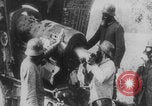
German soldiers shoot gas shell, German Kaiser Wilhelm II observes, Allied troops marching.
German soldiers wearing gas masks load a gas shell into artillery in the 1918 Spring Offensive (also known as the Kaiserschlacht or “Kaiser’s Battle”) during World War I. Soldiers fire gas shell from artillery. German soldiers assume “brace position” in trenches. From an observation position, German Emperor Wilhelm II speaks to German generals belonging to the Supreme Army Command or the Oberste Heeresleitung (OHL). German troops advance "over the top" from the trenches, running past obstacles. British soldiers firing with artillery. Soldiers running as noxious gas disperses in the battlefield, with German soldiers in trenches. A French soldier uses a telephone under a tree during a battle. United States soldiers marching with rifles. French troops wearing gas masks fire with artillery, stacks of shells amassed alongside them. Allied troops, including French soldiers and American soldiers, marching in farmland. Bodies of German soldiers killed lying in meadow.
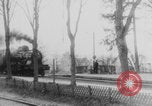
German Kaiser Wilhelm II arrives by train and speaks to military officials (WW1)
German Kaiser Wilhelm II arrives by train to witness the 1918 Spring Offensive (also known as the Kaiserschlacht or “Kaiser’s Battle”) during World War I. A moving steam locomotive train. Kaiser Wilhelm II salutes to a senior German military official after disembarking from the train. Kaiser Wilhelm II speaking with a senior German military official. A smiling military assistant salutes Kaiser Wilhelm before joining him on the train station platform. Military officers put coats on Kaiser Wilhelm II and the senior military official before assisting them into the car.