


 Francais
 Deutsch
 Italiano
Refine Your Search
+"Europe" +1918 stock footage and images
- Showing 7 to 12 of 72 results more
more Hide
Hide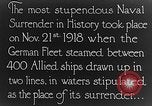
The German Naval Fleet surrenders on November 21, 1918 at end of World War I
Camera pans from mast downward on a British Tiger-class battle cruiser, attending the surrender of the German Fleet at end of World War 1. Her crew lines the outer edge of her foredeck and wave their hats as the German warships pass. Other Allied warships are seen dimly in the background, including other battle cruisers and battleships. A biplane aircraft flies overhead. Closeup of the crew standing on the gun casemates of the Tiger-class battle cruiser. Angular rotation marks, in degrees, are inscribed on the casemates. British sailors fill a warship and cheer as the German ships pass. A succession of German U-boats and destroyers complete the parade of surrendering warships. Another view of ship's company filling the foredeck of a British battleship to hear remarks by a British political leader. He salutes and so do they all. View of the British White Naval ensign waving in the breeze. (World War I; World War 1; WWI; WW1)
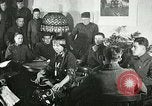
U.S. soldiers watching the performance of Tsianina Redfeather (a.k.a. Tsianina Blackstone), during World War I .
Tsianina Redfeather (also known as Tsianina Blackstone), a famous Creek-Cherokee Native American Indian mezzo-soprano, plays the Hawaiian guitar and sings for U.S. soldiers in YMCA- sponsored entertainment for the troops in a canteen, 1917-1918, during World War 1. (Historic note: While sailing to Europe in 1918 as a member of the American Expeditionary Forces, her vessel, the HMS Carmania, was struck by a torpedo. She continued the journey, entertained thousands of troops, and received a commendation for her service. Her interest in entertaining the troops, according to her autobiography, rested in the fact that so many American Indian soldiers were fighting overseas-- around 17,000. After her return to the U.S. her career continued to escalate. This clip perhaps represents the only surviving footage of this truly remarkable individual.)

Scenes of American forces in France at conclusion of World War I, Christmas gifts, and immediate postwar period
Several u.S. Army soldiers of the American Expeditionary Forces (AEF) stand near three French children, outside a church building in France, during World War 1. A large relief of Christ on crucifix is displayed on the wall behind them. One soldier kneels down next to the children and gives them some chocolates. He talks with them. Closeup of the children eating their candy. A boy wipes his hands on his sweater. The children make circles on their tummies, indicating that the food tasted good. New sequence shows American Army of occupation troops celebrating Christmas, 1918, at Montabaur, Germany. They are assembled at a hillside, around a platform holding a monument and statue. A large decorated Christmas tree is set up on one side of the monument, and an Army brass band stands on the other side. Captain William A. Turner, of the Salvation Army, dressed as Santa Claus, hands out gifts to some of the soldiers, assembled in the foreground. There also appear to be some local German people gathered to the far right, of the brass band. Next, "Santa Claus" is seen throwing gifts out to the gathered soldiers. Scene shifts, again, this time to several U.S. Navy dreadnought battleships that might be returning troops from Europe back to the United States. The first seen is a two-stacker, Florida-class; the second is the USS Pennsylvania (BB-38) and the third is the two-stacker USS New York (BB-34). Final sequence shows U.S. Secretary of the Navy, Josephus Daniels, and Secretary of War, Newton D. Baker, in top hats, stand on deck of a ship with with its Captain (a U.S. Navy Commander) to review U.S. Battleships returning from service with the British fleet in World War 1. The dim image of a battleship is seen in the background. (World War I; World War 1; WWI; WW1)
U.S. 105th Field Artillery march up to the docks and on to USS America and Madawaska in Newport News, bound for France
U.S. 313th Labor Battalion troops, 105th Field Artillery and 2nd Battalion Pioneers embark from Newport News, Virginia for Europe in 1918 during World War I. The troops of U.S. 313th Labor Battalion at a pier. U.S. 105th Field Artillery and 2nd Battalion Pioneers march up to the docks and on to gangplanks by U.S. Navy transport ships USS America and USS Madawaska. The World War 1 American troops at dock. The covered artillery at the dock. The troops walk up the gangplank. A building and a ship at the dock.

World War 2 film promoting public investment in War Bonds and stamps to aid the war effort and temper inflation
World War 2 era film that also includes some World War 1 scenes. Show girls or chorus girls in follies-like show, costumed as U.S. silver dollars and marching to tune and lyrics alluding to dramatic increase of currency in circulation, over the years. Animation with stacks of coins shows increase in national income from $46 billion,in 1933, to $71 billion, in 1939, and $142 billion in 1943. Back to the "follies dollars," a boy asks why, and then scenes of the Japanese attack on Pearl Harbor,are shown, with U.S. battleships being sunk. Wartime arms plants are shown. An M2A3 Light Tank rolls off a production line. Ships being constructed in a shipyard. B-24 Liberator bombers being built in a factory. Artillery shells being produced. Defense workers receiving their pay. The "follies dollars" group themselves to illustrate the fractions of income devoted to taxes and savings. But other spending is curtailed by wartime shortages. A woman talking with clerk in a drug store. U.S. Army troops crossing a pontoon bridge in open trucks, towing 75mm M1A1 howitzers. Infantry on the march. Animation showing industrial production devoted to war materiel and lots of dollars chasing few civilian goods. A grocery clerk offers to sell a woman customer butter for more than the established price, and she agrees. The "follies" performers then introduce the idea of an "inflationary dollar," and some history of past U.S. inflations. Animated examples of price inflation are shown. Glimpses of World War I scenes are seen, circa 1917 -1918, including: a 12-inch railway gun firing; a huge explosion from shell bursting near the camera; various scenes of United States infantry soldiers and French soldiers in battle action, running to bomb craters for cover and emerging from trenches to go up "over the top" into no-mans land during combat. Meanwhile, singing narration refers to the home front inflation due to competition for limited civilian goods. Map shows Europe and singing narration cites rising prices for food in occupied France and other countries suffering ravages of World War II. Montage of scenes showing needy civilians obtaining food in those countries. Animation shows increases, by 1944, in cost of U.S. civilian goods since the Pearl Harbor attack. "Follies" character called "Double-duty dollar," appears explaining he serves the war and curtails inflation on the home front by being saved through investments in War Bonds and stamps.
Training film for U.S. troops with the Army of occupation in Germany after world War II
Opens with bell tolling Victory against Germany in World War II. Next, a slate reads: "Victory Leads to Peace," and a farmer is seen with cattle pulling a plow. But narrator says "the problem now is future peace," and a map of Germany is shown overlaid with "Your Job in Germany." A cartoon of a soldier is superimposed on the map, along with one of a World War 1 American soldier and a figure of possible future soldier with similar mission. Camera focuses on parts of German aircraft in a jumbled heap. Closeups of weary defeated German soldiers at end ot World War II. Glimpse of Adolf Hitler speaking and haranguing an audience from a podium in an animated and forceful way. Swastika flags displayed from houses in a quaint German town. Joseph Goebbels, Nazi Reich Minister of Propaganda, at a microphone. Glimpse of a German concentration camp. But as they appear, each of the Nazi elements promptly disappears, showing the scenes without such Nazi symbols and persons. Skeleton remains of bombed buildings. Flower displays. Bucolic German rural countryside and quaint old villages in peaceful settings. Camera focuses on a book titled "German History." Chapter I, titled "Blood and Iron," shows Image of Otto von Bismarck. German troops march in a parade. Narrator states that "under Bismarck, the German empire was built." (He formed the German Empire in 1871, unifying Germany with himself as Imperial Chancellor, while retaining control of Prussia at the same time.) The film shows mounted German lancers as it alludes to Bismarck's campaigns against Denmark in 1867; Austria in 1866; and France, in 1870. Germany's leaders celebrating its status, in 1871, as the mightiest power in Europe. Troops marching and girls dancing nearby. Farmers plowing field with a horse and cow. Classic peaceful rural alpine scenes with local people in agricultural pursuits. A group of local German musicians playing folk music as village people dance outdoors. Back to the book, Kaiser Wilhelm II is shown on Chapter 2, entitled: "Deutschland über Alles." Gathering of German soldiers in Pickelhaube (spiked helmets). A German Big Bertha howitzer firing. German troops marching against Serbia; Russia; and France (with view of war damaged French cathedral). German invasion of Belgium in 1940 (with view of clock tower resting in rubble). German troops seen in Italy, walking past battle-damaged buildings. German Zeppelin dropping bombs on British targets and view of bombed out London neighborhood. Next scene shows a capsized ship with survivors running across its hull. Film slate labels the scene as United States, as if it is a U.S. ship attacked by Germany. (Actually, it is the Austro-Hungarian Battleship, SMS Szent Istvan, torpedoed, by Italian torpedo boats, during World War I.) Next, American soldiers in trench are seen going "over the top" and into "no man's land" on the western front of World War 1. Glimpse through a window of Kaiser Wilhelm II, after defeat of Germany, in 1918. View of Germans in a Beer Garden. Picturesque view of German town. A German orchestra performing. American soldiers marching out of Germany, with flags waving. Back to the history book,as chapter III is revealed, entitled "Today Germany, tomorrow, the world," and featuring Adolf Hitler. German troops invading Austria (where a civilian lies dead on the ground). German troops entering Czechoslovakia (where local people in tears render the Nazi salute). They march into Poland (where a girl weeps over someone, not seen, on the ground). They march into France (where a wounded, bandaged child cries in a bed). Next, is a scene from England, where a British child victim of bombing lies dead in the remains of a shelter. German troops invading Norway, Holland, Denmark, Belgium, Luxembourg and Russia (where a woman tries to rouse a dead woman). They invade Yugoslavia (where women sit near coffins of children) and Greece (where a woman rescues a naked child). A U.S. merchant ship explodes after being torpedoed by a German submarine (unseen). Scenes of destruction with people plucking dead victims from rubble of buildings. American troops invading Normandy, France on D-day, June 6, 1944. Several American soldiers fall to German gunfire on the beach. Wounded American soldiers being transported in jeeps on the battlefield and being placed on landing craft for evacuation. Americans walking past huge piles of destroyed aircraft parts. A landing craft filled with wounded American soldiers. American wounded and dead on a battlefield. Sailors abandoning a burning American ship by jumping into the sea. A sailor picked up in a life boat. A wounded American soldier being dragged from the beachhead at Normandy. Various wounds being treated by U.S. Medical Corps personnel. More scenes of American wounded being moved on stretchers. Scene shifts abruptly to German people folk dancing. Film concludes with question marks about the future.