


 Francais
 Deutsch
 Italiano
Refine Your Search
+"Europe" +1918 stock footage and images
- Showing 37 to 42 of 72 results more
more Hide
Hide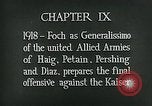
Allies prepare for final offensive in World War 1. Views of key commanders and leaders on all sides.
Generals of united Allies Armies prepare the final offensive against Kaiser Wilhelm II in Europe during World War 1. Marshal Ferdinand Foch, British Field Marshal Douglas Haig, French General Philippe Petain, United States Army General John Pershing and Italian Commander General Diaz gather in discussion. Closeup of Marshall Ferdinand Foch. Marshall Joseph Joffre talking to U.S. Army General Pershing. King Victor Emmanuel and General Diaz reviewing troops. Field Marshal Haig posing with a group of Generals. Marshal Ferdinand Foch and Marshal Philippe Pétain together. Georges Clemenceau greeting French officers. U.S. Secretary of War, Newton D. Baker, passes by a line of French soldiers and is seen using binoculars in the field. American General Bliss (Tasker Howard Bliss), U.S. representative on the Supreme War Council, speaking to a woman as other officers stand by. Closeup view of U.S. Army General Robert Bullard, Commander of the First American Army. General John Lejeune, Commander of U.S. Marines, speaking to a group. Kaiser Wilhelm II with his heir, Crown Prince Wilhelm of Prussia, in front of a building as the Kaiser speaks to a German officer. German Field Marshal Paul von Hindenburg with General Erich Ludendorff. German military band leads large column of German soldiers marching on a road. Long line of German soldiers walking up a turning road. British soldiers improving roads and transporting supplies. British soldiers and cavalry riding on horseback. Long line of British soldiers marching through trench and through a bombed out building. British soldiers marching on road. Allies, British and French forces on the move. U.S. General Pershing addressing a huge crowd of soldiers in an open field area. Lines of American soldiers marching. Colonel Teddy Roosevelt watches as U.S. Army soldiers advance. Italian Army soldiers marching and ascending a hill. Huge artillery piece being towed on a road.
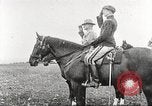
U.S. infantry of the American Expeditionary Forces march jointly with French infantry during World War I
American and French Army officers, on horseback, salute as a French and American infantry parade on a field in France during World War 1. The American and French flags are carried and various contingents of troops carry their respective identifying colors. Mounted officers accompany their units. General John J.Pershing reviews the joint French-American parade with French President Raymond Poincare and French Prime Minister Paul Painleve. French and American staff officers stand in the background. Animated map show the U.S. flag being overlayed on a smoldering Europe. A U.S. Stars & Stripes shield. (Note: Interestingly, only infantry units participate in this parade. No cavalry, or artillery are involved and rifles are the only weapons seen.)
U.S. Army training film on poisonous gas, flamethrowers, gas cylinders and gas artillery shells used by Germany in World War I.
A training film titled 'Gas and Gas Mask' shows how lethal gas is disseminated from gas cylinders and artillery shells in Europe by Germany during World War 1. German soldiers wearing gas masks move out from a trench through a screen of smoke or gas.The soldiers in prone positions advance through poisonous gas smoke and carry square shields. American forces demonstrate use of liquid fire (flame thrower) like that used by German troops to spray liquid fire in the trenches. Condensed gas in a cylinder. The cylinder lying on the ground in a horizontal position. A U.S. Army soldier wearing a gas mask opens the knob of the cylinder. The gas comes out. A gas cloud is formed and moves in the direction of the wind. A soldier holds a German gas shell. A large number of gas shells are exploded. A U.S. soldier demonstrates two different forms of gas masks. The first is a basic scarf which holds a small pad of cotton soaked in soda solution. He puts on the scarf mask. Next he puts on a more advanced "Gas helmet" (early gas mask).
Newspaper headlines relating to World War I.
View of picture of 1908 McLauglin-Buick and 1915 sedan auto. Map of Europe with German Iron Cross superimposed. Newspapers running off presses. Headline on paper reading, 'Arch Duke Assassinated.' Headline reading, 'Germany Declares War; All Europe is in Arms.' Headline reading, 'Germany Invades France', superimposed over German troops marching in background. Headline, 'French Resist at Marne.' Headline, 'Lusitania Sunk' with picture of the ship. Newspaper presses running. Printer reading paper with headlines 'U.S. Declares War.' Paper reading, 'U.S. At War.' Headline, 'U.S. Troops Land in France.' Billboard sign, 'Beat Back the Hun With Liberty Bonds' superimposed over picture of troops marching in background. Ships under construction. Destroyer underway.
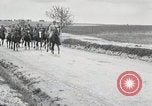
African American soldiers of 369th Infantry, 93rd Division, U.S. Army marching on road in Maffrecourt, France, during World War I
African American soldiers of the 369th Infantry Regiment, 93rd Division ("Harlem Hellfighters"), United States Army, march in formation along a road in Maffrecourt, France, in World War 1. They are led by mounted officers, and a brass band (likely under the direction of band leader Lt. James Reese Europe). Unit leaders salute as they pass the camera. Mules pull several artillery pieces and caissons. Several medics march with stretchers. The U.S. flag is the only one carried by the color guard. No unit colors are seen. The 369th Infantry soldiers wear French helmets because they were assigned to the French Army during the war, as the U.S. Army (American Expeditionary Forces) did not permit African Soldiers in combat.
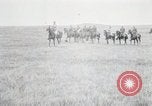
African American soldiers of U.S. Army 369th Regiment, 93rd Division, march in review near Maffrecourt, France, during World War I
African American soldiers of United States Army 369th Infantry Regiment, 93rd Division, Colored (sometimes called the "Harlem Hellfighters") on parade across an open field near Maffrecourt,France, during World War 1. They are led by their Commander, Colonel William Hayward, on horseback, followed by 8 other mounted officers. Several soldiers are walking bicycles behind them. Next is seen the famous 369th Regimental marching band, led by Bandmaster, Lieutenant James Reese Europe. Troops of the Regiment march with shouldered arms in formations of 30-man fronts. At the end of the film, the troops execute a right flank maneuver. A three-man color guard poses for the camera with the American flag. No other colors are displayed during the review.