


 Francais
 Deutsch
 Italiano

Refine Your Search
+"Europe" +1944 stock footage and images
- Showing 73 to 78 of 234 results more
 Hide

United States troops improvise time saving devices and work on a military jeep in Europe.
United States troops improvise time saving devices in Europe. Soldiers repair a military vehicle. A soldier works on an electric tower. Jeep parked on a railway track. The soldiers turn the jeep on track. Jeep moves on the track. Soldiers work on the jeep in a snow covered field. (World War II period).
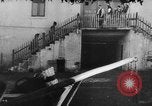
Europe begins to normalize as World War II comes to an end; scenes in Serbia, Spain, and Czechoslovakia.
A Slav festival in Serbia. People climb stairs to enter a Greek Catholic Church, where a priest is seen waving a container of incense, as part of the ritual. (Narrator notes that the theme is protection of native cultures, including protection of religion.) The Priest slices a large piece of bread for the Mass. Next an accordion is seen and dancers assemble for the "Kolo" (a Serbian national dance). View of dancing, that marks end of the festival. Scene shifts abruptly to a sailboat race in Malaga, Spain. Narrator says it "suggests the idea of normal living with a prosperous new Europe." Film shifts to mountains of the high Tatras, in Czechoslovakia, where Ski troops of the Czech army demonstrate their abilities.

Cyclists compete during a French Belgian cycle race in Europe.
Film obtained by OSS. OSS logo seen at start. A bicycle race in Europe, held during World War 2. Cyclists ride bicycles during a French-Belgian bicycle race. The cyclists speed away on their bicycles. A church. The winner being thronged by people after winning the race. The winner smiles after winning the race.

General Ira Eaker being awarded a medal by Russian Ambassador Bogomolov in Europe during World War II.
General Ira Eaker receives Russian decoration from the Russian ambassador in Europe during World War II. Russian Ambassador M. Alexander Bogomolov and his wife Lydia in front of a U.S. Army Air Forces C-27 aircraft. General Jacob L. Devers and General Ira C. Eaker greets Russian officials as they get off a U.S. Army Air Forces C-47 aircraft. Mrs. Bogomolov and a WAC ( Women's Army Corps) Captain talk. They walk towards a staff car. Nose of C-47 in the background. Army officers with ambassador Bogomolov including General Ira Eaker. He talks to Mr. And Mrs. Bogomolov. Wac Captain and Russian staff in club patio of General's campsite. Ambassador Bogomolov reads citation and then pins up a medal onto General Eaker.
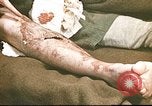
Soft tissue wounds of U.S. soldiers and their recovery after successful surgical operations in Europe during World War II.
A film shows U.S. soldiers being hit by shell fragments and their recovery after surgery in Europe during World War II. A case of soft tissue wound shows a wound on the leg of a soldier who was hit by a shell fragment. Surgery on the wound shows gentle exploration revealing the path of a muscle. The skin incision is enlarged. A blood cord is evacuated. A shell fragment is removed. The wound is dressed. The wound after few days of injury. The wound is ready for skin grafting. The graft being stitched on the wound. Stitches are removed after few weeks and the patient is discharged. A case of multiple soft tissue wound shows a wounded soldier on an evacuation hospital bed. Two wounds on the left arm of the patient. X-rays of the arm of the patient. An incision is made to connect the two wounds. Margins of the wound are divided. Multiple wounds on the hand of a patient. The wound on the left arm after two weeks. The wound is ready for secondary closure or skin grafting. Strapping is done to bring skin margins together. Surgeons operate the same patient. The wound is stitched. The patient shows his hand after healing. A soldier with a wound just below his buttock. A soldier with a scar under scapula. Wounds on right leg and left arm of a soldier. Medics evacuate a wounded soldier. A surgical operation in progress. The soldiers smile after their successful recoveries from soft tissue wounds. U.S. troops during operations of World War II.

United States soldiers get affected by 'trench foot' in Europe during World War II.
A film titled 'Trench Foot' shows medical condition 'trench foot' of U.S. soldiers which was caused by prolonged exposure of the feet to damp and cold conditions during World War II. Cold weather in Europe. Heavy rains in a town. U.S. soldiers walk along a muddy road. The soldiers in winter clothing rest under a tent. The soldiers in foxholes. The soldiers walk through deep mud. Effects of 'trench foot' on the feet of a soldier. The feet with dilated vessels.