


 Francais
 Deutsch
 Italiano
Refine Your Search
+"Europe" +1944 stock footage and images
- Showing 43 to 48 of 226 results more
more Hide
Hide
Early pictures of General Eisenhower showing his childhood home and his welcome ceremony when he returned home.
'The Big Picture' depicts the life of U.S. General Dwight D Eisenhower. Sergeant Stuart Queen of the U.S. Army stands in front of a map. He gives an introduction of Eisenhower. In 1945 Eisenhower returns to his homeland in Denison, Texas. A banner reads 'Welcome IKE'. People gather on the sides of the streets to welcome him. He waves from an open car at the cheering crowds. People at parade carry the U.S. flags during a ceremony. Eisenhower salutes. D Day, June 6, 1944- Barges carrying American troops land on the shore of Normandy. Eisenhower with another military officer. Eisenhower salutes. Streets of the city Abilene. Exterior of the Eisenhower Museum. Two boys enter the museum. Pictures of Eisenhower in his childhood - during infancy, house in which he was born, Eisenhower with a group of children, Eisenhower with his family, with his baseball and football team. View of Eisenhower's bedroom- scripture readings on the walls and books in the shelves. A truck passes the creamery where Eisenhower worked in his spare time. Pictures of Eisenhower leaving home to join the Military Academy at West Point. Cadets marching at the grounds of the military academy. Graduation Certificate of Eisenhower. Eisenhower with his wife Mamie Geneva Doud. Fight in Western Europe during the World War I. Picture of Eisenhower with other cadets. The certificate of the Distinguished Service Medal presented to Eisenhower for his services for training tank crews in Pennsylvania.
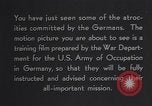
Training film for U.S. troops with the Army of occupation in Germany after world War II
Opens with bell tolling Victory against Germany in World War II. Next, a slate reads: "Victory Leads to Peace," and a farmer is seen with cattle pulling a plow. But narrator says "the problem now is future peace," and a map of Germany is shown overlaid with "Your Job in Germany." A cartoon of a soldier is superimposed on the map, along with one of a World War 1 American soldier and a figure of possible future soldier with similar mission. Camera focuses on parts of German aircraft in a jumbled heap. Closeups of weary defeated German soldiers at end ot World War II. Glimpse of Adolf Hitler speaking and haranguing an audience from a podium in an animated and forceful way. Swastika flags displayed from houses in a quaint German town. Joseph Goebbels, Nazi Reich Minister of Propaganda, at a microphone. Glimpse of a German concentration camp. But as they appear, each of the Nazi elements promptly disappears, showing the scenes without such Nazi symbols and persons. Skeleton remains of bombed buildings. Flower displays. Bucolic German rural countryside and quaint old villages in peaceful settings. Camera focuses on a book titled "German History." Chapter I, titled "Blood and Iron," shows Image of Otto von Bismarck. German troops march in a parade. Narrator states that "under Bismarck, the German empire was built." (He formed the German Empire in 1871, unifying Germany with himself as Imperial Chancellor, while retaining control of Prussia at the same time.) The film shows mounted German lancers as it alludes to Bismarck's campaigns against Denmark in 1867; Austria in 1866; and France, in 1870. Germany's leaders celebrating its status, in 1871, as the mightiest power in Europe. Troops marching and girls dancing nearby. Farmers plowing field with a horse and cow. Classic peaceful rural alpine scenes with local people in agricultural pursuits. A group of local German musicians playing folk music as village people dance outdoors. Back to the book, Kaiser Wilhelm II is shown on Chapter 2, entitled: "Deutschland über Alles." Gathering of German soldiers in Pickelhaube (spiked helmets). A German Big Bertha howitzer firing. German troops marching against Serbia; Russia; and France (with view of war damaged French cathedral). German invasion of Belgium in 1940 (with view of clock tower resting in rubble). German troops seen in Italy, walking past battle-damaged buildings. German Zeppelin dropping bombs on British targets and view of bombed out London neighborhood. Next scene shows a capsized ship with survivors running across its hull. Film slate labels the scene as United States, as if it is a U.S. ship attacked by Germany. (Actually, it is the Austro-Hungarian Battleship, SMS Szent Istvan, torpedoed, by Italian torpedo boats, during World War I.) Next, American soldiers in trench are seen going "over the top" and into "no man's land" on the western front of World War 1. Glimpse through a window of Kaiser Wilhelm II, after defeat of Germany, in 1918. View of Germans in a Beer Garden. Picturesque view of German town. A German orchestra performing. American soldiers marching out of Germany, with flags waving. Back to the history book,as chapter III is revealed, entitled "Today Germany, tomorrow, the world," and featuring Adolf Hitler. German troops invading Austria (where a civilian lies dead on the ground). German troops entering Czechoslovakia (where local people in tears render the Nazi salute). They march into Poland (where a girl weeps over someone, not seen, on the ground). They march into France (where a wounded, bandaged child cries in a bed). Next, is a scene from England, where a British child victim of bombing lies dead in the remains of a shelter. German troops invading Norway, Holland, Denmark, Belgium, Luxembourg and Russia (where a woman tries to rouse a dead woman). They invade Yugoslavia (where women sit near coffins of children) and Greece (where a woman rescues a naked child). A U.S. merchant ship explodes after being torpedoed by a German submarine (unseen). Scenes of destruction with people plucking dead victims from rubble of buildings. American troops invading Normandy, France on D-day, June 6, 1944. Several American soldiers fall to German gunfire on the beach. Wounded American soldiers being transported in jeeps on the battlefield and being placed on landing craft for evacuation. Americans walking past huge piles of destroyed aircraft parts. A landing craft filled with wounded American soldiers. American wounded and dead on a battlefield. Sailors abandoning a burning American ship by jumping into the sea. A sailor picked up in a life boat. A wounded American soldier being dragged from the beachhead at Normandy. Various wounds being treated by U.S. Medical Corps personnel. More scenes of American wounded being moved on stretchers. Scene shifts abruptly to German people folk dancing. Film concludes with question marks about the future.
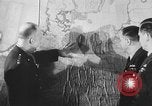
Invasion of Allied Forces in Germany and German surrender (WW2)
General Eisenhower confers with British Air Marshal Leigh-Mallory and British Air Chief Marshal, Sir Arthur Tedder, in front of a map of Europe on a wall. New York Post, June 6, 1944, headline reads "INVASION Smashing Inland." U.S. troops assault beach at Normandy on D-Day and several fall from enemy fire during World War II. German troops surrendering as Americans advance. Dead German soldier. Adolf Hitler sits in a room. B-24 bombers of the U.S. Eighth Air Force, 2nd Air Division, 2nd Bomb Wing, 446th Bomb Group, in flight on mission over Germany. Bombs falling on target. View through gun camera of fighter strafing German aircraft on the ground and strafing a railroad train filled with ammunition, that explodes. Sun newspaper headline reads: 'Allies plunging deep into Reich.' U.S. troops move through grassy field. U.S. artillery crew fires M-114, 155mm Howitzer under camouflage net. New York World Telegram newspaper headline reads: 'Allies swarm across Rhine'. U.S. troops crossing the Ludendorff Bridge, at Remagen, Germany. View of dead victims at German concentration camp. Journal American newspaper headline reads: 'Mass surrender of foe underway'. German prisoners of war double-time march running along a road with hands held high in surrender. Emotion and distress show on face of very young German boy soldier as he unbuttons his coat. A German woman sits quietly in background. A mile long line of German prisoners march in a field. A Nazi Swastika flag burning on the ground.
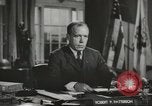
American Undersecretary of War speaks to difficulties facing Allies in confronting Germany and Japan in World War II
Undersecretary of War, Robert Porter Patterson, Sr. speaks about a report from the General staff outlining the needs for combating Germany and Japan in World War 2. He cites Operation Husky, the invasion of Sicily, as an example of what will be needed. He continues to narrate in the background as an animated map appears showing the buildup of supplies and Allied forces in North Africa; Allied air forces flying 60 thousand sorties over Sicily and, the direct amphibious assault using 3,200 vessels. Map also depicts opposing forces of 12 (“unwilling”) Italian Divisions and 3-1/2 German Divisions. View of Allied troops carrying some of their 31 thousand casualties on stretchers from field ambulances. Allied medics attending to the wounded. Some are seen lying on stretchers in a row on the ground near a wall. Interior of a field hospital where surgeons and other medical personnel treat the wounded. Animated map shifts to Europe with Germany at its center, showing , in contrast to Sicily that was only an “outpost,”, the heavily fortified perimeter of Axis controlled areas; the axis industrial might; and the disposition of 300 German Divisions (mostly on the Eastern front) defending the region. Next, the map illustrates Japan’s defended regions in the Pacific Image returns to Undersecretary Patterson i n his office, speaking of the Allied offensives planned for next year (1944), and emphasizing their challenge and difficulty. Scene shifts to General Jonathan Wainwright and his garrison at Corregidor, in the Philippines, surrendering to Japanese forces in 1941. Japanese military camera pans over the Americans being taken prisoner. Other Americans and Filipinos are seen being marched together under guard. Scene shifts to classic views of the Japanese attack on Pearl Harbor, Hawaii, on December 7, 1941. View of Japanese soldiers executing two Chinese civilians in 1937. Dangling bodies of persons hung by Nazis during Operation Barbarossa in Russia, in 1941 A Russian soldier comforts a little girl as he escorts her across a snowy landscape. Time bomb left by German forces retreating from Naples, Italy, in 1943, blows up a Post office building . Views of damage to building and bodies of victims. American Military Police assisting a victim. American soldiers carrying an injured civilian on a litter. Scene shifts to British Foreign Minister, Anthony Eden, Soviet Foreign Minister, Vyacheslav Molotov, and U.S. Secretary of State, Cordell Hull, entering a hall in the Spiridonovka Palace, during the 1943 Moscow Conference in Russia. Close-up of the American, Soviet, and British flags on a table. View of many delegates seated around the table. Close-up of Molotov, Eden, and Hull signing conference document.
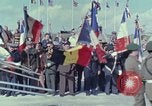
The USAFE band marches while Omar Nelson Bradley with other officers lays wreaths at a memorial in Normandy, France.
A ceremony at a military cemetery near the site of the Allied invasion of Normandy, France(6th June 1944) to mark the 30th anniversary of the D-Day. A band of the United States Air Forces in Europe(USAFE) marches. Girls bring wreaths. U.S. Army General Omar Nelson Bradley and other Allied officers lay wreaths at a memorial. The officers salute.

U.S. Army General Wade Haislip presents Congressional Medal of Honor to Technical Sergeant Charles Coolidge in Darmstadt.
Decoration of a technical sergeant of U.S. Army in Darmstadt, Olm Area soon after end of World War II in Europe. Soldiers lined up. An aircraft taxiing on a field. Commanding-General of 7th U.S. Army General Wade Haislip presents Congressional Medal of Honor to T/Sgt (Technical Sergeant) Charles H. Coolidge of Signal Mountain, Tennessee for outstanding duty with 141st Infantry, 36th Division the "Lost Battalion" in October 1944. Troops and Honor Guard parade along field.