


 Francais
 Deutsch
 Italiano

Refine Your Search
+"Europe" +1944 stock footage and images
- Showing 37 to 42 of 234 results more
 Hide
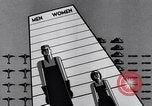
American women at home and work in the context of WW2
Graph compares the number of female factory workers to men during World War II. Factory workers producing war materiel in the United States. Workers using lathe. Welders welding machines. Tanks are loaded onto rail freight cars. Railroad freight yards and shipping. Posters advertising war jobs for women. Women interviewed for war jobs by men. Alarm clock rings as tired woman wakes up in bed. Women in front of Sterner's Department Store and buying fur coats. Women reading newspapers while smoking. Crowd trying to get onto an overcrowded bus. A mother comforts her boy who has skinned his knee. Men and women leaving a factory. Interior of World War 2 airplane factory. Soldier examines broken radio on battlefield. Wounded American soldiers carried on litters. A telegraph is delivered to a woman by a girl. Woman reads the telegraph. Woman crying in bed while reading the telegraph that announces her husband's death, while her son comforts her. Close up photo of deceased husband. Montage of graveyards with gold star of service superimposed on image. Newspaper headline "All Job Deferments Face Drastic Review" View of men inside Selective Service local board 226 office. Some men being drafted then in 1944 are shown, including older men, more fathers, and men who had been doing essential industrial work. Man working with metal lathe. American soldiers climbing mountain in snow in Italian mountains. American soldiers wade through deep water in a jungle region of the Pacific. View of a sinking ship or merchant ship, and two crew members jumping off the sinking ship into the water. View of London England blitz damage and devastation, and people digging through piles of rubble from bombing. Dead bodies of adults and children from war in Europe. Crying women, London Blitz. Woman holding boy in arms. Woman kissing girl. Old woman sewing in factory to help with the war production effort. Women picking crops to help with farming and supply of food for soldiers.

U.S. industrialist, Henry J. Kaiser appeals to Americans to donate used clothing for war victims throughout the world
American industrialist, Henry J. Kaiser appeals for donating clothing to war victims in China and Europe during World War II. Seated at desk in office, he addresses the nation and announces a drive, commencing April 1, 1944, to collect used clothing for war victims, all over the world. Scenes shows : War victims in food lines. Starving and wounded civilian victims of war. An American woman and a girl at home in America select clothing for donation. Mr. Kaiser shows a banner which reads "what can you spare that they can wear?"
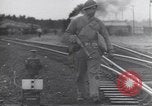
Troops board trains with war equipment and other supplies en route to ports of embarkation from the United States during World War II.
Plans underway in the United States in 1944 for participation in the invasion of France during World War 2 by Allied forces. A U.S. Army sentry of the Army Service Forces (ASF) patrols a rail line, where military men and equpment are being transported abroad., during World War 2. ASF soldiers drive DUKWs (amphibious vehicles) up a ramp for loading into railroad box cars. A long line of DUKWs being driven for loading. Many men load 55 gallon drums of petroleum products into rail cars. An M3 Stuart light tank being driven on an open rail car. Soldiers loading motorcycles on a train. An Army M3 Half-track Amored Personnel Carrier (APC) driving onto a railroad train. (Narrator notes that it requires 75 trains to transport a single Armored Division by rail.) Men loading a 105 mm Howitzer Motor Carriage M7 (Called Priest, by the British) onto a flat rail car and securing it in place with wooden supports. Army personnel that would participate in an invasion are shown. Paratroopers with their packs. Women's Army Corps (WACs) fill their duffel bags with clothing and other items, and are then seen climbing aboard an open stake truck. An Army band plays and marches giving troops a sendoff at a train station. U.S. soldiers board passenger railroad trains, carrying their field packs and weapons. A steam locomotive pulling a troop train. A train load of Sherman M4 medium tanks and other equipment, including a caterpillar tractor, is seen underway. Unidentified tanks being fastened to rail flat car. Many Army trucks and heavy equipment on train passing a town train station. Military equipment moving on trains over bridges. Two ladies under hair dryers at a salon, discussing boys in service going overseas. United States Army troops bound for the war front are seen boarding railroad trains and also changing trains, monitored by Army military police (MPs) at night. Soldiers inside a moving train car occupy themselves by playing cards; shooting craps; An African American porter watches a game. An Army chaplain talking with some of the soldiers. A soldier reading a magazine. His seat partner keeps falling asleep against him. American civilians at a newsstand. Newspaper headline reads: "London expects invasion of Europe at any hour."

World War 2 film promoting public investment in War Bonds and stamps to aid the war effort and temper inflation
World War 2 era film that also includes some World War 1 scenes. Show girls or chorus girls in follies-like show, costumed as U.S. silver dollars and marching to tune and lyrics alluding to dramatic increase of currency in circulation, over the years. Animation with stacks of coins shows increase in national income from $46 billion,in 1933, to $71 billion, in 1939, and $142 billion in 1943. Back to the "follies dollars," a boy asks why, and then scenes of the Japanese attack on Pearl Harbor,are shown, with U.S. battleships being sunk. Wartime arms plants are shown. An M2A3 Light Tank rolls off a production line. Ships being constructed in a shipyard. B-24 Liberator bombers being built in a factory. Artillery shells being produced. Defense workers receiving their pay. The "follies dollars" group themselves to illustrate the fractions of income devoted to taxes and savings. But other spending is curtailed by wartime shortages. A woman talking with clerk in a drug store. U.S. Army troops crossing a pontoon bridge in open trucks, towing 75mm M1A1 howitzers. Infantry on the march. Animation showing industrial production devoted to war materiel and lots of dollars chasing few civilian goods. A grocery clerk offers to sell a woman customer butter for more than the established price, and she agrees. The "follies" performers then introduce the idea of an "inflationary dollar," and some history of past U.S. inflations. Animated examples of price inflation are shown. Glimpses of World War I scenes are seen, circa 1917 -1918, including: a 12-inch railway gun firing; a huge explosion from shell bursting near the camera; various scenes of United States infantry soldiers and French soldiers in battle action, running to bomb craters for cover and emerging from trenches to go up "over the top" into no-mans land during combat. Meanwhile, singing narration refers to the home front inflation due to competition for limited civilian goods. Map shows Europe and singing narration cites rising prices for food in occupied France and other countries suffering ravages of World War II. Montage of scenes showing needy civilians obtaining food in those countries. Animation shows increases, by 1944, in cost of U.S. civilian goods since the Pearl Harbor attack. "Follies" character called "Double-duty dollar," appears explaining he serves the war and curtails inflation on the home front by being saved through investments in War Bonds and stamps.
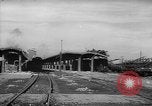
Destruction in Ploesti, and Brasov, Romania, from U.S. Army Air Forces bombing during World War II
Destroyed rail yards in Ploesti (Ploiesti) Romania, from attack by U.S. 15th Air Force bombers, during World War 2. Destroyed rail cars and damaged switch yard. Fires burning in distant background. Passenger trains with slight damage to their cars. One is labeled in Hungarian: "NEMZETKOZI JALOKOCSI ES EUROPAI"(International sleeping cars and Europe).Twisted rails and ties beneath a bridge and all along the rail lines in and out of the marshaling yards. Destroyed stations and steel frameworks of trains. Repair crew pulling a rail car along some useable track. A church in the background (possibly St Pantelimon Church). Bombed-out industrial buildings and railroad sidings. Locomotives steaming as trains sit on some remaining useable track. Work crews looking over the wreckage. Lumber strewn all over an area. At timecode 2:11, Scene shifts to Brasov, Romania, in May, 1944, with a truck driving toward the camera on a street parallel to the Railroad Station Square. The camera pans left, past destroyed buildings to the Station Square where a bus and some passengers are seen. Camera pans right showing more destroyed buildings, and then a locomotive steaming at head of a train on some undamaged rails. Views of bombed out freight cars. At timecode 2:54, Men are seen sitting and standing on useable rails as they look at some destroyed rail cars. The station is seen in distance at the right. View is along the railroad leading in the direction of Bucharest. Remaining views show the damage to building at Station Square, and the bus parked there.
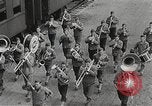
US Army soldiers and heavy equipment transported by railroad trains in the United States, bound for war front in World War 2
Activities of the United States Army in the United States during World War II. A U.S. Army band from the 407th Engineer Battalion playing musical instruments and marching. U.S. Army soldiers board railroad trains at a railroad station for transportation toward the war front. A railway steam locomotive pulling train cars. M4 Sherman tanks are seen on them as well as M2A4 (Mae West) tanks sitting partially turned with their guns out of sight away from the direction of travel.Browning M1919 .30 caliber machine guns are seen in their extra turrets. Army trucks and other military vehicles are also aboard the supply trains. The supply train moves through American countryside. Two women seated under hair dryers converse about the war in a beauty shop or beauty parlor. U.S. troops on troop transport railroad trains at night. Interior of a train car. American soldiers read books, sleep, and some play dice. An African American porter watches the game. A chaplain speaks to the soldiers. Civilians buy newspapers at a news stand. Headline on newspaper reads "London Expects Invasion of Europe at Any Hour" (before the upcoming Normandy Invasion of France in June 1944.)