


 Francais
 Deutsch
 Italiano

Refine Your Search
+"Europe" +1945 stock footage and images
- Showing 1 to 6 of 530 results more
 Hide
American aircraft strafing small factories and vehicles on roads in 1945, near end of the War in Europe.
American aircraft in flight strafing woods. Aircraft strafes a vehicle on road. Explosion on road. Aircraft strafing small factories and clusters of buildings, in 1945 near the end of World War II in Europe.
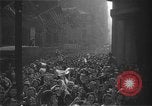
Crowd celebrates Victory in Europe (VE Day) on Wall Street, in Manhattan, New York City, May 8, 1945
Women in a street in United States. United States miniature flag on poles. Showering of ticker tapes. Mass of women standing in a street as they cheer the end of World War 2 in Europe.
Scenes in a German city as World War II in Europe ends on VE-Day, May 8, 1945
Opening scene shows local German citizens chatting in small groups near a city street on the day World War 2, in Europe, ends. Next, American soldiers are seen standing beside a road as a German soldier on a motorcycle leads a truck filled with unarmed German soldiers. Another truck drives behind. Scene shifts to a long line of such trucks carrying German soldiers. Several open trucks, filled with German soldiers, ride past the camera. A Sd.Kfz. 8 halftrack filled with German soldiers pauses a while in front of the camera. Several other vehicles pass, followed a pair of German soldiers driving by a horse-drawn covered wagon. German soldiers assembled in loose formation on the edge of a large lawn. Discarded military equipment is on the ground nearby. Two German officers stand in front of the formation. One is giving instructions. Meanwhile, American soldiers begin to examine the arms and equipment on the ground nearby. Closeup of the German officers as the one is giving instructions to the formation of troops.

Opening statement of the prosecution at the Nuremberg Trials; flashback scenes of Nazi crimes and starving civilians in 1945
Events related the Nuremberg Trials held at the Palace of Justice in Nuremberg, Germany. Flashbacks of a variety of Nazi crimes against humanity during World War II. Europe during 1945. War devastation: buildings and cities laid in waste, people in hunger and despair emerge from shelters searching for the causes of the war and of the immediate human suffering. Deprived children and adults weep, starve and beg on the streets. November 21, 1945, Nuremberg, Palace of Justice, seat of the International Military Tribunal. List shows the names of the convicted Nazi criminals. Chief prosecutor from the United States, Robert Houghwout Jackson, makes the opening statement of the prosecution. He presents Count 1 of the indictment a conspiracy to commit war crimes and crimes against peace and humanity. He makes the statement that criminals who have done injustice to the laws of humanity must be brought to justice. Stenographers wearing headphones take down notes. Defendants stand in their dock including Herman Goring, Rudolf Hess, Joachim von Ribbentrop, Wilhelm Keitel, Karl Donitz, Erich Raeder, Baldur von Schirach and Fritz Sauckel. Faces of the convicted criminals. Scenes from mass burial of victims from German bombing of Coventry, England. Scenes from the end of World War 2, with women weeping and civilian victims of war in Europe, including Germany, seen scavenging on streets for food. Women and hungry children scrape out trash cans and metal lids for bites of food. Desperate civilians cut down remaining tree stumps from formerly tree-lined streets to use for fuel. A group of men and women struggle in a food relief line in Italy.

German Junkers JU-29 and U.S. P-80 shown on Air Force Day at Wright Field in 1945. Orville Wright attends the event
Celebration of the 38th anniversary of the U.S. Army Air Forces, dating back to establishment of the Aeronautical Section of the U.S. Army Signal Corps, in 1907. Airmen of the Army Air Forces march in formation on the flight line at Wright Field in Dayton,Ohio. Aviation pioneer, Orville Wright, is seen in the reviewing stand. A color guard marches past the the reviewing stand. A 4-engine German Junkers JU-290 transport aircraft is seen parked on the field. (It arrived on July 31, 1945, after being flown to Wright Field from Europe, by U.S. Air Forces Colonel Harold E. Watson and co-pilot Captain Fred McIntosh,who were delivering it to Air Technical Intelligence Headquarters.) The crew of the JU-290 (named "Alles Kaputt") pose in front of it. Colonel Watson, is seen holding a Dachshund dog. The JU-290 takes off on a demonstration flight. A new U.S. P-80 "Shooting Star" jet airplane (serial number 44-84995) is rolled out for all to see. It takes off in a demonstration flight. (Late in World War 2.)

World War 2 battle scenes; wrecked buildings and masses of displaced persons in Europe after World War II.
'Problems of Peace in Europe' produced in 1948, depicts reconstruction problems in aftermath of World War II and includes footage from during the war and soon after the war. Scene of desperate and hungry civilian people (possibly in Germany but could be elsewhere in Europe) scrambling over each other and trying to find food on the ground among garbage or wreckage, circa 1945 or 1946. European peoples massing to reestablish political order and seek relief in post-war Europe. Montage of images of people from all walks of life. Reminders of war showing aircrews in bombers and bombs falling. Batteries of rockets being fired. A formation of U.S. B-17s and a B-26 aircraft with D-day stripes, in flight. Allied bombing of cities with devastating effect (likely 1944-1945). Aerial view of the Statue of Liberty in New York Harbor. Aerial view of a major U.S. industrial complex, with many smoke stacks and industrial pollution. Mass of workers leaving at end of shift at a U.S. manufacturing plant or factory. Views of two different streamlined locomotives pulling passenger trains at high speed, approaching camera position. Freight trains speeding on railroads. Farmers harvesting and baling hay by machine and cultivating fields with tractor. Multiple wide views of the K-25 building of the Oak Ridge Gaseous Diffusion Plant, in Oak Ridge Tennessee, the world's largest building in 1944 when it was built, and an instrumental part of the Manhattan Project effort to develop the atomic bomb in World War 2. Huge sprawling industrial sites in America. Map of Europe. Street scene in Germany with destroyed buildings and rubble cleaned from street, but still piled up in places. Desperate, hungry, and poverty stricken German citizens rummaging through garbage piles for anything to eat or anything of value. Two very young German boys standing together on a street, with one boy smoking a cigarette. Children scrambling over trash and rubbish heaps.