


 Francais
 Deutsch
 Italiano

Refine Your Search
+"France" +1908 stock footage and images
- Showing 13 to 18 of 41 results more
 Hide
Scenes from the Wright Brothers first public demonstration flight in Le Mans France.
First public demonstration flight of the Wright Brothers in Le Mans France in 1908 as seen in a 1928 commemoration film. Mechanics rotate the propellers of the aircraft for engine start. Orville Wright sitting in the cockpit with a person. The aircraft is launched by means of a catapult. The Wright aircraft flies low over a field.
Wright brothers preparing for first public demonstration flight in Le Mans, France
August 8, 1908 newspaper front page story about the Wright Brothers first public demonstration flight completed in France. Wilbur Wright adjusting a launching wheel for their airplane. Horses pull the airplane across a field. Two men turn the propellers of the Wright's airplane to start the engine. Men maneuver the Wright airplane on a steel takeoff rail.
Henri Farman's flying machine in flight over France
Tail section of plane designed by Henri Farman, a successful competitor of the Wright brothers. Three men seen around the plane. Farman pours gasoline into tank from a can. Plane taxiing for take-off. Plane in flight over Issy-les-Moulineaux in France during demonstration in 1908.
Pressmen watch the Wright aircraft as it flies carrying a French journalist in France.
The history of aviation. Wilbur Wright and a French journalist fly in an aircraft in France. October 3, 1908 headlines proclaim the event. Wilbur Wright and the journalist get into the aircraft. Launching of the aircraft. The aircraft in flight overhead. Pressmen standing on the airfield duck as the aircraft flies overhead. The Wright aircraft flies overhead.
Aviation history; historic early flight scenes; first hand accounts from persons who knew and worked with the Wright brothers.
Views of traffic on a city street around the turn of the 20th century. A mix of horse and buggies and motorcars and bicycles. People waiting for a trolley car. Reenactment of persons using an early telephone and of early filmmakers at work with camera on motion picture film. The Wright brothers home at 7 Hawthorne Street, West Dayton, Ohio. The Wrights' former housekeeper, Carrie Grumbach, recalls December 17, 1903, a telegram arriving about the Wright brothers successful first powered flight. Glimpse of Wright brothers machine shop. Charlie Taylor, who had worked in their shop, speaks of being pleased at their accomplishment. View of the Wrights flying gliders at Kitty Hawk, North Carolina. Charlie Taylor describing how he machined and built the motor for the Wright brothers airplane. Glimpse of that motor or a facsimile. Men positioning the Wright brothers airplane for launching, and French citizens gathered to watch a demonstration of their airplane in France. French aviation pioneer, Henri Farman with two other men in his Voisin-Farman I airplane. They begin takeoff. Closeup of Brazilian aviation pioneer, Alberto Santos-Dumont. Other early aircraft in flight. A Wright Flyer passing over the Fort Myer drill ground in Virginia. An Army balloon in the background. Retired United States Air Force Brigadier General, Frank P. Lahm, walks across the tarmac on an airport and speaks for interviewer (unseen). He speaks about the difficulty the Wright brothers had in convincing the U.S. Army of the value of their airplane. He tells that in December, 1907, Wilbur Wright was finally granted an interview with the Board of Ordnance and Fortifications, which led to a contract, in 1908, with the Signal Corps. Moving imagesof Orville Wright and assistants bringing a Wright Flyer to Fort Myer, Virginia, to conduct flight trials for the Army. Views of the airplane being flown all around the area, watched by spectators. (This footage is a mix of 1909 footage where the aircraft shows two half-rounds of canvas in the front elevator, and 1908 footage, taking off and flying, where the aircraft has a single half-round of canvas in the front elevator.) After landing on the 9th of September, 1908, then, Lieutenant Lahm, accepts Orville Wright's offer to fly with him. Lahm climbs aboard the airplane, sits next to Orville Wright, and they are seen taking off and flying about for six minutes and forty seconds. (Lahm is the first. military officer to ever fly in an airplane.) The next scene shows the wreck of a Wright Flyer, in which Army Lieutenant Thomas Selfridge was killed and Orville Wright injured, on September 17, 1908.
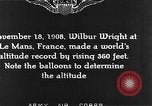
The Wright aircraft in flight over high snow covered mountains at Le Mans in France.
The history of aviation. The Wright aircraft at Le Mans in France on November 18, 1908. The aircraft in flight overhead. Three balloons in the background used to determine the altitude of the aircraft. A high snow capped mountain peak. The aircraft in flight. High snow covered mountains having pine trees vegetation.