


 Francais
 Deutsch
 Italiano

Refine Your Search
+"France" +1908 stock footage and images
- Showing 19 to 24 of 41 results more
 Hide

Montage of Wright brothers and their airplanes in France and at Ft. Myer, Arlington, Virginia.
As a contrast to the early pioneering airplanes, passengers are seen seated inside cabin of a "modern" airplane (Douglas DC-4E). View of the DC-4E in flight. A view of Orville Wright. Wilbur Wright gesturing as he talks with officials in France about an aerial course to be flown. Wilbur Wright placing wheels under a Wright Flyer before it is moved across a muddy field in France. A team of men pull a rope raising a catapult weight in a tower. The weight falls, catapulting the Wright Flyer airplane into the air. Soldiers remove a Wright Flyer airplane from a storage building onto the parade grounds at Ft. Myer, Virginia. The airplane is seen in flight with Orville Wright alone, at the controls, On July 30, 1909, soldiers are seen moving a Wright Flyer from its shed for its final acceptance test. President William Howard Taft, U.S. Army Major George Owen Squier, U.S. Army Major Charles E. Saltzman and Wilbur Wright are among those standing with the President, as the Wright Flyer is moved toward the parade ground. Views of the monorail and weight and catapult used for launching an airplane. Men turn the two propellers on a Wright Flyer, as Wilbur Wright stands at the rear of the aircraft engine and makes an adjustment. . On September 9, 1908. U.S. Army Lt. Frank P. Lanham, seen in uniform, seated on a Wright Flyer, is joined by Orville Wright. Wilbur. They take off and set a new airborne endurance record, and Lt. Lanham becomes the first Military officer to fly in an airplane. On July 30th, as part of the final acceptance test, Orville Wright takes Army Lt. Benjamin D. Foulois on a cross country flight to Alexandria, Virginia, and back again. They are seen aboard the Wright Flyer, and then high in the air on their way to Alexandria.
Beginnings of successful powered heavier-than-air flight. Wright Brothers flights in U.S. and Europe. General Hap Arnold
History of aviation. A balloon in flight. Historic glider such as that which interested U.S. War Department as early as 1898. In 1903, a crew of men moving a Wright Flyer into position. Two men turn over propellers on a Wright Flyer, and the engine starts. View of the Wright-designed water-cooled engine. View of Orville Wright. The famous first powered flight, at Kitty Hawk, North Carolina, with Orville Wright at controls. Animation shows that 120 foot flight juxtaposed against a B-36 wing. Wilbur Wright in Europe, in 1908, gesturing as he converses with interested parties. A gallery of spectators including the President of France, King of England, King of Spain, and King of Italy. Wilbur Wright places a wheel under the right wing of a Wright Flyer and lashes it to the strut. A team of horses pulls the plane across the field. Men maneuver the plane onto a monorail on the ground. Men pull on a heavy rope to raise a weight in a tower, for a catapult. Two men spin the propellers and the Wright Brothers airplane motor starts. Wilbur Wright and his passenger, a French journalist, board the plane. The catapult weight drops, launching the aircraft which flies low over the field. U.S. President Theodore Roosevelt speaking (He is seen on a podium campaigning for the Bull Moose Party nomination at the Kansas State Fair in Hutchinson, Kansas on September 22, 1912.) War department issues specifications for a heavier-than-air craft. Reenactment of a Wright brother signing a bid contract. A Wright Flyer airborne at Fort Myer, Virginia, as the Wrights meet the Army specifications and sell, U.S. Army airplane number 1, to the War Department, in 1908. Gold Aviator wings being pinned on the uniform of a U.S. Army pilot. Photograph of Army Air Forces Chief, General Henry (Hap) Arnold, wearing his original aviator wings on his service uniform. A Glenn Curtis training airplane starting up and taking off. View of a DH-4 airplane and a Wright Flyer taking off together.
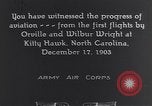
Awards given to the Wright Brothers by Aero Clubs of France and the United Kingdom for their contribution in aviation field.
Gold medals given to the Wright Brothers for their contribution to the field of aviation. Gold medals awarded to the Wright Brothers by Aero Club of France, Aero Club of the United Kingdom and the International Peace Society in the year 1908. the medal awarded by the U.S. Congress.
Wright brothers' success in aviation
1902 Still photo of glider made by Wright brothers in which they used wing warping technique for balance in flight. 1903 Still photograph of Orville Wright's first flight and plane on the ground. 1908 Newspaper headline and front page story of Wilber Wright's flights in France along with pictures. Wilbur Wright works on a transporting wheel of his plane in France. Horse tows plane across a field in France.
Launching of Wright Brothers' glider and aircraft in different places in Europe.
The history of aviation. A glider being launched from a hillside in Germany. The glider is parked. Several men stand nearby. The glider in flight overhead. The first flight of the Wright Brothers at Kitty Hawk in North Carolina on December 17, 1903. A still photograph of Wright Brothers' aircraft in flight. The pilot in a prone position while piloting the aircraft. Launching of Wright Brothers' aircraft in France on August 8, 1908. A launching tower, weight dropping and the take off of the aircraft are shown. Spectators in stands watch the air show. Headlines of a New York newspaper proclaim Wright's flight in France.
The Wright Flyer is demonstrated at a horse racing track before a large crowd.
People gather in the grandstand of the Hunaudieres horse racing track near Le Mans, France, in 1908, to watch Wilbur Wright's demonstration of the Wright Flyer airplane. It is a major social event. An article about Wright in the newspaper. They take a passenger with them for 36 miles. An airplane in the field. Men work on the plane. Views of the Wright Flyer aloft, with a passenger.