


 Francais
 Deutsch
 Italiano
Refine Your Search
+"France" +1943 stock footage and images
- Showing 13 to 18 of 64 results more
more Hide
Hide
WW2 German defensive preparations on French coast; Allied invasion scenes; Allied bombing over Germany
Slave laborers digging during the construction of the Atlantic Wall in World War II. German engineers oversee the construction. Men working around a large gun turret. Nazi German fortifications, bunkers, and artillery posts along coasts facing the Atlantic Ocean in Europe. The 380 mm gun at the Todt Battery near Cape Gris-Nez, Pas de Calais, France. 40.6 cm SK C/34 gun “Battery Lindemann” (German unit MKB 6 / MAA 244) as part of the Dover Strait coastal guns. German emplacements and troops marching along Normandy in France. A German soldier uses binoculars to watch the English Channel. Adolf Hitler and a Nazi German general. Adolf Hitler greets Benito Mussolini as the latter exits a plane in Vichy France. Allied leaders Winston Churchill, Franklin Roosevelt, Joseph Stalin, and General George C. Marshall at the Tehran Conference in 1943 during World War 2. Armies from various European countries march and prepare themselves for war against Germany. Supreme Commander General Eisenhower and other Allied generals during a meeting. Fleet of ships in sea ready to land in Normandy on D-Day. Navy and coastal command aircraft drop bombs on Nazi German submarines. Anti-aircraft guns fire at Nazi bombers. Docks damaged by German bombing receive aid from Allied countries. Cranes and hooks lower relief supplies, medicines and warfare material at dock. Warships loaded with artillery and warplanes lowered in ships by hoists. A locomotive train is being lowered from a ship. A military band plays music in a dock. Soldiers move towards the ships. British and Royal Canadian and Australian bombers at their base take off for bombing on Nazi bases at night. A soldier directs a bomber taxiing in runway. Aerial views of British bomber aircraft bombing targets in Germany at night, with immense explosions.
Joseph Stalin, Franklin Roosevelt and Winston Churchill at Tehran conference; also Yugoslavian and French resistance fighters.
General Secretary of the Communist Party Joseph Stalin, President Franklin D Roosevelt of the U.S. and Prime Minister Winston Churchill of the UK seated on porch of Soviet Embassy building in Tehran, Iran, 28 November 1943, during World War 2. Scene shifts to group of Yugoslav Partisans and closeup of their leader, Marshal Tito, at their mountain headquarters. Yugoslavian Marshal Tito smoking a pipe while standing on the porch of his headquarters with American Office of Strategic Services (OSS) Officer, Army Major Linn M. Farish, U.S. Liaison to the Partisans, and British Brigadier General Fitzroy Maclean, Winston Churchill's special envoy to the Yugoslavia leader. Next scene shows French resistance fighters with their flag on a mountaineer's pick. It reads,""Vaincre ou Mourir"" and displays a cross of Lorraine. Closeups of French resistance fighters at attention and also relaxed, smiling, and singing. Scenes of various such groups joining in the June 6, 1944 Allied invasion at Normandy, France. Aerial glimpse of D-day task force crossing the English Channel. Animated map shows Germany being attacked by Russian forces from the East, by the other allies from Britain in the West and from Italy, in the South. Allied forces moving across a pontoon bridge and engaging German forces in France. A U.S. M3 Gun Motor Carriage firing its 75mm gun. American troops firing machine guns, carrying wounded on stretchers and using flame throwers. Troops, including ambulatory wounded moving under enemy fire. Paratroopers of the 101st Airborne Division in France. One carries a wounded buddy. American troops firing a variety of artillery from under camouflage netting. French underground forces engaged in Paris. Closeup of one wearing a French Adrian helmet firing a rifle. Another throws a grenade out an apartment window. An American tank moving under the base of the Eiffel Tower as French Resistance fighters run across the area. French citizens celebrating the liberation of Paris. View from an American jeep as French people cheer. Closeups of French people. A bombed out bridge. A battlefield cemetery. Destruction and death in the wake of combat. Fallen French civilians lying on pavement. A U.S. tank slowly driving through a masonry wall. Soviet forces advancing through destroyed buildings. Chinese troops marching along the Great Wall. British troops on parade in tropics. Asian ally troops marching. Huge formation of marching U.S. soldiers. United Nations flags in the breeze.

Allied forces prepare for D-Day, also known as 'Operation Overlord' (WW2)
'Eve of Battle' depicts the Allied invasion of Europe during World War II. Slave labor from Nazi Germany-invaded countries construct Atlantic Wall. German artillery and fortifications in the Atlantic Wall. Nazi German soldiers marching in groups. Nazi leader Adolf Hitler shake hands with Italian fascist leader Benito Mussolini. Allied leaders Franklin D. Roosevelt, Winston Churchill and Joseph Stalin sit together during the Tehran Conference in December 1943. Exiled Allied leaders such as General Charles de Gaulle of France, Queen Wilhelmina of the Netherlands and Dr. Edvard Beneš of Czechoslovakia inspect Allied troops. Various Allied troops from Poland, Norway, England, United States, and Czechoslovakia prepare to launch an invasion in France. Eisenhower along with other officers plans the European invasion. Allied ships and aircraft on their way to Europe. Allied bombers drop bombs over Nazi German U-boats. Naval battle begins and explosions occur, smoky docks. In England war supplies unloaded. Supplies include weapons, military equipment, and food. A tank and locomotive trains being loaded into a ship bound for Europe. Allied aircraft take off at night. A man directs an aircraft taking off. Allied bombers bombard German targets resulting into fiery flare in Europe. British children playing jump rope as a supply train pass by in the background. Tanks and fighter planes transported by train. Supply boxes unloaded and stacked for transport to the battle front.
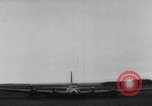
Numerous wrecked Allied warplanes. German ace Adolf Galland and other pilots. FW-190s and ME-109 airplanes in flight (WW2)
German soldiers climbing over a crash-landed B-17 bomber of the USAAF 96th Bomb Group, 337th Bomb Squadron, with tail number 42-3353. Its props are all bent and skin is peeled off its rudder and horizontal stabilizer. (This aircraft, named "Tar Fly," was hit by flak on September 9, 1943, and crash-landed west of Evreux, at Beamont-Le Roger, France. Two crew were killed and 8 taken as prisoners of war.) Smoking wreckage of an Allied aircraft in a field with two dead fliers lying on the ground about 50 yards away. Engines of a downed U.S. aircraft. Numerous views of wrecked American and British airplanes. Sign painted on one piece of wreckage reads: "When I go sightseeing in Tokyo, Tojo's gonna be my Ricksha Boy!" Piles of scrap alumunum from crashed airplanes piled up at a railroad siding, where German workers load it into rail freight cars. German army workers using tools to dismantle parts. Sequence shifts to a Messerschmitt Bf 109 that lands in a field. German airmen run to greet the pilot, who steps from the cockpit and describes some aerial maneuvers to a surrounding audience. Next, German ace, Adolf Galland is seen discussing tactics with other pilots. Several camouflaged Me Bf-109s lined up on a grass field, where ground crews are repairing and maintaining them. Closeups of German pilots climbing into cockpits of planes. Ground crews hand crank their starters. Next sequence shows Focke-Wulf FW-190 aircraft taxiing and then making a formation takeoff from grass field. Then an Me-Bf-109 is shown right after takeoff. FW-190s and Me-109s buzz the field. (World War II period)

Unescorted B-17 Flying Fortress planes under heavy attack by German FW-190s during Schweinfurt raid in World War II.
Scenes of the first daylight strategic bombing by the United States Air Forces against targets in German-controlled Europe. A dozen B-17s execute the first mission against railroad marshaling yards in German-held Rouen, France, on August 17, 1942. A year later, large numbers of U.S. bombers attack Schweinfurt, Germany during World War II. U.S. B-17 Flying Fortress planes take off from U.S. Air Base in England. A formation of B-17s in flight. They head towards Germany. U.S. General Dwight D. Eisenhower and his aides confer. Unescorted B-17s over Schweinfurt under heavy attack by German FW-190 fighter planes. The B-17s drop bombs over the target area. Ruins of Schweinfurt after bombings. A FW-190 goes down after facing attack. Dead and wounded men unloaded from B-17s which return from the Schweinfurt raid. Panoramic views of ruined Schweinfurt on August 20, 1943.
Jerry Jones, played by George Murphy, receives his draft letter during his performance at the Follies in New York, 1917
A 1943 American feature film titled 'This is the Army' depicts dancer Jerry Jones, played by George Murphy, as he receives a draft letter during a Follies performance during World War I. Dramatize scenes: Uncle Sam is depicted on a poster in New York that reads: 'I Want You for the U.S. Army Enlist Now'. Buildings along a side of a street. Camera zooms to newspaper headline that reads, "Huns Boast No American Troops Will Reach France." A woman in uniform sings in the street.. She sings and men play musical instruments. Exterior of a building. A banner outside the building reads: 'US Army Recruiting Station'. 'Follies' written outside a theater. Interior of the theater. Performance of singer and dancer Jerry Jones in the theater, played by actor George Murphy. Jerry Jones sings and girls dance in colorful costumes. People watch them. A woman watches the performance of Jerry Jones. A man arrives near her and gives her mail for Jerry Jones from the office of the President. The woman reads the mail. The mail is a draft letter to Jones, inducting him into the U.S. Army.