


 Francais
 Deutsch
 Italiano
Refine Your Search
+"France" +1944 stock footage and images
- Showing 1525 to 1530 of 1897 results more
more Hide
Hide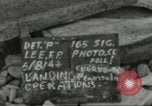
U.S. M5 high speed tractors tow howitzers from LST in Colleville-sur-Mer after Allies invade Normandy, in World War II.
U.S. Task Force in Colleville-sur-Mer after the D-Day invasion of Normandy, France during World War II. A beachhead at Omaha Beach. M5 high speed tractors tow howitzers from LSTs (Landing Ship Tank). U.S. soldiers on the beach.
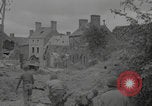
United States soldiers enter ruined La Haye du Puits, install phone lines, capture Germans (WW2)
Occupation of La Haye du Puits under American control during World War 2. United States infantry troops under General Omar Bradley enter the town of La Haye du Puits, with buildings significantly damaged and roads covered with debris. Two soldiers enter an empty and damaged “Café du Progres B. Folliot Lefranc”. Two soldiers carefully walk on debris during a mopping up operation. Soldiers on the street during a mop-up. United States soldiers on top of an M4 Sherman tank covered with tree branches rolls through the center of town. Shop sign for “Citroën”. United States infantry troops on foot enter the town limits. Town signage “La Haye du Puits” at the town limits. Infantry troops find damaged buildings and debris of La Haye du Puits. The town square of La Haye du Puits (now known as Général-de-Gaulle Place), with the Presbytère Church (18 Rue Loret, 50250 La Haye, France) on the background. United States soldiers stringing communication lines in La Haye du Puits. Soldier pulls telephone cable from cable spool. Another soldier installs cables on a post. A German prisoner-of-war raises his hands upon his capture. German soldiers with their hands on their heads after their capture by American forces.
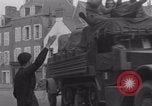
French civilians welcome Free French 1st Armored Division troops arrival in La Haye Du Puits, Normandy (WW2)
French men and women welcome the arrival of the Free French 1st Armored Division in La Haye-du-Puits during World War 2. A young French man waves at the Free French 1st Armored Division troops on top of moving M3 half-tracks and trucks. Tanks pass the damaged Eglise de La Haye ( 18 Rue Loret, 50250 La Haye, France. ) as two boys look on and wave. Willys MB army Jeeps and tanks. Two French men wave at passing Red Cross ambulances. French soldiers, civilian men, and women sitting on top of a tank at Pl. du Gen de Gaulle. The tower of the Eglise de La Haye in the background.
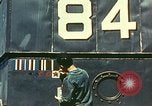
U.S. Landing Craft, in England, preparing for the Normandy invasion during World War II
U.S.Coast Guard crewmen painting battle star on superstructure of Landing Craft Infantry (Large), LCI(L) number 84, during World War 2, in France. (This craft was already a veteran of North African and Italian campaigns, and is preparing to take part in the Normandy invasion.) Another Guardsman questions whether it will be as good as other stars already painted. Others keep pestering the painter about this and he reassures them all. (View of perfect finished red star.) Landing craft Gunners display the landing craft's Oerlikon 20-millimeter Mk 4 automatic antiaircraft cannon. Views of LCI(L)s numbered 85, 89, 92,90, and 496, all tied together at a port in England. Sailors on LCI(L) 85, at their Oerlikon 20-millimeter cannon. U.S. Navy Union Jack displayed nearby. U.S. Coast Guard officers viewing sky with binoculars.
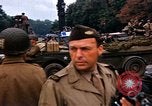
American troops and war correspondents in Paris during World War II.
American troops and war correspondents in Paris around time of liberation of Paris during World War 2. Correspondents take pictures and record the event. U.S. troops march to the front lines. Arc De Triomphe. Soldiers hold the U.S. flag as they march on the Champs Elysees Avenue. Civilians on the streets. Intact bridges, Opera House, Eiffel Tower, and other monuments. A war correspondent and A Frenchman on the Eiffel Tower. View of Paris including River Seine and bridges. People cross banners that read 'France Libre' and 'Monde Libre.' Crowd in a park. Brussels, Belgium: Spectators gathered at a Race Track. Jockeys race their horses. French women in elaborate hats watch the race.
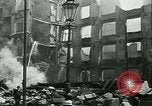
British response to Nazi air raids in Battle of Britain, and use of American radar in the European Theater during World War II.
The role and contribution of the U.S. Army Signal Corps in combat and war. Opening scenes show bomb damage due to German Luftwaffe blitzkrieg air raids (The Blitz) in Southern Counties of London earlier during Battle of Britain in World War 2. Firemen and rescue workers try to extinguish the fires with water hoses. The rescue workers conduct operations amidst bomb damaged buildings and rubble. Severely damaged buildings. Rubble strewn all over the streets in England. A Food Flying Squad van makes its way on the streets. Food distributed from the van. A British man walks amidst the rubble. Relief work in progress. Buckets of food and water lying at camps. Displaced civilian people eat and drink. London civilian residents evacuate numerous areas. Evacuees walk across a bridge. Big Ben seen in the background. Allied bombers in flight. Royal Air Force de Havilland Mosquito aircraft track and shoot down enemy aircraft. The dogfights result in mid air explosions. Two soldiers operate a U.S. radar designed to direct antiaircraft fire in combat area. The radar tracks a target moving up to 600 miles an hour. The soldiers track down aerial targets, the gun directors make adjustments and the antiaircraft guns are fired at buzz bombs. Enemy V-1 Flying bombs are hit and downed before they can reach the coastline. German V-1 rockets are tracked over England by radar and shot down. An V-1 is hit. It descends to the ground and explodes. France: A downed V-1 flying bomb is examined. The wreckage of a V-1 in a field. Soldiers and civilians near the wrecked V-1 Flying Bomb