


 Francais
 Deutsch
 Italiano
Refine Your Search
+"Germany" +1914 stock footage and images
- Showing 19 to 24 of 64 results more
more Hide
Hide
Rocket motor designs by International scientists and inventors, reflecting early work by German rocket researchers
Designs by various international scientists and inventors who have contributed to solving the problems of rocket motor development, based on the German preparatory work. Their combustion chamber designs owe much to the German pioneers in the field. Shown are design sketches by Russian scientist, Konstantin Tsiolkovsky (Ziolkowsky) in 1914; French inventor Henri Melot, in 1920; German Friedrich Zander, in 1931; Bull, 1932; The American Rocket Society, with several designs from 1932; and The Cleveland Rocket Society. Views of rocket combustion research activity by Ernst Loebell of the Cleveland Rocket Society in 1933. He is seen outdoors in the snow with his apparatus. View of Loebell's test firing stand, and a picture of an actual test firing, outdoors. Ernst Loebell with model and rocket motor from his spaceship projects of 1934 and at the International Exposition dedicated to Art and Technology in Modern Life held in Paris, 1937. Cutaway views of the spaceship. The rocket motor wrapped in cooling coils. Rocket motor design by John Shesta of the American Rocket Society, from 1934. Design by Rene Armengaud of France, in 1934 and Deich in 1935.
Film 'Why We Fight' gives historical background to Adolf Hitler's plan of world conquest in 1930s
Film 'Why We Fight' provides historical perspective on Adolf Hitler's plan of world conquest. Image of Otto von Bismark and year 1863 is seen with quote,"We will dominate the whole world." Year 1914 and image of Kaiser Wilhelm II and quote,"God has made us for civilizing the world. Woe and death to all who resist my will." Year 1933 and image of Adolf Hitler and quote: My motto is,'Destroy by all and any means. National Socialism will reshape the world'." German eagle monument with swastika. Troops in precise large formation during Totenehrung (honoring of the dead) at the 1934 Nuremberg Rally as Adolf Hitler, Heinrich Himmler, and Viktor Lutze walk forward during the ceremony. Buglers blow and troops march at another Nazi rally. Images of military graves in a cemetery. Images of British soldiers blinded by gas attacks in World war I. Bodies of persons dead from diseases due to war. Fleeting images of destruction and grief from war, including hanged persons. Hitler at a podium flanked by Himmler. Closeups of Hitler. The buglers previously shown are seen again.Hitler standing with Viktor Lutze and Rudolf Hess. Brief images of Mongols marching and riding horses, with image of Genghis Khan. Map showing Mongolian 13th Century conquests in Asia and Eastern Europe. German Institute of Geopolitics in Munich, founded by Karl Ernst Haushofer. Closeup of Haushofer with backdrop of world map. Clerks in the institute cataloging information. German soldiers entering and studying in the institute. Brief images of economic wealth of the world, roughnecks setting pipe at an oil well, a "forest" of oil well derricks, harvested trees, steam shovels at an open pit mine, ore on a conveyer, cattle, farmers harvesting grain, flocks of sheep, and human labor. Animated map showing distribution of land area in the world and comparing Hitler's plan of conquest to that of Gengis Khan.
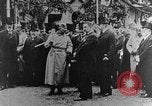
Kaiser Wilhelm II of Germany reviews his marching troops, Germany.
Kaiser Wilhelm II of Germany, with officials in top hats, and German military officers, in formal uniforms, outside a building. They review goose-stepping German troops on parade. Garlands of greens are strung throughout the town. (World War i; World War 1; WWI; WW1)
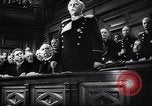
Unification of Germany under kingdom of Prussia; German military attacks on its neighbors; leadup to World War 1.
Mix of actor portrayals and actual footage: Otto Von Bismarck the Prime Minister of Prussia declares war against Denmark in a house of Ministry of Prussia. Scenes of war, cavalry and infantry invading Denmark. War against Denmark. Victory parade by German soldiers, while people cheer for them. War against France in year 1870. Meeting of minister to declare unification of Germany. Actual footage of Palace of Versailles and nearby buildings. Dramatized crowning ceremony for German Emperor Wilhelm I. Mix of actor portrayals and actual footage of growth of German military complex: Closeup view of sculpture of Chariot driven by Victoria atop Brandenburg Gate. German industries and men working in factories; merchant marine ships of Germany at harbors. German man drinking beer from glass. German man eating a sausage. German farmers tending fields on hillsides in Germany. Mountain villages in Germany. Fleet of German Navy warships. Actual footage of troops of German army, riflemen, cavaliers march through the streets in decade of 1910s. Dramatization of German men dueling swords in German universities. Actual footage of German Army officers in discussion in early 1910's before World War 1, including Helmuth von Moltke the Younger and other officers.
Germany in years leading up to World War 1 and during World War I
Traces events leading up to and through World War I. Portrait of German emperor Kaiser Wilhelm II. Wilhelm II riding on horseback. He starts the preparations for war. Views of German military officials including Helmuth von Moltke the Younger. Newspaper headlines of assassination of Austrian Archduke. Celebrations on streets of Germany at start of World War I including views of German soldiers and citizens preparing for war. Germany launch war on Serbia, France and England. German infantry and u-boat submarines target enemy positions. U.S. President Woodrow Wilson in his office . U.S. declares war on Germany. U.S. forces departing from American cities and arriving in Europe; moving toward battle. Scenes from trench warfare of World War I in France. Soldiers going up "over the top" out of trenches during offensive operations and into "no man's land". Retreat of Germans, views of General von Luddendorff, the German Chief of Staff. Armistice declared after secret message sent to German government by Luddendorff. Cheering people celebrate the end of World War 1 after armistice. Views of United States General Pershing.
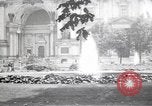
People walk by monuments in Berlin, Germany.
View of a fountain in front of the Berlin Cathedral. People stand in front of the City Palace of Berlin (the Stadtschloss Berliner, Schloßpl. 1, 10178 Berlin, Germany). An equestrian statue of a German emperor near the Berlin Cathedral or Unter den Linden. People walk on a road. People walk by sculptures besides the road. The National Gallery of Berlin (Alte Nationalgalerie, Bodestraße 1-3, 10178 Berlin, Germany). People walk on the sideways near the Nationalgalerie.