


 Francais
 Deutsch
 Italiano
Refine Your Search
+"Germany" +1915 stock footage and images
- Showing 7 to 12 of 23 results more
more Hide
Hide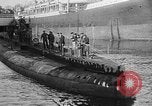
Various WWI events: German submarine Deutschland leaving US; sinking of SMS Szent Istvan; survivors of Lusitania
Variety of events in World War I years. German merchant submarine Deutschland (a British blockade buster) in 1916 in the United States (then neutral), departing New London, Connecticut on November 21, 1916 headed back to Germany carrying silver bullion. The submarine had just completed repairs following a collision with the tugboat T.A. Scott Jr. when first attempting to leave New London on November 16, 1916. The North German Lloyd Shipping Company submarine Deutschland is seen leaving the dock at New London, Connecticut. The officers on the submarine Deutschland wave. Periscope of submerged submarine is seen slicing through calm water. Sailor on an Italian destroyer blows general quarters call on bugle. Another sailor brings a telescope on deck. Next, crew members fire their deck gun at periscope in the water. Change of scene the shows the destroyer making way, leaving visible wake, astern, as crew members load and fire depth charges from the ship's stern. View of a submarine underwater. Exploding depth charges raise huge columns of water. Underwater view of submarine shows columns of bubbles nearby. View of Austro-Hungarian Battleship SMS Szent Istvan (Saint Stephen), capsizing and rolling after it is torpedoed off the Dalmation Coast of the Adriatic Sea by Italian torpedo boats on June 10, 1918. Survivors being rescued in small boats. View of a merchant vessel at dock and in a harbor. View of survivors of the May 1915 Lusitania disaster, with belongings, arriving in a harbor. Men and women with children posing. Two small girls pose among the group of Lusitania survivors.
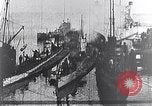
Germany expands U-boat fleet during World war I
Germany undertakes a massive submarine-building effort early in World War 1. Boatyard scene with new German submarines being outfitted at a pier. A sleek, UB-III class, coastal torpedo attack U-boat underway on the surface, with officers on the conning tower.
German cavalry passes through a street in Germany.
German cavalry on the march in Germany during World War I. Buildings along the sides of a street. Trees in the background. Soldiers on horses pass on the street. People watch the soldiers.
Wilbur H. Durborough, America's famous Press photographer, goes to Germany during World war I
Closeup scenes show Wilbur H. Durborough-America's famous press photographer, seated behind the steering wheel of a 1911 Alto touring car parked on a street in Chicago, Illinois, getting ready to depart for Germany, during World War 1. Sitting behind him is his assistant cameraman, Irving G. Ries. Both have goggles pushed back on their foreheads. and both smoke cigars. Some spare tires are seen behind Mr. Ries. As camera moves back, they are seen surrounded by numerous friends and well-wishers as they prepare to depart from Chicago. Next, Durborough is seen standing on the bridge of the Holland-America steamship, S.S. Nieuw Amsterdam, with ship's Captain Jan Baron, who is on lookout for mines and submarines. Captain Baron passes his binoculars to Mr. Durborough. Captain Baron and Mr. Durborough stand on the deck looking at some documents. Lifeboats on davits behind them are ready for emergency. Durborough drives his car from the ship terminal onto a street in Rotterdam, with Captain Baron standing on a running board. The car is loaded down with luggage and equipment. He drives away as the Captain and others wave goodbye. Displaying an American flag on the hood, Durborough arrives at the German border. Dutch officials examine the car's contents, including a look into the engine compartment. Next, Durborough is stopped by German border guards, who examine his passport and greet him in a friendly manner. Durborough is seen in the offices of U.S.Ambassador James W.Gerard, as he describes his plans for visiting. He is honored by a visit from Prince of Reuss of German General Staff, Prince Max of Baden and Count Von Bernstorff- son of German Ambassador to the United States, who are seen chatting with him, before entering their car to depart.
German soldiers entrain for the front in Germany.
German soldiers at a railway station having a meal during World War I. Members of an association pin badges on the shirts of the soldiers. The soldiers eat food and drink milk. They board a waiting railroad train, bound for the front, after having the food.
Military trucks passing on the street leave for the war front, Germany.
Military trucks leave for the front during World War I. The trucks pass on the street. Men watch the trucks. Jeeps pass along with the trucks. Trees along the sides of a street. Soldiers on horses pass on the street along with the trucks.