


 Francais
 Deutsch
 Italiano
Refine Your Search
+"Germany" +1918 stock footage and images
- Showing 61 to 66 of 83 results more
more Hide
Hide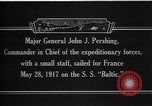
American Expeditionary Forces (AEF) arrive in France during World War I
The United States declares war against Germany during World War I. On May 28, 1917 Major General John J. Pershing, Chief of American Expeditionary Forces aboard the S.S. Baltic on its way to France during World War I. Nearly 2,000,000 American soldiers disembark at a port in France. The troops disembark from the ship. A ship at the harbor. Ships underway at sea. Sailors on the deck of a ship. A German U boat underway. Naval gun being fired at the U boat. Explosion occurs at sea. A man waves signal flags from a ship. The troops disembark from the ship. Soldiers at a rail road station and a train pulls up to carry them to the war front. (World War I; World War 1; WWI; WW1)
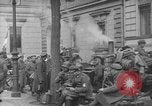
Central Powers troops at end of World War I
German soldiers relaxing on sidewalks of a city in Germany at end of World War 1. German Imperial flag with crest on display. Smoke rising from field kitchen stove. View of troops resting on sidewalk island. Arms are stacked and some troops are napping. Complete change of scene to Ottoman Empire Turkish troop bivouac in a valley during First World War. Numerous tents are erected. A soldier getting shaved in the foreground. Turkish troops eating at open air mess tables.
Scenes of World War 1 and the period between the wars, illuminating career of U.S. Air Force General Henry (Hap) Arnold.
Newspaper headline in Washington post reads 'United States and Germany at War'. Civilians recruited into the army. American pilots of the 103rd Aero Pursuit Squadron, in France, with their Spad aircraft. American airplane production factories in operation, with manny women war production workers seen assembling aircraft. People celebrate in the streets at end of World War I at time of armistice. Airplanes, under command of General Billy Mitchell bomb obsolete warships in demonstration of aircraft power in warfare. 1920s: Postwar flyers and stunt wing walkers perform in the roaring twenties. Developments and improvements in parachutes, and view as stunt men parachute from high buildings and airplanes. Aircraft flying forest fire patrols. Aerial view of burning forest fire below. Lieutenant Colonel Arnold commands emergency airlift and drop of food to snowbound Native American Indians in American Southwest, in 1932. World War I scene of American 103rd Aero Pursuit Squadron Spad airplanes taking off, in France. Lieutenant Colonel Hap Arnold with his family, including two young boys and a young girl (his sons and daughter) and his wife.
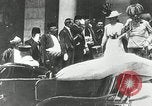
America mobilizes for World War I and confronts demobilization afterwards
Opening scene shows Austrian Archduke Franz Ferdinand and his wife, Sophie, Duchess of Hohenberg. Newspaper swirls into the image, with headline announcing their assassinations. Glimpse of railways guns firing. View of a ship's bow as it sinks beneath the ocean, is covered by newspaper headline announcing the sinking of the RMS Lusitania, by a German submarine. U.S. President Woodrow Wilson at his desk. Newspaper headline reads: "U.S. Declares War !!" U.S. soldiers marching in Washington, DC, with U.S. Capitol building in background. Newspaper announces: "Yanks are Coming!" American General John Pershing on horseback leading a contingent of the American Expeditionary Forces (AEF). American troops going "over the top" (charging out of their trenches) in France during World War 1. Troops firing French 75 artillery pieces at point blank range. A formation of Allied Airco (de Havilland) DH9 aircraft in flight. Bombs bursting near trenches on the front lines. Renault FT-17 tanks accompanying American infantry on the Western Front. Persons playing roles as employees in the Department of Labor when they served as the War Labor Administration in World War 1. Women in the War Labor Administration working with long paper rolls of personnel records. Women in various war effort endeavors including airplane and arms manufacturing. Men working in a wartime steel plant. Marchers and a band demonstrating for the rights of workers to organize. People celebrating the at the end of World War 1, by gathering in the streets, throwing tickertape, dancing in the streets and waving effigies of the Kaiser. Stern view of the U.S. Army Transport Ship, President Grant filled with American soldiers returning from France at the end of the war. Lettering on stern reads, "U.S.A.T. President Grant" (The ship, AP-29, was originally the German ocean liner Konig Wilhelm II, and seized from Germany on 6 April 1917.) Views of United States soldiers returning home, disembarking, and assembling on a wharf home on American soil. Department of Labor persons assisting returning soldiers and prospective employers. Views of workers on farms, and in factories.
President and Mrs. Woodrow Wilson on USS George Washington in the Atlantic Ocean en route to Paris Peace Conference
American President Woodrow Wilson heads for France to negotiate peace between Germany and Allies. The President's flag flying at mast head of USS George Washington. Captain Edward McCauley Junior, Commander of USS George Washington and Rear Admiral H. S. Knapp converse with each other. Commander Pekins looks through binoculars. Commander Roesch, Chief engineer of USS George Washington smokes a cigar and laughs standing on the ship deck. Captain W. R. Pratt and Rear Admiral H. S. Knapp on the ship deck. The President and First Lady, Edith Galt Wilson, aboard the ship. The President looks through binoculars. A sunset in the Atlantic ocean. President Wilson converses with reporters on the ship's deck. (World War I; World War 1; WWI; WW1)
American sailors abandon a ship drill and officials aboard USS George Washington in the Atlantic Ocean heading for France.
American President Woodrow Wilson heads for France to negotiate peace between Germany and Allies. Sailors abandon a ship drill. The sailors stand next to life boats on the ship. Officials stand with their wives on the ship deck.