


 Francais
 Deutsch
 Italiano
Refine Your Search
+"Germany" +1918 stock footage and images
- Showing 67 to 72 of 83 results more
more Hide
Hide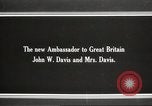
U.S. Ambassador to Great Britain John W. Davis and other officials aboard USS George Washington on their way to France.
American President Woodrow Wilson heads for France to negotiate peace between Germany and Allies. U.S. Ambassador to Great Britain John W. Davis and his wife on a ship deck. John W. Davis looks through binoculars. Mrs. Gordon Auchincloss, Mrs. David H. Miller and Arthur Bullitt converse with each other standing on the deck. French Ambassador to the U.S. Jules Jusserand with his wife, G. F. Close and R. C. Sween, confidential secretaries to President Wilson aboard USS George Washington.
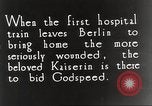
German troops advance and take prisoners in the European Theater during World War I.
German troops in the European Theater during World War I. German Kaiserine Hermine Reuss talks to medics and German officers in Berlin, Germany before a hospital train leaves for the war front. German units advance past a building towards the western front. Horse drawn carts loaded with supply boxes being pulled along. Allied prisoners march as German soldiers keep guard.
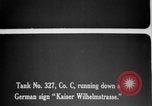
A U.S. operated Renault FT tank runs down a road sign during World War I.
A Renault FT tank operated by Americans, runs down a street sign in Germany during World War I. Caption reads: "Tank No. 327, Co. C running down a German sign Kaiser Wilhelmstrasse". However, the number 8329 is displayed on the tank turret, along with a diamond insignia (signifying the Third Section of its Tank Battalion). The tank driver operates from an open position behind the turret and another American soldier rides on the rear of the tank. (Note: After the war, Americans referred to these tanks as FT-17s.)
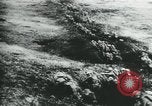
Numerous scenes showing evolution of mechanized warfare emphasizing World War I. but including footage as late as 1934
Montage of scenes illustrating development of mechanized warfare beginning with American Expeditionary Forces (AEF) engaged in World War I. U.S. Army infantry soldiers moving out of trenches going "over the top" into "no man's land" and advancing on battlefield. U.S. troops firing Browning M1917 machine gun,1903 Springfield rifles, and Stokes mortar from trench positions. Soldiers firing mortar are wearing gas masks. AEF trucks and other vehicles ostensibly an improvement over horses, but seen having difficulty in mud. A truck pulling a large artillery gun. A German 80cm K (E) rail gun (developed in 1934) shown at the Rugenwalde Test Range in Germany. It moves along curving rails and is elevated to its maximum elevation (65 degrees). Two World War 1 rail guns firing. An American World War I Naval 14-inch rail gun firing. Allied heavy howitzers firing in World War 1 (one with gun crew in gas masks). American gunners with a French 75 field piece and caisson. French soldier advancing in no-mans-land. The Wright brothers brought warfare into the air with their Wright Flyer airplane, seen being maneuvered on the ground by U.S. Army personnel at Fort Myer, Virginia in July 1909. A De Havilland DH-4 airplane taking off in World War I. A German Fokker D.VIII aircraft in flight. Three U.S. Army Air Service Curtiss P-1B Hawk pursuit aircraft in flight, circa 1926. Aerial dogfight scene including view from behind a pilot in open cockpit biplane (from feature film, circa 1927). Brief view of Renault FT tank maneuvering in World War I. Narrative and clips shift to historical perspective of warfare, showing use of horse and chariot, starting in ancient Assyria and use of elephants in later years by Hannibal. Pictures of mounted soldiers, in the middle ages, waging war in armor, and being transported in a wagon. Shift to World War I showing British Mark IV tanks maneuvering in a field.
German military aircraft of World War I. including bi-planes, tri-planes, seaplanes and highwing monoplanes.
Various World War I planes (mostly German). Fokker D-7s and Fokker DR1. German seaplane. British tri-wing bomber with "RAEWAR Mark II" on its nose section. German Zeppelin Staaken R.VI bomber, with Fokker fighter plane parked under its wing. A German bi-wing bomber in flight.
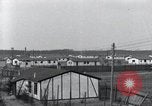
German prisoners of war in British prison camp during World War I
German soldiers sitting at a prison compound. A group of them marching. stockade fence in background. Prisoners relaxing and socializing on porch of a building. Children pulling and pushing a cart filled with bottles. British soldier guards open the gate for them. A woman approaches and talks with a British soldier. German soldiers clowning around with British soldiers. One German puts a monocle in his eye and imitates a supercilious Prussian officer. British soldiers socializing with the German prisoners. (World War i; World War 1; WWI; WW1)