


 Francais
 Deutsch
 Italiano
Refine Your Search
+"Germany" +1919 stock footage and images
- Showing 25 to 30 of 60 results more
more Hide
Hide
Jane Addams, Alice Hamilton, and Aletta Jacobs in Berlin, during World War I
Three influential women in the early 20th century women's movements and suffrage are seen walking in front of the Brandenburg Gate, in Berlin, during World War 1. On the left is American, Jane Addams, co-founder of Hull House, in Chicago, and President of the newly formed Women's International League for Peace and Freedom (WILPF). In the middle is Alice Hamilton. She was a close associate of Addams in the Hull House project, and, in 1919, became the first woman professor at Harvard University. The third woman is Dutch pacifist, feminist and suffragist (sometimes called a suffragette) Aletta Jacobs, who was also involved with founding of the WILPF. Jacobs was also the first female University graduate in the Netherlands. (Medicine in 1877 and 1878). (Note: Film shot by photographer William H. Durborough.)
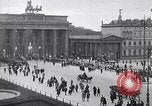
People, cars and horse carts pass by Brandenburg Gate Square in Berlin, Germany.
Brandenburg Gate or Brandenburger Tor (Pariser Platz, 10117 Berlin, Germany) in Berlin, Germany. People walk in the Square. Cars and Horse cart on road. The Statue of Victory Column or Siegessäule in the background. Men and women pass by the Gate. Building beside the Brandenburg Gate. Statue of Quadriga on the Gate.
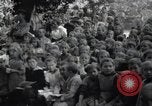
German children gather at a park, watch other children dance, and get hot chocolate in Weisbaden, Germany.
German children gather at a park in Weisbaden, Germany soon after the end of World War I. Two kids performing a dance in front of the other children and the men and women present there. Children applaud. Women give hot chocolate to the children. Young boys and girls in war torn Germany enjoy the entertainment and hot drink.
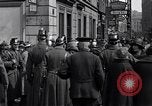
Large open air assembly of Germans expressing political sentiments in Berlin, Germany
Berlin City police control crowds of protesting people on a street in Berlin, Germany. Large crowd of Germans in open air assembly. Many demonstrate support for a new German Republic. People with signs and banners. One announces a group's support for the German Socialist Republic. Some carry tricolor flags of Germany. Some carry solid (red?) communist flags. The crowd marches by the Reichstag and Brandenburg Gate. Berlin Police on horseback control the marchers. A man conducts a band of muscians in the midst of the crowd back in the open air assembly location.
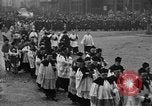
Religious procession to steps of a cathedral in Germany celebrating founding of Weimar Republic
Celebration of the Weimar Republic in Germany, following World War I. A Roman Catholic procession led by clergy, and involving Karl Josef Schulte, Archbishop of Paderborn, moves through the streets of Cologne, Germany, to the steps at the front entrance of Cologne Cathedral. The procession also includes many persons including students in various uniforms, carrying banners. One banner refers to the years 1853 to 1903. Large numbers of persons fill the streets. Policemen on horseback are seen. (Note: It is not clear whether Felix von Hartman or Karl Joseph Schulte is the Bishop in this film. The weather appears to be pleasant, which suggests it might be Hartmann, who fell ill in September and died in November. He was succeeded by Karl Joseph Schulte, Bishop of Paderborn, who formally became Archbishop of Cologne in March, 1920. Historical records describing this film mention "Archbishop Shulpe" with no further information or details. We believe that to be a misspelling of "Schulte".)
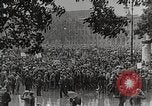
Demonstrators in front of the Altes Museum in the Lustgarten, Berlin, Germany
Demonstrations in Berlin, Germany. People gather in large numbers in front of the Altes Museum (Bodestraße 1-3, 10178 Berlin, Germany) in Lustgarten. They hold signs and banners. One sign reads, " Frankreich gieb unserer Kameraden Frei," an appeal for France to free German prisoners of war. (Note: After World War 1, France was slow to repatriate German prisoners of war, and had transported many abroad, to work in her colonies.)