


 Francais
 Deutsch
 Italiano
Refine Your Search
+"Germany" +1933 stock footage and images
- Showing 37 to 42 of 103 results more
more Hide
Hide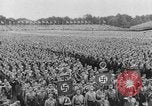
Adolf Hitler is appointed Chancellor. German President Hindenburg is honored with a military parade
Opening scene shows many thousands gathered in a Nazi rally at Zeppelin Field in Nuremberg. Adolf Hitler shakes hands with some Nazi Storm Troopers (Sturmabteilung). Next, Hitler is seen on stage with German President, Paul von Hindenburg, when he was appointed Chancellor of Germany on 30 January 1933. German troops and some sailors parade, in honor of Hindenburg, along Unter den Linden in Berlin. A contingent does goosestep march past Neue Wache. Camera records various views of the parade. A military band plays for the marchers, while standing in formation in the center of the avenue.
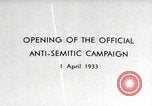
Reich Minister of Propaganda Joseph Goebbels delivers a speech during opening of the official anti-semitic campaign.
Opening of the official anti-semitic campaign on 1st April, 1933 in Germany. Reich Minister of Propaganda Joseph Goebbels delivers anti-Jewish propaganda speech to a crowd, declaring that a boycott of Jewish businesses began at 10am that morning. He says it It is taking place with sudden force and impressive discipline. There is a cut in the audio and then he continues with a phrase that translates to "which now have found sanctuary in Paris and London and New York, our Party and our Führer-- Hail! Hail! Hail!" Crowd cheers him on. Soldiers of SA (Stormtroopers) loaded on truck along a street. Boycott of Jewish businesses showing a shop with a sign reading 'Achtung Juden'. SA pickets boycott Jewish owned shops.
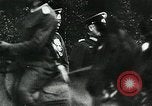
German officers review German Army parade and the promulgation of new German constitution in Potsdam, Brandenburg.
German activities after World War I. Hans Von Seeckt, a German General, reviews parade of German Army infantry and artillery in Potsdam. Paul Von Hindenburg, a German General, reviews a parade. The German Army using cardboard tanks and fake weapons in maneuvers during period after World War I and before militarization of Germany under the Nazis. Promulgation of new German constitution in the Garrison Church of Potsdam in March of 1933 in the presence of Paul Von Hindenburg, Adolf Hitler and Franz Von Papen, a German Catholic Monarchist politician. Parade scenes of German soldiers in the early 1930s. Newly created Nazi Labor Corps and Adolf Hitler digging with a shovel at an inaugural ceremony. Shirtless labor corps members pulling together on ropes. Scenes of factories, manufacturing, industrialization and rebuilding of Germany and its military with remilitarization in the mid 1930s.
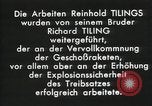
Rocket research and development work carried on by Richard Tiling, in Germany, after death of his brother, Reinhold Tiling
Following his death in 1933, Reinhold Tiling's work on rocketry was carried forward by his brother, Richard, who successfully worked on perfecting projectile missiles,and especially on improving the explosion safety of propellants, during 1934. A photograph of several rockets is shown, followed by a series of animated design sketches. Slate refers to Swirl nozzle provided with rotating projectile in describing one sketch. Another is described as Richard Tiling's design of Projectile missiles to shoot down aircraft. Richard Tiling and assistants are shown standing over many rocket projectiles in preparation for a demonstration before the Navy and the Army Ordnance Department in Meppen on April 17, 1934 (in which they were shot distances reaching 12 thousand meters). View of a 10 centimeter rocket on its launching stand. Richard Tiling and assistants placing a missile on a stand. Views of 10 and 15 centimeter missiles at a demonstration in Cuxhaven in Summer, 1934. The missiles are shown on the ground. Launching stand for direct and indirect fire with special "Dickkopf" missile. Catapult launch frame for 10 and 15 centimeter projectiles in April, 1934. Photograph of a 10 cm projectile being fired.

Scenes from World War 1, and world events in the period between World War I and World War II.
Rail guns firing in World War 1. U.S. troops charging out of trenches. Allied gunners firing "French 75s" Allied twin-tailed biplane bombers. French Renault F17 tanks. Crowds in cities celebrate Armistice Day and end of World War I. Treaty of Versailles. Destruction of warships. Scenes of Paris. A pagoda in Japan. Temples in Siam, China, and Manchuria. Two Kayan women in Myanmar or Thailand perform a dance. Both Kayan women wear long brass coil neck rings. In the U.S., a boy hits a baseball and runs toward first base. Scenes of Japan invading Manchuria. Newspaper with headline: Henry Stimson denouncing Japan. U.S. Army troops dispel World War I veteran bonus marchers. Men lined up in bread line for unemployed during Great Depression. Brief shot of Gangsters in gun battle in an American city. Scenes of dust bowl in American with farmers and families heading West in caravans. Family standing by tent. Torchlight parade in Germany. Adolf Hitler standing with German President Hindenburg circa 1933. Adolf Hitler, Heinrich Himmler, and Victor Lutze, at 1934 Nazi Rally in Nuremberg. Italian Caproni bombers over Ethiopia. Ethiopian tribesmen and Haile Selassie. U.S.Neutrality Act. American youths with a 1930 Ford coupe. Scenes from Civil war in Spain. Spanish Rebel forces in ground combat with Nationalist forces. German and Italian aircraft participate in bombing Spanish Nationalist targets in Spanish Civil War. Spanish civilians flee bombing, tend to wounded and dead victims following bombings. Italian Savoia-Marchetti S.M.79 Sparviero bombers. Crowds running for shelter. Women and children victims of bombing, some crying and in shock. Spanish General Francisco Franco arrives by train in southern France to meet with Hitler. View of Gallup Poll forms, and findings, with Americans against entering European war and preferring neutrality. Japanese planes and warships attack China. Naval Chinese civilians run for cover; bodies of Chinese in trucks. Japanese freighters, Buenos Aires and Tatsuno Maru, in U.S. ports being loaded with scrap iron and metals. Hitler, Goering and other officers in 1938. Adolf Hitler, Neville Chamberlain, Edouard Daladier, Benito Mussolini, Count Ciano sign Munich Agreement. Hitler riding standing up in an open car during a rally in Germany. Elevated view of Los Angeles, then view of traffic on streets of Los Angeles California and newspapers being sold to pedestrians. View of faces of American citizens in a movie theater watching Confessions of a Nazi Spy. German-American Bund activities including outdoor rallies in the U.S. (Camp Siegfried in Yaphank, Long Island, New York, in 1937), and an indoor rally in New York City at Madison Square Garden in 1939. Emperor Hirohito reviewing World War 2 troops of Japan. Japanese steel production and arms production in Japanese factories. The Hokoku Maru Japanese ship being launched with fanfare from Tama Shipyards on July 5, 1939. Meeting of United States Military Affairs Committee of the U.S. House of Representatives in late 1939 to consider national defense matters. In meeting of Naval Affairs Committee, representative asks for increase of 25 percent in authorized naval tonnage.
Montage of German rocketry scenes from 1930s through World War II. Nazi surrender. Atomic bomb. Japanese surrender
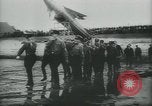
German rocket pioneer, Gerhard Zucker, attempting to develop postal rockets in the 1930s. Location is Wadden Sea off Cuxhaven, on April 9, 1933, where Zucker follows Nazi Sturmabteilung (also called SA or Stormtroopers) carrying the mail rocket across wet sands. The rocket is set up on a launch stand. Zucker and an assistant ignite the 8 side rockets and the mail rocket takes off. It noses up and loops over backwards, falling to the sand. German Stormtroopers lift up the damaged device. Next, is seen a later, more modern, rocket trial ending in failure. Two German engineers display a model similar to the pulse-jet-powered "buzz bomb" (V-1) employed by the Nazis in World War 2. A brief glimpse of similar American machine on sand flat, as narrator states German acknowledgement of knowledge gleaned from Dr. Robert Goddard's work. A German V-1 flying bomb (aka Doodle Bug) being launched in 1944, during World War 2. View of British houses of Parliament, London, England; an air raid shelter sign in City of Westminster. Londoners waiting out a raid in the shelter. Scenes of fire and destruction during German bombing of London, as narrator speaks about the more advanced German V-2 ballistic missiles employed later in the war. Londoners trudging through debris amongst bombed out buildings. Change of scene to U.S. infantry and armor advancing deep into Germany. Narrator refers to them overrunning rocket bases and other vital war-making facilities, near the end of the war. Glimpse of large number of German prisoners of war. Documents of military surrender being signed by Field Marshal Wilhelm Keitel, in Berlin, May 8, 1945. Closeup of Keitel. Scenes of American forces operating in Pacific theater. Aerial view of atomic bomb explosion. Japanese surrender ceremony on September 2, 1945, aboard the battleship USS Missouri. U.S. soldiers and other service personnel return home and greeting loved ones at end of war. Aerial view of Pentagon building and surrounding area in Arlington Virginia near Washington DC. U.S. troops boarding a ship in San Francisco, bound for war again, this time in Korea (1950).