


 Francais
 Deutsch
 Italiano
Refine Your Search
+"Germany" +1935 stock footage and images
- Showing 19 to 24 of 47 results more
more Hide
Hide
Still pictures and comments about Aviation pioneers who stimulated interest in propulsion methods.
Still pictures and comments about three pioneers who stimulated international thinking about rocketry. The first shown is German, Hermann Ganswindt (1856-1934), who proposed using high explosives to propel aircraft. Next is Russian, Konstantin Eduardovich Tsiolkovsky, AKA Ziolkowsky, (1857-1935), some of whose popular writings on the possiblilities of rocket propulsion are shown. Last is a picture and comments about Austro-Hungarian Hermann J Oberth (1894-1989) who developed the first theory of the liquid rocket. A copy of his original treatise is shown and then opened to its table of contents. Another of his books,"wege zur Raumschiffahrt" (Pathways to Space Travel) published in 1929, is shown and opened to its table of contents.
Soviet combat film showing segments of the Battle of Berlin in World War II, including Soviet soldiers planting Red flag atop the Reichstag building.
Opening scene shows Soviet soldiers, carrying PPSh sub machine guns with drum magazines, enter burning building in Berlin during World War 2. One is seen dragging a German soldier from a cellar. The German soldier immediately falls to the ground and the Soviet soldier does too, to avoid gunfire. View from inside a burning shop as Soviet soldiers enter. Others climb stairs inside an elaborate building and throw throw down a suit of armor. A tank fires its gun. Heavy white smoke rising obscures everything behind the Brandenburg Gate. View of the Quadriga statue atop the Brandenburg Gate. Flashback glimpse of German troops marching through the Brandenburg Gate much earlier in World War 2. View of that same area now a scene of destruction and fire. Soviet troops fire a heavy gun in a street. Its shell strikes causing a large explosion and raising heavy smoke. Soviet soldiers loading rockets into a Katyusha launcher. The rockets being fired and striking buildings and creating fires. Shells being picked up to load a heavy gun. A Soviet 152 mm gun M1935 (Br-2) firing in the street. Other artillery firing in the streets. Brief closeup of two Soviet gunners. Smoke rising everywhere as Soviet troops carrying a Red flag rush toward the Reichstag building. They clamber up the steps of the badly damaged building, and enter it. Next, accompanied by several others, a soldier ties a Red flag to the Statue of Germania atop the Reichstag Building. Group of Soviet soldiers pose and wave tor their photographer. Another glimpse of the Red Flag waving vigorously in a strong wind on the Germania statue. More views of posing Soviet troops. View from the ground of the Red Flag on the Germania statue.
U.S. Army orientation film "Here is Germany" showing the contrast in life in Germany pre-war and during World War 2
U.S. Army training film titled 'Here is Germany'. Circa 1930 - 1938 views of pre-war German countryside, and German cities including Berlin and others before destruction in World War 2. Shots include famous German landmarks and buildings in major cities including Brandenburg Gate and Victory Column sculpture close-ups and other monuments all before bombing of World War II. Lifestyle of German people with families and children in their routine lives in the decade of 1930 before the war. Farmers working fields, mined coal transported by rail, potatoes poured from a full sack, a boy shepherd with geese; a farmer counting pigs descending a ramp at a farm. City port or harbor scene with ships and a modern looking railroad train arriving at a station, sign on side reads Deutsche Reichsbahn (German Reich Railway). High speed highway roads like the Autobahn. German cruise ship at sea. Aerial view of airport with "Berlin" sign on ground. German schools, offices, factories and markets. German woman braiding a girl's hair. German woman taking in washed clothing from a clothesline. German men, women, and children cleaning and polishing work areas and possessions. A German library with people studying and others at book shelves. German classroom with a teacher instructing children and writing on a blackboard. Scenes of German musicians and symphony orchestra and musical instruments, artisans, masons, cooks. Busy roads with cars. Narrator then presents a darker other side, showing an arms factory during rearmament of Germany, German soldiers escorting away a religious priest. German military officials. Scenes circa 1945 of victims of German armies and of the concentration camps. Lumps of dead bodies from massive public shootings, a man being tortured, burning chambers, prisoners of war, concentration camps, human ovens, gas chambers. Survivors of the German custody in relief camps of Red Cross. Evidence of atrocities committed by Nazi Germany. Articles made of human skin and bones. Daily utility items like toys and brushes made from human body parts. Scenes of survivors of concentration camps. Polish people dead from Nazi atrocities at Lublin Castle. Italians and Belgians murdered by Germans, American POWs murdered by Germans. Scenes return again to 1930s views of peaceful German citizens and German lifestyle juxtaposed with views of German soldiers and military actions in World War 2. Some famous Americans of German roots: Wendell Willkie, Admiral Chester Nimitz, Henry J. Kaiser. Narrator talking about American customs and values. View of two teenage American boy students viewing a housing area and taking notes. One of the teenage boys is African American. Some men gathered at a bar in an American town. A man holding a long fly fishing pole preparing to depart on a fishing trip. Woman neighbors in discussion. Young American women walking down a sidewalk in an American town as a group of American boys watch and admire them.
Rudolf Hess, Deputy to German Chancellor Adolf Hitler, delivers a speech in Germany.
Rudolf Hess, Deputy to German Chancellor Adolf Hitler, in an appeal to all the world's leaders in the struggle for Nazi ideals, delivers a speech in Koenigsberg, Germany, stessing the peaceful intentions of Germany.
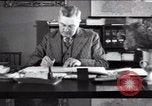
German Minister of Justice, Franz Gurtner, checks documents at his desk and speaks on telephone, in Berlin, Germany.
German Minister of Justice, Franz Gurtner, in his office, in Berlin, Germany. He fills out some ledgers and reads others. He answers the telephone. Ornate framed picture hangs on wall behind him, and a map of Germany.
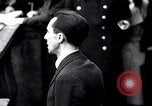
Nazi Propaganda Minister Joseph Goebbels addresses a gathering in Germany.
Nazi Propaganda Minister Doctor Paul Joseph Goebbels addresses a gathering in Germany. A large crowd of Nazi Germans gathered outside a building. Joseph Goebbels and a few civilians on a balcony. Goebbels addresses the crowd and talks about their great prospects and their leader,r Adolf Hitler. People with posters and banners. The crowd gives the Nazi salute and chants 'Heil' after Goebbels.