


 Francais
 Deutsch
 Italiano
Refine Your Search
+"Germany" +1936 stock footage and images
- Showing 61 to 66 of 144 results more
more Hide
Hide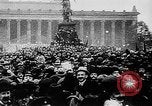
Montage of scenes from immediate Post-World War I Germany and into the 1930s
A crowd of Gernan civilians is seen gathered in front of the Alte Nationalgalerie in Berlin, Germany. Glimpses of Leaders, of the German Communist Spartacus League, including Rosa Luxemburg. Scenes of unrest during the Spartacist uprising (Spartakusaufstand) in January, 1919. Scenes of post-World War poverty, hardship and deprivation for German citizens during time of hyperinflation, with German people shown living in improvised housing, cooking outdoors, scavenging for coal. A sign is displayed for the Winterhilfswerk (WHW) Winter Relief program run in the 1930s by the Nationalsozialistische Volkswohlfahrt (National Socialist People's Welfare). It states its aim against Hunger and Cold (Gegen Hunger u Kalte). Uniformed persons with swastika arm bands, including Joseph Goebbels, and Hermann Goering, of the National Socialist German Workers' Party (Nazi Party), are seen surrounded by enthusiastic German citizens. Closeup of hot meal being dispensed and people eating. A sign in the background refers to the People's Welfare Program. People gathered in an outdoor food dispensing station, under a banner reading: "Berlin isst heute sein eintopfgericht" (Berlin is eating its stew today). Another glimpse of hot food being ladled into a dish. Adolf Hitler stands and gives a haranguing speech from a table where Nazi party members are seated. A banner on the front of a steam locomotive announces Winter Aid donation related to East Hannover (Winterhilfe Spende gau Ost-Hannover). Another sign refers to the 1936-1937 Winter Relief program (WHW) donation related to East Hannover (Gau Ost-Hannover Gifhorn W.H.W. Spende). Railroad train box cars are seen transporting contributions, from various places in Germany, to the program.
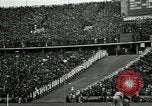
A player holds the Olympic Torch, climbs up stairs and lights the Olympic flame during the XI Olympiad in Berlin.
The XI Olympiad in Berlin, Germany. Spectators and players in the Olympic stadium. They sing a song. A player runs holding the Olympic Torch. The Olympic flag. The players climb up stairs and light the Olympic flame. The Olympic flame burns at the 1936 Olympic games in Berlin Germany. The players march holding their nation's flag. The flags of the participating nations in the background.
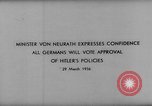
Rudolf Hess, Joseph Goebbels and others cast votes in Germany.
German Foreign Minister Konstantin Freiherr Von Neurath expresses confidence on 29th March, 1936 that all Germans will vote approval for Hitler's policies. Officials and dignitaries cast their votes. They put their votes in a ballot box. Rudolf Hess, the deputy of Hitler ; Reich Minister of Public Enlightenment and Propaganda, Joseph Goebbels and others also cast votes.
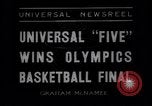
Universal Pictures beats McPherson Globe Refiners in basketball to win Olympics final in New York City
A newsreel titled "Universal five wins Olympics basketball final" shows a game between the company team from Universal Pictures and the McPherson Globe Refiners from Globe Oil and Refining Co. of McPherson, Kansas. The McPherson team is sometimes also referred to as the Oilers, or the Refiners. The teams are seen playing in the Olympics Qualifying basketball final in New York's Madison Square Garden. People cheer the two teams. Universal defeats the McPherson Globe Refiners to win the Olympics final. The win entitled the Universal Pictures team to name 7 players to the Olympic basketball team representing the United States in the 1936 Olympics held in Berlin Germany, and McPherson Globe Refiners was able to name 6 players to the team. These two teams beat out five U.S. college teams to earn the spots in the final and determine the makeup of the U.S. Olympic Basketball team. Players in the game in this video clip include Globe Refiners forward Francis Johnson, Centers Willard Schmidt and Joe Fortenberry, and Universal forward Carl Knowles. Universal beat the Globe Refiners by a score of 44 to 43. According to a Time Magazine article of April 13, 1936, the Globe Oil & Refining team, "...have perfected a technique called dunking with which they score by jumping up above the basket, dropping the ball into it." This may be one of the earliest references to dunking, now a staple technique in basketball. The same Time article further stated of the Oilers, "On the defense, they prevent opponents from scoring by batting the ball out of the basket." Again, the Globe Refiners were demonstrating play that later became standard in modern basketball. The idea for the Globe Refiners was a company promotion scheme, thought up in 1934 by Gene Johnson, the Sales Manager of Globe Oil who had several years experience coaching basketball. The Olympic team also included Washington State Huskey player Ralph Bishop. The USA went on to win the gold, defeating Canada 19-8.
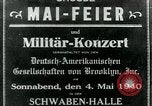
Animation of night sky, man harnessing fire and steel and early blacksmith operations leading to World War 1 era war production
Opening shows a German language poster promoting a May 4, 1940 Grosse Mei-Feier and military concert sponsored by the German American Companies of Brooklyn New York City, to be held in Schwaben Hall at Myrtle and Knickerbocker Avenue in Brooklyn. Next is opening credits for German film "Mettaldes Himmels" (Metals from Heaven), made in 1936. Animation shows the night view of the sky in Germany. Moon and stars in the sky. Meteors shoot. One impacts the earth and explodes. A crater on the earth's surface. Blacksmith of middle age pounds piece of glowing metal into a sword. A water wheel in a hut. Men work. They hammer metal in glowing hot fires. Rapid montage of scenes of war armament production and application of metals in war materiel. Rifles and artillery on a World War I era battlefield. World War 1 German tank on the battlefield. Military biplane aircraft fly in the sky. Naval ships fire guns and bombard targets. A German naval torpedo running near surface of water. Smoke arises due to firing.
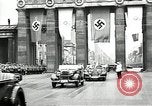
Adolf Hitler arrives at a stadium and players run holding the Olympic Torch during the XI Olympiad in Berlin.
The 1936 Olympics held in Berlin, Germany. German Chancellor Adolf Hitler arrives at the Olympic stadium in a car. A Nazi flag at the entrance. Spectators in the background. The Nazi flag and the Olympic flag. A man runs holding the Olympic Torch with other players behind him. People crowd on either side of a street. Hitler waves. The players run through the streets and people look at them. The flags of the participating nations.