


 Francais
 Deutsch
 Italiano
Refine Your Search
+"Germany" +1939 stock footage and images
- Showing 103 to 108 of 162 results more
more Hide
Hide
Adolf Hitler, the Chancellor of Germany, arrives in a car with other officials during the Polish Campaign in Warsaw, Poland.
The German viewpoint of events during the Polish invasion campaign, in Warsaw, Poland. Adolf Hitler, the Chancellor of Germany, arrives in a car with other officials. A crowd runs after the car. He is greeted by an officer. He walks with other officers. He salutes the soldiers.

Prime Minister Chamberlain in London declares a state of war against Germany and British forces prepare for war.
Britain declares war on Germany. Artillery poised on streets of London with Big Ben clock tower in the background on the grounds of the Palace of Westminster. People gathered outside and near fountain of Trafalgar Square. Prime Minister Neville Chamberlain declares a state of war in London. Troops mobilize and air raid defenses are manned to prevent bombing attacks. Soldiers firing artillery, building barricades. Battleships underway at sea. Soldiers continue firing at night. Destroyed buildings and wrecked equipment. Thousands of children are evacuated to the countryside.
Ruined towns and destroyed communication lines after invasion of Poland by Germany in World War II.
Invasion of Poland by Germany during World War II. Aerial view of damaged Polish bridge; destroyed Gas tank near railroad marshalling yard; and smoke rising from burning buildings all along a major highway. Smoke rises from explosions on a field. German troops pass over debris and through bombed out buildings where snipers abound. Fires rage in some buildings. German troops and equipment advance along a road. German troops include one walking with a captured goose under his arm, and one soldier who prepares a pig for a roast. Remnants of pig roast. A soldier distributes newspapers among other soldiers. Newspapers report enemy armored train stopped at Warsaw. Views of the destroyed Polish armored railroad train.
German officers review German Army parade and the promulgation of new German constitution in Potsdam, Brandenburg.
German activities after World War I. Hans Von Seeckt, a German General, reviews parade of German Army infantry and artillery in Potsdam. Paul Von Hindenburg, a German General, reviews a parade. The German Army using cardboard tanks and fake weapons in maneuvers during period after World War I and before militarization of Germany under the Nazis. Promulgation of new German constitution in the Garrison Church of Potsdam in March of 1933 in the presence of Paul Von Hindenburg, Adolf Hitler and Franz Von Papen, a German Catholic Monarchist politician. Parade scenes of German soldiers in the early 1930s. Newly created Nazi Labor Corps and Adolf Hitler digging with a shovel at an inaugural ceremony. Shirtless labor corps members pulling together on ropes. Scenes of factories, manufacturing, industrialization and rebuilding of Germany and its military with remilitarization in the mid 1930s.
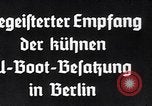
Crew members of German U-boat, U-47,being greeted in Berlin after sinking British battleship, Royal Oak. Also Slovak Jozef Tiso.
Captain Gunter Prien and crew of German U-boat, U-47, being greeted in Berlin, Germany during World War II. Crew members of U-47 submarine exit aircraft at Tempelhof Airport, Berlin, and are greeted by officers and cheered by crowd. Motorcade of crew member pass on a street cheered by crowd. Next scene, unrelated, shows Jozef Tiso, President of the Slovak State (Slovakia) greeting victorious Slovak 1st Infantry Division soldiers of the Field Army Bernolák following their participation with Nazi Germany in the invasion of Poland. Axis Slovak soldiers in Holíč M32 helmets (style of Czechoslovakia) seen marching and receiving awards from Slovak commander and Minister of Defense, Ferdinand Čatloš. View of a visiting German General greeting a non-uniformed official. Then same General poses with Ferdinand Čatloš seen behind his right shoulder.
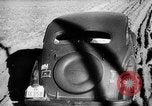
Road construction and a new housing project with roof installation in Germany.
Cars pass on an unpaved road. Number plate on a car reads 'W 18358'. Polish laborers use German technology to pave dirt roads. Trees lined on the sides of the unpaved road. Workers use spade and other equipment and machinery. Road construction in progress. A horse driven carriage passes on road. German civilians complete new housing project with roof installation. Several houses in a row. Construction crew working. Flags with Nazi sign on the houses.