


 Francais
 Deutsch
 Italiano
Refine Your Search
+"Germany" +1939 stock footage and images
- Showing 31 to 36 of 162 results more
more Hide
Hide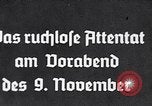
Bomb destroys historic German beer Hall. Hitler escapes, but Nazi veterans killed. Hitler attends funerals in Munich
Entrance of a memorial with the years 1923 and 1939 posted above the doorway on large wreath. Two German Eagle statues stand on either side. A German military officer is exiting the doorway. Seen are remains of Bürgerbräukeller or Burgerbraukeller Hall, the historic site of the 1923 Beer Hall Putsch in Munich (Rosenheimer Str. 5, 81667 München, Germany) that was destroyed by decapitation strike using a time bomb. The explosion occurred 15 minutes after Hitler departed after giving speech there, marking memory of old veterans of the Nazi movement. Six veterans were killed outright and 60 injured in the blast. The building is a shambles, with steel girders collapsed. German Chancellor Adolf Hitler attends funeral ceremony for 8 victims of the bombing. Soldiers hold Nazi flags. Some of the Nazi veterans are seen bandaged with injuries. Hitler and his Deputy Rudolf Hess honor the dead with a Nazi salute. Hitler talks to relatives of the victims. A large wreath is carried bearing the name Adolf Hitler. Funeral procession moves along a road, as Nazi veterans carry the coffins of their comrades. The funeral procession moves through the Victory Gate (Siegestor 80539 Munich, Germany) in Munich. Hitler and Hess ride in a car and step down in a small plaza. Nazi movement veterans stand, some with bandaged injuries. Crowds in the streets of Munich. Hitler rides standing in open car as he is cheered by crowds. German bombers fly overhead in formation.
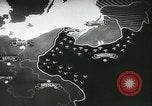
British officials meet in England as Adolf Hitler prepares his troops in Germany during World War II.
The first phase of German assault on France and the Low Countries during World War II. Animated maps illustrate Czechoslovakia and Poland defenses against Germany, and the East Prussian Corridor. Civilians including children flee war violence. German troops and tanks parade. England: UK Prime Minister Neville Chamberlain addresses a gathering. Britain's Foreign Secretary Lord Halifax (Edward Fredrick Lindley Wood, 1st Earl of Halifax), Winston Churchill, Leon Blum, and other officials. Germany: Hitler arrives at the Reichstag in Berlin. He addresses the Nazi officers and officials. A sign for the custom border district at Kreis. Bullet ridden walls and bomb damaged buildings. German troops load and fire artillery. German Panzer tank units invade Poland in 1939. Hitler looks through an artillery periscope. Black smoke rises due to numerous explosions.
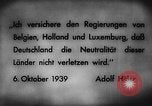
Germany invades Belgium, Holland and Luxembourg on May 10th, 1940
View of the Peace Treaty between Germany and Belgium, Holland and Luxembourg, signed on 6th October 1939. The treaty breached on May 10th, 1940, Germany launched a massive attack on the above mentioned countries. Scenes of fire and destruction as aerial bombing by Luftwaffe leaves devastation in Belgium, Holland, and Luxembourg. Nazi troops take over the cities. German troops marching at night while buildings in the target cities burn in the background. (World War II period).

American workers and OSS in World War 2 work to estimate the loss of German military manpower in battle.
Film outlines process of U.S. military and War Department to estimate the German military manpower losses from 1939-1943 during World War II. Scenes of German military forces in battle. German tank on the battlefront smashes down a tree and German soldiers follow, running behind it. Dead bodies of soldiers lay on the battlefield. Airplane falling from sky to ground after being hit. German Soldiers fire rifles during battle. German soldiers carry wounded on litters and German medical staff treat the wounded soldiers. A wounded soldier on a hospital bed. Nurse leans over hospital bed and talks to a wounded soldier. A study made to find out the number of soldiers returning to their jobs after being injured. A man reads a magazine which reads: 'Estimate of non battle causalities'. German soldiers march through Arc de Triomphe in Paris during occupation of Paris by Nazi Germany. Headline of a newspaper reads: 'Germans silent on Russian gain'. Brief scene of Soviet leader Stalin speaking at a microphone. Cavalry soldiers, likely Soviet, crossing a battlefield. Scenes of World War I German troops being reviewed by officers. Civilian or OSS men lean over a German map and discuss among themselves. They study the map. Scene of men and women at a German news stand buying German newspapers in order to obtain obituary information. OSS personnel translate casualty reports from German newspapers to help estimate deaths of German soldiers and determine force strength. An operations room with American staff analyzing German newspapers. View of a Boeing 314 Clipper Flying Boat aicraft taking off from water. The reports from World War I and II, allied forces, chart, graphs and NARS computers used to estimate German Army's manpower loss. African American women workers operate keypunch machines recording battle casualty statistics which yield punch cards for further data analysis. Punch cards being created and being loaded in sorting and reading machines bearing brand "International" (for International Business Machines or IBM). A document entitled "analysis of obituaries." Man in an office studying a map and a document. A woman helps him as she enters numbers into a Remington Rand adding machine. They estimate the officers killed in war and the number of the killed enlisted men, in order to estimate the total battle loss. They compare the data of soldiers missing, killed, wounded, and unfit for duty from 1939 to 1943.
British prosecutor Shawcross presents crimes by Nazi leaders during Nuremberg Trials; scenes from Molotov-Ribbentrop Pact signing
Trial of Nazi leaders for war crimes in Nuremberg, Germany soon after the end of World War 2. British Chief Prosecutor Hartly W Shawcross presents count no 2, crimes against peace involving wars of aggression in violation of international treaties and agreements. A document reveals Adolf Hitler's plans to occupy Poland. Footage showing Soviet Leader Joseph Stalin and Germany's Joachim Von Ribbentrop as they sign non-aggression pact between Russia and Germany on August 23, 1939 (also called the Molotov-Ribbentrop Pact). Germany prepares to occupy Poland as Pope Pius XII and President Franklin D Roosevelt appeal for peace just before start of World War II.
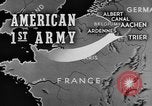
The United States First Army enters Roetgen and supplies are dropped to and retrieved by the Belgian White Army (WW2)
The United States First Army enters Roetgen, Aachen and other German border towns without opposition during World War II. Map showing the capture of the Ardennes, Albert Canal, Aachen, and Trier by the First Army. View of Luxembourg’s Ardennes. A dugout in Wallendorf, in the state of Rhineland-Palatinate. A captured pillbox displays sign in German reads “Der führer besichtigte diese anlage am 15. mai. 1939” (“The Führer visited this facility on May 15, 1939” in English). The town of Wallendorf with heavily damaged buildings from recent Allied shelling. Civilians saving their belongings outside the bombed “Gastwirtschaft von Franz Wenzel” in Wallendorf. Troops on moving M4 Sherman tanks and Jeeps. Soldiers climb the hill and enter Germany. The troops maneuver over fields. Troops occupy the Roetgen, located approximately 16 km (10 mi) south-east of Aachen. 'Roetgen' written on building. White flag on building of 'The Deutsche Reichsbahn'. View of village and huts. Belgian White Army lights fire for supplies by airborne. They gather hay to make bonfires. A White Army soldier with bayonet scans the sky. Another soldier holds a rifle. Soldier watches through binoculars towards plane. A passing bomber drops supplies for the Belgian White Army. Parachutes landing on earth. Supplies and arms are dropped to and retrieved by Belgians. Parachute are rolled and returned to England. Men load supplies into a truck. Horse cart moves away.