


 Francais
 Deutsch
 Italiano
Refine Your Search
+"Germany" +1942 stock footage and images
- Showing 223 to 228 of 251 results more
more Hide
Hide
Brazilian troops prepare to fight against Nazis with alliance of U.S. troops during World War 2
Brazil enters World War II against Germany. Map of Brazil shown. Crowds gather on the streets of Rio de Janeiro as war is declared. German embassy is closed for safety of Brazil. Stores and shops are closed in Axis countries. Axis ships are confiscated at sea. U.S. President Franklin D. Roosevelt and President of Brazil Getúlio Dornelles Vargas meet and sign documents of alliance between two nations. Lend-lease military equipment is unloaded from ships. U.S. and Brazilian pilots meet. U.S. pilots give training to Brazilian pilots. Planes take off. Brazilian pilots fly trainer planes to Brazil from the U.S. Flags of Brazil at mast. Brazilian airplanes take off for patrolling the coast. Brazilian ships depart from Brazilian shipyard. Brazilian President Getúlio Vargas promises to defend the coast of Brazil. Ships underway at sea. U.S. sailors stand at attention aboard a ship at a Brazilian port. Workers work in an ordnance factory. Brazilian armed forces and U.S. troops march parade. Military equipment pass on road.
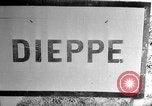
Allied Operation Jubilee offensive against Dieppe, France, during World War II.
Allied Operation Jubilee, the assault against Dieppe, France, during World War Two. A sign reads 'Dieppe'. Fighter aircraft diving down across a harbor area. German anti-aircraft guns are fired from fortified positions behind barbed wire. Explosion of a gas tank in the dock area. German defenders, in grass above beachhead, firing rifles and artillery pieces. Wrecked British Churchill tanks on Dieppe beach. Wrecked tanks and a landing craft along a shore. Dead bodies on the beach. German soldiers sitting abandoned craft in the water. The streets of Dieppe, France showing captured British soldiers being marched down a street escorted by German soldiers. A wounded English soldier being carried down a street by four other English soldiers. The wounded soldier with his left eye covered with blood. Other British casualties entering the town. Surrendering British soldiers being escorted up a country road. The coastline of Dieppe. City population going about their business. Men, women and children walking in a street. German coastal guns being erected. Various types of guns and their mountings, camouflaged gun positions, guns being raised into firing position. Coastal gun barrels. A German motor train moving through a street of Germany. A large half-track vehicle towing a string of trucks through a street. A ship plowing through a heavy sea. A large submarine fleet underway at sea. The guns of a battleship are fired. A Higgins boat going through water towards a coastline. Marines aboard the Higgins boat approaching the shore. A coastline showing invasion troops hitting the shore.

Red Cross provides food as refugee children disembark from Portuguese liner Serpa Pinto in New York City, United States.
Refugee children, displaced children, and war orphan boys and girls arrive in New York harbor, United States during World War II. The European refugee children aboard the passenger ship Serpa Pinto as they arrive in New York to begin a new life after fleeing war and persecution in Europe. Children, including many Jewish children, from much of war torn Europe, including Poland, Czechoslovakia, Spain and Germany disembark from the ocean liner operated under the auspices of the United States Committee for the Care of European Children (USCOM). A group of children poses for camera. Red Cross provides food and fresh milk to refugee children. The children eat the food.
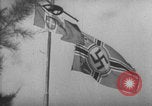
Jagdgeschwader 53 Luftwaffe officers play with dog, paint planes in Sicily, WW2
Jagdgeschwader 53, also known as "Pik As" (Ace of Spades) Geschwader German Luftwaffe in Sicily, Italy during World War 2. Flags of Italy and Nazi Germany together. German officers play with a fox terrier dog, passing him to each other as he doggedly hangs on to a shoe while biting it. Nazi pilot, wearing a flight vest and an Iron Cross, plays cards with comrades. The "Pik As" (Ace of Spades) symbol on an airplane. German Luftwaffe pilot painting another of many Abschussbalken symbols of air victory on the tail of a plane. Mechanics fixing the engine of a fighter, likely a Messerschmitt Bf 109. A crane lifts a Daimler Benz 605 engine. Man spray paints “3” on a plane. A sign in German saying “Die an “dicke Luft” gewöhnten Jöge sind dem Pressluft rausch verfallen” (“Boys, who got used to “Thick Air”, are addicted to the high of compressed air” in German). A man picks up a fox terrier dog by the scruff of its neck and carriers it away.

Prominent guests pay their respects during the funeral of István Horthy in Budapest, Hungary (WW2)
The funeral of István Horthy, son of Hungarian Regent Admiral Miklós Horthy and World War II fighter pilot. View of the dome of the Hungarian Parliament Building (Budapest, Kossuth Lajos tér 1-3, 1055 Hungary) in Budapest. Pallbearers carry the coffin of István Horthy from a gun carriage. Sign bearing the name and coat of arms of István Horthy. Funeral procession of István Horthy. The coffin is taken inside the Hungarian Parliament Building. Banners with the Swastika, 'Adolf Hitler' and 'Benito Mussolini' in the flower arrangements. Prominent guests from Axis nations pay respects during the funeral. Nazi Germany Minister of Foreign Affairs Joachim von Ribbentrop and Luftwaffe Generalfeldmarschall Albert Kesselring attend the funeral in Budapest. Officers perform the Nazi salute. Men bring in a large funeral wreath with a royal monogram “VE” (Victor Emmanuel II of Italy). Count Gian Galeazzo Ciano conte di Cortellazzo, the Italian Minister of Foreign Affairs, attend the funeral. Guests gather around the casket and the flower arrangements and honors for István Horthy. A military funeral parade with the coffin of István Horthy carried on a cannon carriage. Two women with their heads completely covered with black veil (probably Magdolna Purgly, wife of Admiral Miklós Horthy and Countess Ilona Edelsheim-Gyulai, widow of István Horthy) accompany Admiral Miklós Horthy as he trails behind the cannon carriage. A black flag on top of a building.

German young men participate in calisthenics, running and pole vaulting.
German young men participate in sports. An instructor guides young men during a calisthenics session on a snow covered field or lake. German boys running. Young men practice pole vaulting indoors. Some men sit on stands and watch the practice.