


 Francais
 Deutsch
 Italiano
Refine Your Search
+"Germany" +1943 stock footage and images
- Showing 1 to 6 of 300 results more
more Hide
Hide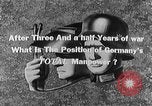
The comparison of Germany's total labor and military manpower from 1939 to1943.
Estimation of Germany's total working manpower. People walk with their equipment towards a factory. They read a notice pasted on the wall. They work in the factory. Vehicles parked on the street. Soldiers walk. Comparison of the military manpower from 1939 to 1943. The number of soldiers missing is also estimated. Destroyed military vehicles on the battlefield. Soldiers advance with tanks on the battlefield. Dead body of a soldier lay on the field. (World War II period).
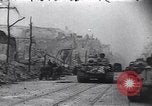
Contrasting views of Berlin, Germany from 1945 to 1943, to 1945 again, during World War II
Soviet Forces battling in Berlin during 1945, in World War 2, employ tanks and heavy machine guns. A Soviet soldier herds two German prisoners from a building. Groups of German soldier prisoners struggle through rubble as they are led from buildings, under guard. Soviet tanks firing as they pass a church building. A Soviet heavy gun being fired point blank on a Berlin street during Battle of Berlin. Buildings on fire. Soviet soldiers firing artillery field pieces. Views of destroyed and damaged German military aircraft on and in hangars of an airfield. Soviet Ilyushin II aircraft land on the airfield. Closeup of distressed German General rubbing his eyes. Flashback in time to 1943, in World War II. Field Marshal Hermann Goering is seen reviewing flyers of a German Luftwaffe (Air Force) unit. A Junkers Ju 52 trimotor aircraft lands and parks on an airfield. Italian leader Benito Mussolini steps from the aircraft after his rescue from imprisonment by the Italian Government at the Hotel Campo Imperatore. He is personally welcomed by Adolf Hitler, who had ordered the mission to rescue him. Change of time, again, to 1945, when Berlin, Germany is attacked by Forces of the Soviet Union. Closeup of a despairing German General. Scenes of utter destruction as Soviet troops batter Berlin, Germany with artillery. Soviet soldier steps down from his tank and gives a Soviet General a handgun, which he pockets and then leads a group of Soviet officers into a building

Analysis of the German labor force from 1939 to 1943 (WW2)
Analysis of the Germany's labor force, military strength and effects of World War II on manpower. German soldiers march. Men work in factory on equipment and machinery. Women work in factory. A cemetery of World War 1 soldiers in Germany. Narrator explains how loss of man power from world War 1 deaths, and subsequent lower birth rate leads to war production worker needs being filled by many young German women and even German boys and girls working in industrial factories also. Wounded German soldiers being treated in field during World War 2. A map points Germany, Sudetenland and Austria. Graphs examine labor force by sex, age and military replacement availability; compare the labor force according to sex from 1939-1943; detail the increase of work force through the women part time workers and the veterans. Women weld equipment in a factory. Men do mining work. Narrator speaks of foreign workers (such as from Poland, Netherlands, Czechoslovakia, Yugoslavia), and how some now serve "under economic pressure and compulsion" (as forced labor or slave labor). Views of forced labor crews working digging earthworks. Laborers also work on building or repairing railroad stations and track work. Lines of prisoners of war, also used for labor, walk under German guard as lines of German uniformed troops walk in the opposite direction. Graphs compare the labor force in agriculture, industry, trade services, transport and government.

German soldiers raffle chances on geese during 1943 Christmas celebration in Germany.
Christmas celebration in Germany. World War 2 German soldiers raffle chances on geese. Two men seated at a table. Geese picks up numbers from a bowl. One soldier matches the picked numbers with the ones in his ticket.
Scenes cursorily illustrating the development of airplanes from 1908 to 1943, from a German perspective.
German slates refer to the dream of "Northern" people to fly, fulfilled by aircraft development. Scenes from Paris airshow in 1908, when it was a feature of the automobile show that year. Hangars bear names of aircraft companies: Bleriot; Vetze and others, with historic vintage airplanes of the period parked on the grass in front of each. A man plays with a dog in the grass. Spectators are seated in stands set up in the background. Scene shifts to 1935, where a long row of German aircraft are shown parked with engines running. Then it shifts to 1943, during World War 2, with a long line of German Messerschmitt aircraft parked with engines running. An animated map shows air lines of communication emanating from center of Germany and extending throughout Europe. Huge formations of German warplanes are seen in flight.
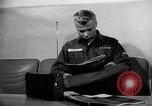
The story of AFN ( American Forces Network) Radio. Founding announced in 1942. First broadcast in 1943; growth in 1944.
U.S. Army soldier reads newspaper while listening to radio. Soldiers doing their respective chores, listen to AFN (American Forces Network) Radio. General Marshall and General Eisenhower announce the creation of AFN, in 1942. July 4, 1943, the first broadcast of AFN. General Eisenhower mingling with paratroopers of the 101st Airborne Division, on the eve of D-day. U.S. B-26 aircraft in flight. United States soldiers aboard landing craft and wading ashore at Normandy, France, on D-day, June 6, 1944. Soldiers tuning radios in the field. United States Sherman tanks and infantry move along country road in France. Audio includes portions from AFN broadcasts, including an announcer saying "You are listening to AFN Paris. This is the American Forces Network, on the road to Berlin." Road sign points to St. Lo. Group of U.S. soldiers gathered around a jeep with a radio, listening to AFN, in Germany. (World War II period).