


 Francais
 Deutsch
 Italiano
Refine Your Search
+"Germany" +1943 stock footage and images
- Showing 13 to 18 of 300 results more
more Hide
Hide
Ribbentrop and a Japanese delegate sign the Japanese German economic pact in Germany during World War II.
Japanese German economic pact being signed in Germany on January 20, 1943. A Japanese delegate walks up stairs and shakes hands with German Foreign Minister Joachim Von Ribbentrop. The two leaders sign the Japanese German economic pact and shake hands.
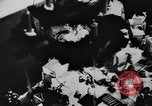
Red Cross nurses prepare gift parcels and airmen carve children's toys during Christmas preparation in Germany.
Christmas preparation in Germany in 1943 during World War 2. German Red Cross volunteers prepare gift parcels for German troops, away at war. They pack them in boxes with Merry Christmas messages written on them. One box is destined to soldiers on the Eastern Front. German Airmen make toys from wood for distribution to German children. Display of the prepared toys.
Acceleration test of Argus pipe engine for V-1 missile.View of rocket sled catapult. Peenemunde-West Test Center, Germany
Winter, 1943, testing at German Air Force Test Center, Peenemunde-West, Germany. Acceleration test of Argus engine for V-1. Test vehicle with Argus jet engine is readied on launch rail and men stand behind it. Snow is falling. A man stands on snow covered ground and directs. The Argus jet engine ignites and vehicle accelerates, leaving track to crash into ice and snow covered water. Views of the Rheinmetal-Borsig solid propellant rocket sled catapult, for V-1, on a rail.
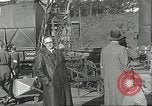
Germans prepare to launch an A-4 missile from Peenemunde, Germany, during World War II.
Preparations for the launch of an A-4 missile in Peenemunde, Germany during World War 2. German military officers and engineers near the missile in the test area. Technicians check the missile on a launching platform. Walther Thiel (in glasses) Deputy Director of the Peenemunde facility, pulls out a document that he and another civilian discuss with several uniformed German officers. View of launch control clocks for minutes and seconds. the second hand begins to move in a countdown. (Note: Walther Thiel was killed on the night of Aug 18 , 1943, during British Air raid - Operation Hydra, the first allied air strike in the "Crossbow" operations against German special weapons and research).

Portion of Trial of Nazi war leaders during Nuremberg Trials in Nuremberg Germany. Audio only.
Audio only. Nazi war leaders on trial in Nuremberg Germany. Coverage on how the charges will be grouped. The speaker focuses on three major issues: international situations and aspirations for expansion of Germany between 1943-1945; conquering of Austria and Czechoslovakia, and improvement of military and political positions.

American workers and OSS in World War 2 work to estimate the loss of German military manpower in battle.
Film outlines process of U.S. military and War Department to estimate the German military manpower losses from 1939-1943 during World War II. Scenes of German military forces in battle. German tank on the battlefront smashes down a tree and German soldiers follow, running behind it. Dead bodies of soldiers lay on the battlefield. Airplane falling from sky to ground after being hit. German Soldiers fire rifles during battle. German soldiers carry wounded on litters and German medical staff treat the wounded soldiers. A wounded soldier on a hospital bed. Nurse leans over hospital bed and talks to a wounded soldier. A study made to find out the number of soldiers returning to their jobs after being injured. A man reads a magazine which reads: 'Estimate of non battle causalities'. German soldiers march through Arc de Triomphe in Paris during occupation of Paris by Nazi Germany. Headline of a newspaper reads: 'Germans silent on Russian gain'. Brief scene of Soviet leader Stalin speaking at a microphone. Cavalry soldiers, likely Soviet, crossing a battlefield. Scenes of World War I German troops being reviewed by officers. Civilian or OSS men lean over a German map and discuss among themselves. They study the map. Scene of men and women at a German news stand buying German newspapers in order to obtain obituary information. OSS personnel translate casualty reports from German newspapers to help estimate deaths of German soldiers and determine force strength. An operations room with American staff analyzing German newspapers. View of a Boeing 314 Clipper Flying Boat aicraft taking off from water. The reports from World War I and II, allied forces, chart, graphs and NARS computers used to estimate German Army's manpower loss. African American women workers operate keypunch machines recording battle casualty statistics which yield punch cards for further data analysis. Punch cards being created and being loaded in sorting and reading machines bearing brand "International" (for International Business Machines or IBM). A document entitled "analysis of obituaries." Man in an office studying a map and a document. A woman helps him as she enters numbers into a Remington Rand adding machine. They estimate the officers killed in war and the number of the killed enlisted men, in order to estimate the total battle loss. They compare the data of soldiers missing, killed, wounded, and unfit for duty from 1939 to 1943.