


 Francais
 Deutsch
 Italiano

Refine Your Search
+"Germany" +1943 stock footage and images
- Showing 199 to 204 of 300 results more
 Hide

P-47D Thunderbolts of the 56th Fighter Group taking off on bomber escort mission to Emden, Germany, in World War II
P-47D Thunderbolts of the U.S. Army Air Forces (USAAF) 56th Fighter Group taxiing and taking off from RAF Halesworth airfield in England in World War 2. They are on mission ("Ramrod to Emden) escorting U.S. bombers in raid on German U-Boat Base at Emden, Germany.The first P-47 seen is serial 41-6261 "Bat Out of Hell" (coded UN-B) flown by LT Gordon Batdorf of the 63rd Fighter Squadron. Others seen in the sequence include P-47s including: 42-74750 ("Lady jane") and 42-74635. Officer fires a flare to signal takeoff. After taking off in pairs, the aircraft of the 63rd Squadron assemble in a formation of 16 aircraft and then join other squadrons of the 56th Fighter Group to proceed on their mission.
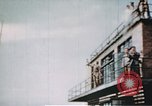
U.S. 351st Bomb Group B-17s take off on mission to Germany, from their base at RAF Polebrook, England, in World War II
Flare is fired from control tower and B-17s of the U.S. 351st Bomb Group begin taking off from their base at RAF Station Polebrook, England, on a mission to Germany during World War 2. The B-17 aircraft fly off in formation. View inside one B-17, as crew goes on oxygen, as they climb through 10 thousand feet. Sky filled with formations of B-17s. U.S. P-47 fighter escort aircraft of the U.S. 487th Fighter Squadron (352nd Fighter Group) at RAF Station Bodney, take off to accompany the B-17s part way. Gunners inside a B-17 are alerted to German fighters at 3 O'clock low. They are identified as the American P-47 escorts. Squadron of U.S. P-47s seen in flight. B-17s and escorts pass over the enemy coastline. They being to encounter flak which can be seen as Black clouds.

British Lancaster bombers taking off from the UK on nighttime missions over Germany, during World War II.
British 4-engined AVRO Lancaster bombers take off at dusk, from the UK, for nighttime bombing missions over Germany, during the second world war.

B-17s of 8th Air Force, 91st Bomb Group, returning to Bassingbourn Airfield, England,from mission over Wilhelmshaven, Germany
Airmen and ground crews at RAF Bassingbourn airfield anxiously await return of 91st Bomb Group B-17s from their bombing mission over Wilhelmshaven, Germany. They engage in various diversions as they wait. Flare from a returning B-17 signals wounded aboard. An ambulance races out to meet the aircraft after landing. Injured are helped into the ambulance. A dead crewman is covered. A gunner receives blood plasma. (World War II period).

B-17s of 91st Bomb Group, including the "Memphis Belle," return from mission over Wilhelmshaven, Germany.
One by one, 29 B-17 aircraft of the 91st Bomb Group (out of 36 launched) return from their bombing mission over Wilhelmshaven, Germany during World War 2. Many suffered battle damage and have wounded crew aboard. The B-17, "Dame Satan," is seen with large holes in it. The B-17, "Old Bill," is shot to pieces, with its nose missing. Lieutenant Colonel Stanley T. Wray waits in control tower as three more aircraft arrive, including the "Memphis Belle." Her crew members relax and smile as she lets down to land. Her pilot, Captain Morgan buzzes the airfield before landing to complete their 25th bombing mission. They are congratulated by well wishers on the ground. Their crew chief paints the 25th bomb on the "Memphis Belle" fuselage. Change of scene: Brigadier General Haywood S. Hansell, Jr. awards a Distinguished Flying Cross to each crew member. Change of scene: King George VI and Queen Elizabeth, of England, visit the flight crew and ground crew of "Memphis Belle" and converse with them. Change of scene: Lieutenant General Jacob L. Devers, Commander of U.S. Army Forces in Europe, and Major General Ira Eaker, Commander of the 8th Air Force, visit and greet the crew. General Devers reads their orders to return to the United States and encourage Americans on the home front.

Exterior view of Germany's main broadcasting station for Ukraine.
Germany's main broadcasting station for Ukraine, during World War 2. Houses and trees in the background. A car passes on a street. Exterior view of the building. The car arrives near the building. A man comes out of the car and enters the building. A sign board outside the building reads: 'Imperial Broadcasting Company'. Newspaper montage of German, Ukrainian and Hungarian films and theater notices in Kiev.