


 Francais
 Deutsch
 Italiano
Refine Your Search
+"Germany" +1943 stock footage and images
- Showing 283 to 288 of 300 results more
more Hide
Hide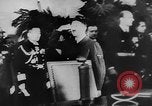
Japanese officer greeted by Fuhrer Adolf Hitler.
Fuhrer Adolf Hitler comes through the door and greets Japanese officer. Japanese officer gives a Nazi salute. Other German officers giving Nazi salute in the background.
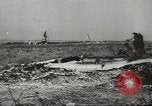
German citizens evacuate from cities and towns being bombed by Allied forces during World War II
Film begins, showing remains of a Boeing B-17F from the U.S. 100th Bombardment Group (BG) with home base at RAF Station Thorpe Abbotts, England, during World War 2. Camera pans over a field of debris containing two of the aircraft's engines and the wreckage of the fuselage and tail. The tail displays the Square D symbol of the 100th BG, plus the letter "T" and some of its tail number: "2303." Camera pans interior wreckage including crew seats and oxygen tanks. It then shows broken wings along with bodies of several crew members wearing parachute harnesses. A different side of the fuselage and tail shows the tail number "230311." This fully identifies it as B-17, number 42-23011. A field grade German officer and another officer examine the wreckage. Views of aircraft wreckage, in a forest, including a Browning M2 .50 caliber machine gun and another aircraft engine. Scene shifts to nearby town, where German women in white are serving meals at an outdoor food kitchen, for local people who are preparing to evacuate. A camper van loaded with family belongings is seen moving in the background. Several women, carrying plates of their food, walk toward tables. Some sit and eat at a table with a German soldier. Women make themselves sandwiches with foods laid out on a butcher block table. Closeup of a large drum of drinking water. local people fill containers from it. German children are seen aboard a bus waving goodbye to their mothers during evacuation for their safety. German children are placed aboard open boats at a port, for transport to safety out of war zone. German women and children board a train during evacuation to safety. Huge piles of their luggage is stacked on the train platform. View of a substantial private home in a residential area. Inside view shows it has been converted into nursery for infants, who are seen in many small cribs. Women sit on the lawn behind a substantial country home, as some small children run toward them from the house.
A Japanese submarine is welcomed in a German harbor as officers greet each other during World War II.
A Japanese submarine in a German harbor on September 30, 1942 during World War II. A German ship in the foreground and the Japanese submarine in the background. Nazi naval officers lined up on the deck of the ship as they salute the Japanese crew on the deck of the submarine. Nazi officers come aboard the submarine and review the Japanese crew. German and Japanese officers pose. A girl presents flowers to a Japanese officer. Japanese officers talk to a German Naval officer.

Reichsmarschall Hermann Goering visits coal mine and visits with a working family and their neighbors, in WW II
German Reichsmarschall (Marshal of the Empire) Hermann Goering visits a coal mine during World War 2. Interior of mine. Goering with coal miners. Coal carried on conveyer belts. Goering inspects objects of various kinds laid out in boxes. He goes up the steps of a house and visits a working family. As he comes out, he talks to children and picks up a baby. He is surrounded by an enthusiastic crowd of local citizens. Goering gets into an open car, and standing, salutes the crowd, who return his salute. Children try to run after his car, as it pulls away.
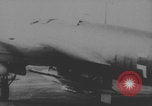
German Heinkel He 111 drops Henschel Hs 293 radio controlled glide bomb during WW2
German Heinkel He 111 on tarmac. Heinkel He 111 in flight drops a Henschel Hs 293 radio controlled glide bomb during World War 2. Camera follows Hs 293 trajectory. Very distant view of another glide bomb being dropped and slowly descending before exploding and bouncing off of water.
German Hs 293 and Hs 294 glide bombs launched during WW2
View of an disassembled R11 260 engine during World War 2. Men assemble the R11 260 engine before hauling it to a Heinkel He 111 bomber. Men attach the R11 260 engine to the bottom of a Henschel Hs 293 glide bomb on the Heinkel He 111. Plane launches the Hs 293 glide bomb, powered by the R11 260 engine. Camera follows the trajectory of the shooting Hs 293 glide bomb before ground target. A different plane launches an Hs 294 glide bomb, also powered by the R11 260 engine.