


 Francais
 Deutsch
 Italiano
Refine Your Search
+"Germany" +1944 stock footage and images
- Showing 61 to 66 of 598 results more
more Hide
Hide
Animation depicts steam generation used to launch V-1 via Walter catapult during WW2
Title card says “Erprobungsstelle der Luftwaffe Karlshagen” (“Test site of the Air Force Karlshagen” in English). “Flakzielgerät 76 Trick 5.1. 1944” (“Anti-aircraft target device 76 trick 5.1.1944” in English). Animation demonstrating how a V-1 rocket, an early cruise missile developed in Germany during World War 2, is launched from a launching catapult ramp. Sectional view of launch ramp, also known as a Walter catapult. Piston for the launch ramp is installed. V-1 rocket is attached to ramp. Cross sectional view of ramp shows hydrogen peroxide (T-Stoff) mixing with sodium permanganate (Z-Stoff) to produce the steam for launch. The steam pushes against the piston to propel V-1 up the ramp. Piston falls away after launch. V-1 animation shows configuration for launch from an airplane. V-1 attached to bottom of plane ready for launch.
V-1 glide bomb catapult and horizontal stabilizer details seen (WW2)
Title card says “Erprobungsstelle der Luftwaffe Karlshagen” (“Test site of the Air Force Karlshagen” in English). “Flakzielgerät 76 Schnittautnahmen 9.2.1944” (“Anti-aircraft target device 76 cut recordings 02/09/1944” in English). Close up rear view of Walter catapult showing piston insertion point at Air Force Karlshagen in Germany during World War II. Rear underside view of V-1 glide bomb horizontal stabilizer, showing elevator actuation.
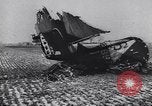
Remains of U.S. 8th Air Force aircraft shot down by German fighter aircraft and flak. U.S.flier POWs during World War II.
Tail and crushed wings of American B-17 bomber, one of several shot down over the Germany-Holland border, during World War 2. Bodies of two U.S. airmen lying on the ground next to the debris. Remains of crashed B-17, Serial number 42-39822, of the U.S. 333rd Bomb Squadron, 94th Bombardment Group, which was shot down by German FW-190s while returning from a mission to Brunswick (Braunschweig), Germany, on January 11, 1944. A fuselage from downed allied warplane being hauled away on a truck. A junkyard filled with American warplane parts, stacked by type, engines in one pile, tails in another, etc. One vertical fin, marked with the 'triangle A' of the 91st Bomb Group, is from B-17G, tail number 42-37737, named "Tennessee Toddy" of the 401st Bomb Squadron. It crash landed after losing two engines, on 10 October 1943, at Brocklanderweg, near Apeldoorn, Holland. Two U.S. Army Air Corps prisoners being interrogated by a German officer. Group of United States airmen prisoners of war, apparently showing personal identifications (dog tags) to a German interrogator.
German war criminals are executed by Allied occupying forces in 1945, in World War 2
View from above, of the surrounding walls and courtyard of a prison in Rheinbach, Germany. Ground view inside the prison yard, where German civilian Matthias Gierens is being escorted to the gallows by U.S. military police, and accompanied by a German Catholic priest, on June 29, 1945. They ascend the gallows and final charges and sentence are read to Gierens. Next scene shows bodies stacked up at the Bergen-Belsen concentration camp operated by Nazi Germany. Scene returns to the gallows, and a hood is placed over Gierens' head. View of Allied army officer witnesses, in formation, at parade rest. Noose is placed over Gierens' hood. View of a a bird flying overhead, trapdoor opens, Gierens drops, and noose tightens. Next is an unrelated scene of several German soldiers being executed. They are seen hanging from four gallows in a line in a public square while a large crowd, possibly Soviet citizens, looks on. (Notes: Regarding the execution of Gierens in the opening scene: German civilian Matthias Gierens was a 37 year old railroad worker. He was executed for the August 15, 1944, murder near Priest, Germany, of a downed American airman, who was later identified as U.S. Army Air Forces 2nd Lieutenant Lester E. Reuss. Gierens and three other German civilians, Peter Kohn, Peter Back, and Matthias Krein, were convicted on June 2, 1945 in Ahrweiler, Germany, of the murder. Their trial was the first Allied trial in Germany of civilians charged with a war crime.)

Representing the life of a typical Japanese soldier and celebrating the defeat of Germany in United States.
Germany and Japan defeated in World War II. The defeat of Germany is celebrated in United States. Scenes represent the life of a typical Japanese soldier: a flag is raised to celebrate his birth; boys in uniform play war; troops sack Nanking; and in1944 he is killed to attack over harbor in America. In a dramatization, a soldier with an American machine gun is killed. Dead Americans. American soldiers honor their dead comrades covered with United States flag.
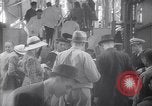
American passengers boarding U.S. Ocean Liner SS Washington shortly before fall of France to Nazi Germany in World War II.
A group of passengers waiting to go on board the American ocean liner SS Washington, standing at the port of Le Verdon Sur Mer, Bordeaux France. Passengers leaving France shortly before its fall to Nazi Germany are shown inspected for passport and searched before boarding. A car being hoisted onto the ship. View of the clock tower and loading areas at the port of Le Verdon Sur Mer (subsequently destroyed by Nazi Germany later in the war, in November 1944). Captain Manning standing on the bridge. View of ship SS Washington pulling away from dock. June 1940.