


 Francais
 Deutsch
 Italiano
Refine Your Search
+"Germany" +1944 stock footage and images
- Showing 73 to 78 of 598 results more
more Hide
Hide
World War 2 battle scenes; wrecked buildings and masses of displaced persons in Europe after World War II.
'Problems of Peace in Europe' produced in 1948, depicts reconstruction problems in aftermath of World War II and includes footage from during the war and soon after the war. Scene of desperate and hungry civilian people (possibly in Germany but could be elsewhere in Europe) scrambling over each other and trying to find food on the ground among garbage or wreckage, circa 1945 or 1946. European peoples massing to reestablish political order and seek relief in post-war Europe. Montage of images of people from all walks of life. Reminders of war showing aircrews in bombers and bombs falling. Batteries of rockets being fired. A formation of U.S. B-17s and a B-26 aircraft with D-day stripes, in flight. Allied bombing of cities with devastating effect (likely 1944-1945). Aerial view of the Statue of Liberty in New York Harbor. Aerial view of a major U.S. industrial complex, with many smoke stacks and industrial pollution. Mass of workers leaving at end of shift at a U.S. manufacturing plant or factory. Views of two different streamlined locomotives pulling passenger trains at high speed, approaching camera position. Freight trains speeding on railroads. Farmers harvesting and baling hay by machine and cultivating fields with tractor. Multiple wide views of the K-25 building of the Oak Ridge Gaseous Diffusion Plant, in Oak Ridge Tennessee, the world's largest building in 1944 when it was built, and an instrumental part of the Manhattan Project effort to develop the atomic bomb in World War 2. Huge sprawling industrial sites in America. Map of Europe. Street scene in Germany with destroyed buildings and rubble cleaned from street, but still piled up in places. Desperate, hungry, and poverty stricken German citizens rummaging through garbage piles for anything to eat or anything of value. Two very young German boys standing together on a street, with one boy smoking a cigarette. Children scrambling over trash and rubbish heaps.
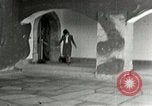
Adolf Hitler's companion Eva Braun, with family and friends, leaving Hitler's mountain residence Berghof in Germany.
Eva Braun’s parents Friedrich Braun (Fritz) and Franziska (Fanny), leaving the Berghof with one of the Scottish terriers. Behind them are their daughters Ilse and Eva Braun with two children of Herta Schneider. The Berghof is camouflaged, implying the footage is from the summer of 1944.
Newsreel depicting victory of Allied military forces capturing German cities and Nazi officials to end World War II.
Newsreel titled 'Allied Drives Split Germany'. Allied troops, tanks and soldiers fight a fierce battle on the streets of Leipzig and gain the control. Allied soldiers seize and guard the radio station in Leipzig. Allied forces win Nuremberg and Braunschweig. Destroyed buildings and houses after the fight. A German commander surrenders to American Major General. Glimpses of Hitler's speech at Nuremberg in 1932. U.S. soldiers atop the same stadium building in 1944. British Army men prisoners liberated and given food and cigarettes. A camp near river Rhine where German prisoners are released and Nazi army officers surrender. German Generals arrested by the Allied Forces. Soldiers of the 3rd Army explore stashed gold and currency reserves of Germany hidden in a salt mine. They also recover stolen art and classic paintings from German museums. Civilians registered by Allied military officials. A crowd in market hears suspension of Nazi government. Nazi army uniforms, arms, caps and badges in a stack to be destroyed. A map showing German-Russian frontier. Russian tanks rushing into German borders after bombing their bases. Tanks advance between destroyed houses, rising smoke and explosion from fights. U.S. and British forces bombing Magdeburg on the Elba river.
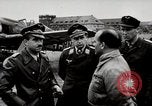
General Adolf Galland with fellow pilots and Fw 190 design team officials at air base in Berlin-Staaken, Germany.
German Ace pilot and General of the German Air force Adolf Galland also called General Der Jagdfleiger visits fellow pilots and Fw 190 design team officials at German AFB. Galland, Streib, and Trautloft are seen inspecting the latest Focke Wulf 190 developments as guests of the design team. Prof. Tank is seen with his assistant Obering. Also seen are Willi Kaether, chief test pilot Hans Sander, and test pilot Alfred Thomas who was later killed testing the Ta 152 H. General inspects telemetry documents of Focke Wulf Fw-190 fighter. Pilots demonstrate capabilities of Fw-190's. General enters inside Fw-190 and takes off. Clip shows another scene where General Galland is welcomed by German pilots and Air force officials at a function. Timing and location of the footage can be determined through review of flight test reports of the Ta 154 A-0, Werknummer 0014, TQ+XD glimpsed briefly in the footage and the Fw 190 V17/U1, an airframe that served as a Fw 190 D-9 prototype -- Galland made flights in both these aircraft on 2 June 1944 in Berlin-Staaken. The first aircraft seen in the footage is Fw 190 A-8, Werknummer 174 014, BH+RN. The camera pans to Galland pulling on his parachute pack in front of Fw 190 V17/U1, CF+OX -- the ‘O’ of the code can be made out, and reveals for the first time elements of the changes made to the airframe in modifying it into Fw 190 D-9 configuration. There then follows a short clip of the V17/U1 in the air. Galland´s flight appears in the flight testing log of the V17/U1. There are brief views of the Ta 154 in the clip showing the forward fuselage and the open canopy. Streib also flew the Ta 154 in Staaken.
Preparations in England for the D-Day invasion of Normandy in World War II
World War 2 invasion of Normandy, France. President Franklin D. Roosevelt, Marshal Joseph Stalin, and Prime Minister Churchill, meeting at Tehran, Iran, in December 1943. U.S. Generals George Marshall and Hap Arnold, at conference table. Closeup of General Dwight D. Eisenhower. Map showing defense areas of the German 7th, 15th and 19th Armies in Europe. Map showing ports at Brest, Cherbourg, Le Havre, Dieppe, and Calais. Cherbourg is highlighted. U.S. Army trucks, tanks, and artillery, stockpiled in England. Railroad train carrying M3 Stuart tanks. U.S soldiers leaving troop ships and marching to their camps in Britain. Allied troops practicing amphibious assaults on Southern coast of England. Formation of B-26 bombers. View from Allied aircraft flying low over German-occupied area. B-17 aircraft dropping bombs over Germany. Bombs away view seen as bombs drop toward enemy targets. German fighter planes attacking B-17 bombers beginning in February 1944. Gunner in turret of B-17 firing at them. Dogfight views with German fighter aircraft. A B-17 exploding in the air. German fighter downed by B-17 gunner. Gun camera footage of German Bf 109 attacked from rear by gunfire. Just as it is hit it releases its drop tank. American soldiers in trucks, DUKWs, M4 tanks, and M8 armored Cars. Troops receive gas masks, waist life belts, field rations, and French money. May 30, 1944, American soldiers board tanks, trucks and other vehicles bound for embarkation points in England. Seen are Stuart M3 light tanks, jeeps, and M7 Priest tanks. M7 tanks are seen, equipped with intake and exhaust ducts. (At TC:11:39, U.S. M7 Priest tanks, equipped for deep wading, are seen passing the base of the Jubilee clock on the beachfront at Weymouth, on their way toward Castle Town in Portland for embarkation.) Transport ships are loaded at the embarkation ports. Trucks being backed onto LCT-453. U.S. Army infantry marching and boarding transport ships. Troops marching into LST 376 at Plymouth, England. Higgins Boats, from the USS Samuel Chase (APA-26) bringing troops to board her. Troops on deck of Attack transport, USS Joseph T. Dickman (APA-13). Barrage balloons overhead. Soldiers shooting craps on a troop ship deck. Coastguardsmen playing with a puppy dog. Gun crews on U.S. Navy warship being briefed. Soldiers field-strip and check their weapons.

United States Army Air Corps film "The Truth About Ploesti."
Formations of B-24 Liberator bombers are seen in flight, headed for Ploesti, Romania, on August 1, 1943, during World War 2. Next, vertical columns of bombs are seen falling from the planes. Animated map of Europe shows Romania and Ploesti. It show paths of oil from the Ploesti oil fields to Germany. (Narrator states Ploesti provides 30% of Axis oil.) Map show path of 9th Air Force bombers from Libya to the Ploesti oil fields. Scenes shift to captured German films from 1944, showing the fires and destruction resulting from the constant B-24 raids. Huge black clouds rise from the area. Firefighters rush to combat flames. They direct streams of water on the conflagrations. (Commenter states: "Delayed action bombs prevented firefighters from rushing in, until too late.") Nighttime views of large fires and heavy smoke from 6 of Ploesti's 7 refineries ripped wide open. Film advances to August, 1944, showing Ploesti with the fires out, following Rumania's capitulation. Next, with some fires still burning, King Michael I of Romania, tours the site with military officers. They walk amidst the debris. Smoke rising near a rail marshaling yard. Against a background of dense smoke rising, a Slate is displayed showing the cost to the United States of the Ploesti raids, as 300 bombers and 3000 American airmen were lost.