


 Francais
 Deutsch
 Italiano
Refine Your Search
+"Germany" +1944 stock footage and images
- Showing 379 to 384 of 598 results more
more Hide
Hide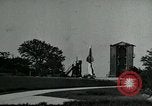
Following test launch, a German Wasserfall missile crashes in wooded area of Greifswalder Oie, Germany during World War I
German Wasserfall missile (Wasserfall Ferngelenkte Flakrakete), a surface to air missile being test fired at the island of Greifswalder Oie, Germany during World War II. Wasserfall missile on a launch pad near a hangar. Missile lifts off emitting a fiery flare. Missile circles and descends. Missile crashes into a wooded area.
A-20 "Boston bombers" and B-25 bombers with other heavy bombers attack German-occupied Northern France and Wuppertal Germany
Bombing campaigns in German-occupied Northern France and in Wuppertal, Germany. Two aviators from free French squadrons stationed in England climb into A-20 "Boston Bombers". View of bombers in flight low over water and then over towns of northern France. A-20s along with B-25 bombers bomb industrial areas over northern France. Views of smoke clouds, destroyed targets and impact of bombing. Dutch squadrons in B-25 aircraft attacking Nazi harbor installations. Aerial view of Wuppertal Germany being bombed at night. (World War II period).
General Patton's 3rd Army moves towards Germany and fights the Battle of Bulge during World War II.
U.S. 3rd Army under Lieutenant General Patton in World War 2. Tanks roll down. U.S. Army soldiers and tanks of the 3rd Army move forward. General Patton looks through binoculars. Patton with other officers. Soldiers fire artillery. A soldier talks into a radio. Patton's troops move forward. Enemy soldiers surrender. Tanks and troops move forward. Soldiers aim and fire. Soldiers in the streets of Saint Malo. German soldiers taken as prisoners of war (POW). Civilians cheer and welcome the American troops. Soldier drinks from cups. A sign reads 'Mayenne'. Troops move towards Germany fighting on their way. Soldiers move through the forest terrain. Patton with his officers. The 3rd Army crosses river Siene. Patton in an aircraft. The planes of the 8th Army Air Force drop bombs on the enemy positions. Tanks fire artillery. Patton with soldiers. Trucks move forward. Headlights of trucks moving forward at the night. Patton comes out of a building and sits in a jeep. Army officers including General Eisenhower and Patton have dinner. Patton with soldiers. Soldiers of the 3rd Army load and fire artillery and capture Metz. Fighting house to house and in the streets of Metz. Dead soldiers lay on the ground. German soldiers taken as prisoners of war. American flag is raised. The battle of Bulge- Soldiers on the snow covered terrain of Ardennes. Patton's 3rd Army moves toward Bastogne. U.S. Army soldiers remove snow from ground in the icy winds. A soldier looks up into the clear sky after snow storms have passed. Aerial view of U.S. Army Air Force Mitchell B-25 bomber aircraft in formation and bombs away views as they drop bombs on snow covered German held positions below. U.S. Army tanks firing at German enemy positions. close up views and point of view shots of American soldiers firing rifles and machine guns. German prisoners are rounded up by U.S. Army, including some German soldiers wounded and bandaged. Patton decorates soldiers at a bridge over the Sauer River. in Germany, where a sign says "General Patton Bridge - built by the Mighty Midgets. Company F, 1303 Engineers" (Narrator in clip is Ronald Reagan).
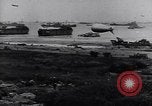
WW2 German defensive preparations on French coast; Allied invasion scenes; Allied bombing over Germany
Slave laborers digging during the construction of the Atlantic Wall in World War II. German engineers oversee the construction. Men working around a large gun turret. Nazi German fortifications, bunkers, and artillery posts along coasts facing the Atlantic Ocean in Europe. The 380 mm gun at the Todt Battery near Cape Gris-Nez, Pas de Calais, France. 40.6 cm SK C/34 gun “Battery Lindemann” (German unit MKB 6 / MAA 244) as part of the Dover Strait coastal guns. German emplacements and troops marching along Normandy in France. A German soldier uses binoculars to watch the English Channel. Adolf Hitler and a Nazi German general. Adolf Hitler greets Benito Mussolini as the latter exits a plane in Vichy France. Allied leaders Winston Churchill, Franklin Roosevelt, Joseph Stalin, and General George C. Marshall at the Tehran Conference in 1943 during World War 2. Armies from various European countries march and prepare themselves for war against Germany. Supreme Commander General Eisenhower and other Allied generals during a meeting. Fleet of ships in sea ready to land in Normandy on D-Day. Navy and coastal command aircraft drop bombs on Nazi German submarines. Anti-aircraft guns fire at Nazi bombers. Docks damaged by German bombing receive aid from Allied countries. Cranes and hooks lower relief supplies, medicines and warfare material at dock. Warships loaded with artillery and warplanes lowered in ships by hoists. A locomotive train is being lowered from a ship. A military band plays music in a dock. Soldiers move towards the ships. British and Royal Canadian and Australian bombers at their base take off for bombing on Nazi bases at night. A soldier directs a bomber taxiing in runway. Aerial views of British bomber aircraft bombing targets in Germany at night, with immense explosions.
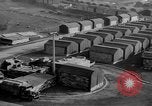
U.S. Army forces build up supplies and advance positions in preparation for invasion of Germany during World War 2
Activities of American first Army in Germany. Aerial and ground views of an Allied supply depot at Liege, Belgium. U.S. Army soldiers arrange supply boxes. Signal Corps engineers work on readying communication lines from the rear to the front and are seen stringing communication lines and preparing communication hubs. New transmission equipment of various kinds are received and installed for news. U.S. Army engineers supervise steel manufacture and sawmill operation in Luxembourg at a protected steel works facility that was taken over by the Allied Supreme Command. U.S. Army Corps of Engineers personnel walk on finished steel beams and check them before shipment front. Plank boards are cut and stacked for use in road projects. U.S. engineers repair a bridge over the Meuse in Belgium that had been damaged in the Battle of Belgium. Train crosses a repaired bridge over the Meuse, and U.S. military and civilian pedestrian traffic seen on the bridge road. Track connectors are installed to better grip in mud and allow passage of Allied tanks and tracked vehicles. Aerial view of Siegfried line and Dragons Teeth. U.S. forces seen using a tank bulldozer and mud to effectively bury Dragon's Teeth tank traps to allow passage through the Siegfried Line. Allied trucks and vehicles are repaired. A convoy of Allied supply trucks passes by through a snowy landscape bringing supplies to the front in preparation for invasion into Germany.
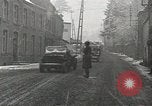
United States 1st Infantry Division soldiers cross the Ramegan bridge and enter into Germany during World War II.
The role of United States 1st Infantry Division in various campaigns during World War II. United States 1st Infantry Division men cross the Ludendorfff bridge at Remagen, over river Rhine in Germany. Smoke rises from the banks of the river. American soldiers move across Germany and enter Czechoslovakia. Closeup of faces of war weary United States Army infantrymen shown. A U.S, Army soldier sleeps.