


 Francais
 Deutsch
 Italiano
Refine Your Search
+"Germany" +1944 stock footage and images
- Showing 385 to 390 of 598 results more
more Hide
Hide
Ralph Heinzen gives an intelligent analysis of internal conditions in Germany as SS Gripsholm arrives in New York (WW2)
SS Gripsholm (Ship) arrives in New York, United States in World War II. Cameramen take photos as SS Gripsholm as it arrives at New York harbor. The rails are crowded with Americans. She docks at Pier F in Jersey City and ambulances roll away with wounded soldiers. Six hundred and sixty-two repatriates from German internment camps come ashore. S. Pinckney Tuck, excharge d'affairs in Vichy seen. Douglas MacArthur (General Douglas MacArthur's nephew), approaches with his dog. Passengers are happy to come in home. Ralph Heinzen of the United Press gives an intelligent analysis of internal conditions in Germany today. Stalingrad was the turning point, he states. Germany began losing the war with that defeat and Hitler started losing prestige.
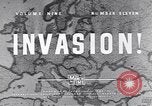
News media military analysts discuss the problems of Allies invading Europe to defeat Germany in World War II
Map of Europe and label "Invasion." Westbrook Van Voorhis leading a panel discussion about the problems arising from the Allied invasion of Europe in World War 2. He introduces panelists: Hanson Baldwin (military editor of the New York Times) Dewitt MacKenzie (Associated Press military analyst), and Paul Schubert (of Mutual Radio Network). He asks Mr. Baldwin about the importance of aerial bombing campaigns. Baldwin also stresses importance of a land invasion of Europe. Relief map of Europe highlighting major German cities. Asked about the merit of invading Italy on the way to Germany, Mr. Schubert cites the problem of the Alps and suggests other more effective invasion routes. Van Voorhis asks Mr. MacKenzie about best route into fortress Germany. He considers the criterion of ease of supply as most important, and suggests the Atlantic coast, near a good port and not far from England. Animated map shows this idea. When asked about this, Mr. Baldwin agrees completely, calling the conflict "a quartermaster's war." He adds, "The problem of victory is the problem of supply."
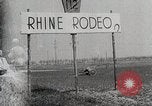
U.S. troops put on a rodeo that entertains themselves and local German citizenry during World War II
American troops take time out during advance into Germany during World War 2. Sign erected by American soldiers, in a field in Germany, reads: "Rhine Rodeo." What appears to be a sign for highway "112" is behind and an artillery piece sits in field in background. Two U.S. soldiers in top hats laugh as they watch others, who appear to be experienced cowboys, take turns in bronco busting and other rodeo events. Local German civilians and youth watch events from the side of the field. U.S. troops seen moving on further into Germany.
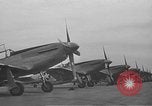
P-51 Mustangs and B-17 Flying Fortress planes attack German aircraft plants during World War II.
U.S. Army Air Force bombers attack Germany during World War II. View of U.S. P-51 Mustang aircraft in flight line at U.S. Air Base in England, United Kingdom. Aerial views of a formation of B-17 Flying Fortress planes and P-51 aircraft in flight over Germany. Bombs fall on German aircraft plants. Ruins of German aircraft plants after facing the bombings. Scene changes to show German war production workers building new Focke-Wulf aircraft (e.g., Fw 190) at production factory in Germany.

Red cross volunteers pack red cross parcels for prisoners American imprisoned in Germany (WW2)
Red Cross volunteers pack Red Cross parcels for American prisoners imprisoned in Germany during World War II. Parcels include food cans, cheese, cocoa powder, box of Jack Frost, box of raisins, cream, cigarettes, biscuits, Milkao milk. Stacks of soap bars and multi vitamin tablets for Allied prisoners. Red Cross parcels move through conveyer belt into a truck.
Allied aircrafts and artillery attack enemy targets in Germany and Italy during World War 2
A film titled 'Allied drive on Italy, planes smash foe in air' shows Allied aircrafts escorted by fighter planes bomb rail junctions in Germany during World War II. Bomb explosion causes pillars of smoke to rise upwards. Nazi airplanes being shot down by Allied aircrafts. Blazing German planes descend. A map shows Allied invasion of Italy. Allied infantry units move forward in Italy amidst heavy firing. General Clark and General Alexander lead the units. Soldiers fight in the streets.