


 Francais
 Deutsch
 Italiano
Refine Your Search
+"Germany" +1948 stock footage and images
- Showing 1 to 6 of 52 results more
more Hide
Hide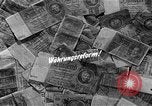
German citizens exchange old currency for new in German Currency Reform of 1948.
German citizens exchange old money for new money in Germany during Currency Reform of 1948. Pedestrian walk on a street in the rain. Crowded street cars in the background. People look at Münchner Merkur newspaper and posters in Munich announcing the currency exchange. People wait in line to get Deutschmark for old Reichmark. Various closed storefronts in a German city. The crowd assembles in a street waiting to get the new currency. Crowds in front of the main railroad station in Frankfurt. Newspapers being unloaded from printing presses of Münchner Merkur newspaper production plant after workers change type casts. Printed newspapers being stacked. People in Odeonsplatz in Munich rush after a newspaper truck to get the latest news on the money change. German people standing and seated reading the newspapers. Boxes with Deutsche Marks are stacked in banks and checked. Packages of newly printed currency on a counter. Money bags sealed and loaded into a bus. View of Marienplatz town square in Munich. Long lines of people carrying umbrellas stand in rain waiting to exchange money. The money being transferred and exchanged. People sign papers after the exchange. Old money dropped into a wooden box. People comparing the new with the old currency. A man changing prices in store windows. Merchants arranging goods for display in previously empty shop windows (due to prevalence of black market before the reform). Ober Director Dr. Puender speaks on the money reform.
United States and Russian troops in Germany after World war 2; division of West Germany and East Germany
Bomb damaged and ruined buildings of Nazi Germany in 1945, including the Reichstag. Nazi Eagle symbol of Third Reich pulled down from building and crashes to the ground at end of World War 2. United States Army of occupation marches into city as German population lines sidewalks and watches them parade. Sign on a shop reads "Gaststatte Schosser." Many buildings in view are damaged or destroyed from bomb attacks during World War 2. American soldiers occupying German give candy to German children who at first hide from them. Nazi leaders including Hermann Göring, Rudolf Hess, Joachim von Ribbentrop, and Wilhelm Keitel, seen on trial in the Nuremberg war crimes trials. German people struggling to rebuild. women and children trying to gather wood from stumps of trees for fuel. A woman sawing a log. Women and children scraping food from inside trash cans and refuse bins, to stay alive during scarcity and shortages after the war. Americans providing food assistance and feeding German children in relief lines. Close up of a smiling boy as he receives food or drink. Soviet Russian Army soldiers occupying East Berlin and marching in formation. Russians removing an industrial lathe and other machinery and tools from Germany as the Soviet Union continues to strip Germany of resources after the war. A map of Germany and Berlin seen with divided regions as American, British, French and Soviet zones. Views of empty streets and heavily damaged buildings of Berlin after the end of the war. Children play amidst the desolation and destruction in East Berlin. View of Kammergericht, Headquarters of the Allied Control Council. Leaders seen meeting inside include American General Joseph T. McNarney, French General Marie Pierre Kœnig (Marie-Pierre Koenig), Soviet General Georgy Konstantinovich Zhukov,. British Field Marshal Bernard Law Montgomery. View of Spandau Prison guarded by troops of occupying powers. Soviet and American troops drill and march on the grounds of Spandau Prison. An American soldier relieves a Soviet soldier at a watch post. Soviet blockade of West Berlin begins in June 1948. View of a man shutting down power in a power plant and lights going dark in Berlin. Blackout conditions in Berlin during the blockade. Germans plant vegetables in city to survive. Germans exchange goods in black market setting. A man plants vegetables in view of the Brandenburg Gate. The Berlin Airlift operations underway. U.S. Air Force C-54 aircraft flying low and arriving in Berlin, bringing supplies to West Berlin. C-97 landing. U.S. military forces unloading relief supplies and food from airlift aircraft. American C-47s and C-54s in the Berlin Airlift. Soap and milk being unloaded from airplanes. German children gather on a hill and watch low-flying American airlift planes as they approach to land at Tempelhof Aerodrome in Berlin. An Air Force airman throws a package out of the aircraft. It is a very small parachute with candy that drops from the American airplane to the waiting children. Children run to retrieve it and they share and eat the candy. Blockade is lifted in 1949 and rebuilding of West Berlin resumes. View of railroad tracks being re-linked, a locomotive running on tracks, and trains cross between East and West Berlin. Ships loading goods onto trains for Berlin. A coal processing factory running again in Germany. German workers producing industrial parts and goods again in production factories. West German construction workers rebuilding structures in West Germany. German people cast votes, establishing Federated German Republic (West Germany). Figures seen include U.S. General Alfred B. Gruenther with Konrad Adenauer, President of the new German Republic, together in Bonn, Germany. Soviet Russian troops marching on parade in East Germany. East German workers rioting in 1953, in protest of increased production quotas in Communist controlled East Germany. Soviet forces in armored vehicles patrol the streets and disperse the crowd. A large electronic billboard banner flashes West German messages and propaganda to those who can view it in East Berlin. Citizen refugees from East Germany arriving in a processing center in West Germany, carrying bags and luggage. East German refugees laying on the ground on blankets in a crowded immigration processing center of West Germany. A woman irons clothes in the immigration center, while a child plays with dolls.
United States Army Air Forces conduct an airlift that enables Berlin to survive in spite of a of Soviet blockade in post World War II Germany
Film begins showing ruins of the Bundestag in Berlin, in June, 1948. A tram rides along a street headed toward a tunnel through a destroyed building. Berliners walk about and eat at outdoor tables, enjoying the pleasant weather. On June 26, 1948, the Soviets established a blockade of West Berlin. View of Soviet soldiers in a line at a square in the city. A manufacturing business is seen being adversely affected by the blockade through denial of coal to generate electricity for it. The employees cover the company's equipment and close the business. People jam a corner store fearing a food shortage. Crowds mingle outside the main buildings of the Templehof airdrome. Some men hold a German newspaper announcing Allied intent to supply West Berlin by air. View of an American Army Air Forces C-47 transport plane landing at Templehof. A number of C-47s lined in a circle at the airport field as large trucks offload their cargoes. C-47 taxiing into position. German men climb aboard an open bus to start work at jobs unloading supplies from the aircraft. Views of the men busy with their labors. Glimpse of a "follow me" jeep leading a just landed aircraft to its parking place at night. Images of the workers dimly seen in the semi dark. View of the circular Templehof buildings. A truckload of German workers being carried to their work places. American pilots entering Base operations at Temlehof. Pilots inside Base operations, taking a break while their C-47 is being unloaded. They head out to their airplane to fly back to Frankfurt, Germany for another load of cargo. The climb aboard through the plane's side door. View of C-47 flying with clouds in the background along the Berlin Corridor. Ambulance seen responding to an Airlift aircraft crash. View of aircraft wreckage in a city. It is up side down with landing gear pointing skyward. The wreckage being carted away on a flat bed truck. German citizens gathered in front of a memorial plaque they had put in place. An Army Air Forces Lieutenant and another C-47 pilot look up as the board their plane to watch a four engine C54 transport plane coming in to land. Several views of C-54 transport aircraft in flight overhead. Airlift pilots are seen in a briefing room. Animated map shows Berlin as an "island" in the Soviet zone of occupation, accessible only by three 20mile wide air corridors. Several air bases in the Western zones are shown. Map shows Berlin's three airfields, Templehof, Tegel, and Gatow in the Western sectors, surrounded by a ring of Soviet fields. A line of American C-47s is shown on the map, flying from Wiesbaden airdrome, along a corridor to Berlin, from 9:30 AM until 11:30 AM. At 12:00 Noon the C-54s began flying from Rhein Main air base. At 3:00 PM the C-54s stopped and the C-47s began again. Illustration shows how the aircraft were separated by three minute intervals and a thousand feet in altitude. Closeup of a C-54 pilot in his cockpit as he starts his engines. The plane has "The Air Transport Command" written on its side. Inside the C-54 the flight engineer is seen at his panel performing engine start at the direction of the Aircraft Commander Pilot. View of the pilot in the cockpit and his instrument panel. The aircraft taking off. Views of cargo handling on the ground. Trucks carrying the cargoes to places they are needed in the city. Bread being baked for Berliners. Coal being unloaded from rail cars after being flown into the city, A crane operates in a Western sector coal yard. Smoke rising from some of the restarted factories. German employees punch a time clock. Doctors examine school age children. View of street cars operating on power generated by burning coal. Commercial vehicles operating on airlifted gasoline. Darkness due to power saving at night. But people arriving in the city by subway in the morning. Glimpse of C-54 overhead. Food being prepared and sold in shops. People patronizing a news stand. The damaged Kaiser Wilhelm Memorial Church, with C-54 in flight in far distant background. German workers sweeping the airfield ramp. An officer from Base operations arrives in a jeep to debrief a C-54 crew as a truckload of German workers pulls up to begin unloading their cargo. Crew members get food from a mobile snack bar the meets their airplane. A German worker who knew a pilot gives him a gift of a wind up musical Steiff bear for his child. The two pilots begin dancing to the toy bear's tune. The pilot places the toy bear next to the window in his cockpit. Back home, near Frankfurt, the pilot greets his wife, baby and school age daughter, whom he gives the toy bear. The next day, the pilot walks to the rear of his aircraft while en route to Berlin. He throws little parachutes of candy out a window for the children of Berlin below. Views of the parachutes descending and children rushing to retrieve and unwrap them.
Scenes of Berlin divided by newly built Berlin Wall; Unrest in the years after division into East and West Berlin, Germany
The divided city of Berlin, Germany caused by the erection of the Berlin Wall. Shows early scenes of the Berlin Wall being built. Opening scene shows camera pan from Brandenburg Gate down to street level where East German construction workers are using a jack hammer and hand digging a trench across the middle of the street to serve as foundation for the Berlin Wall. A Soviet guard watches over the construction workers. East Germans and Soviet Russians walking with a spool of razor wire, putting up barbed wire barricades along other sections of the dividing border. German citizens gathered along the wall as it is built in a field area. Several young men in suits being pushed and harassed by a guard on the East German side of the Berlin Wall. View of a railroad train track that has been cut, and workers digging a deep trench at the site to build the wall right through the run of railroad track. East German refugees walking through a checkpoint area, desperate to leave east Germany before total closure of the border occurred. Refugees gathered in crowded shelters with mattresses on the ground. Young German children and babies sleeping on mats. Views of barbed wire crossing railroad track runs. Animated map showing routing of aircraft for the Berlin Airlift in response to the Berlin Blockade by the Soviet Union in 1948. Views of various aircraft flying overhead, bringing supplies to citizens during the blockade. Relief supplies and food being unloaded at airport for citizens. People waving white handkerchiefs in the air to express thanks as a Berlin Airlift airplane passes overhead. Scene changes to 1953 riots on the streets of East Berlin, Germany, with crowds of protestors throwing rocks at a Soviet tank and views of a building on fire with smoke pouring from its windows. Next scenes show West Berlin scenes as a juxtoposition of the East Germany scenes. Views of successful German industry and commerce in West Berlin. People working in West Berlin. Newly built tall buildings in West Berlin. German people shop in stores. A boy adds a bar of chocolate to a shopping basket. Men working in large industrial plants and factories. Large Siemens equipment in use in an electrical transmission component factory. A scientist or engineer looking through a microscope like device.
Czechoslovak coup with Communists coming to power; anti-Communist demonstrations in various European nations over 10 years
U.S. propaganda piece about threats by communists against various European countries. The Czechoslovak coup and demonstrations. Czech citizens moving on a street in Czechoslovakia during a strike forcing conservative elements to resign from the cabinet. Scenes of police brutality and beatings against strikers. Communists take over the police. Czech President Edvard Benes with conservative politicians in a government building. Huge crowd on a street. Police clashing with crowd. Czech Prime Minister Klement Gottwald with officials. President Edvard Benes, facing possible civil war or invasion by the Soviet Union, accepts a Communist cabinet. He is seen signing documents to that effect on February 25, 1948. Other officials beside President Benes during the signing. View of the first President of Czechoslovakia Tomas Masaryk's son, Jan Masaryk, who remained the Foreign Minister, and did not agree to the new government. Two days later Jan Masaryk is discovered dead. The body of Jan Masaryk in a coffin. Edvard Benes, who resigned in June 1948 after refusing to sign the communist constitution, is seen walking slowly outside the Parliament using a cane. A guard saluting Benes. View of the body of Edvard Benes, who died in September 1948, laying in a coffin. Mourning citizens offering flowers and cry. Officials bearing the coffin. Shift several years later to street strikes in East Germany in 1953. People during a strike and riot in Poland in 1956. Russian tanks moving on a street and Soviet soldiers are seen. Elevated view of panic and Polish citizens fleeing soldiers. October 1956: Student demonstrators on street in Budapest Hungary during the Hungarian Uprising of 1956. Soviet Russian red star is toppled by crowds from a building roof in a sign of defiance. Russian troops respond with tanks on the streets in Hungary. Crowd fights back. Russians retreat. Crowd overwhelms local police. Imre Nagy, Prime Minister of Hungary, ascends steps. Hungarian crowd on streets burn communist books and papers. Russian tanks invade Hungary to crush revolt. Tanks fire guns on Hungarian street. Imre Nagy's execution announced June 17, 1958.
Evacuation of Shanghai as Red Chinese advance; Communist rallies in Italy, East Germany; Riots in Bogota
Refugees and foreigners fleeing conflict and unrest head to Shanghai as the Communist Chinese Army advances, challenging those loyal to Nationalist China. An Orthodox priest looks at an infant carried by a European woman. Many people are screened before boarding the USS General W.H. Gordon (AP-117) to evacuate. Two Roman Catholic nuns board the ship. The ship departs from Shanghai. Scene shifts to view of Communists on parade in Rome, Italy and assemble at event overseen by Communist leader Palmiro Togliatti. Crowds of communist Italians gathered at the Stadio dei Marmi (Viale dello Stadio dei Marmi, 00135 Roma RM, Italy). In East Germany a large poster showing Soviet leader Joseph Stalin. Speakers at rally of East German FDGB (Freier Deutscher Gewerkshaftsbund) which is the Free German Trade Union Federation. Rioting and destruction in riots in Bogota, Colombia, after 1948 assassination of Jorge Eliécer Gaitán. Crowds of Colombian protestors overturn cars and burn cars and streetcars. Protestors through files of paperwork out of windows of a government building during unrest.