


 Francais
 Deutsch
 Italiano
Refine Your Search
+"Germany" +1948 stock footage and images
- Showing 13 to 18 of 52 results more
more Hide
Hide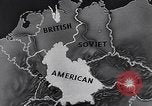
Military and German Police try to stop gun runners and black marketing and conduct free elections in Germany after World War 2
A map shows the United States, British and Soviet occupied zones in Germany after World War II. American and French police checks papers and belongings of Germans entering their zone. They chase and capture a gun runner car and remove a weapon from the back seat. Scene in a building depicts young Nazi die hard followers in a "werewolf gang" meeting in secret to plot how to continue Nazi Germany. German civilians gathered exchanging items in black market activity. U.S. occupation soldiers sell cigarettes in black market to German civilians. German police raid a black market exchange area and arrest many German citizens, rounding them up and loading them onto a truck. A captured German woman cyring. German de-nazification trials at a court in session. At a news conference, U.S. Army General Lucius D. Clay speaks about measures to build democratic processes in Germany, starting with local elections. A leader speaks at a political party meeting. German civilians vote at first free elections after World War II. A German man acts with servility before a U.S. officer and looks vindictively in direction of officer after leaving his room. Narrator describes German people post-war as egotistical people.
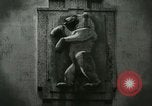
Berlin Germany in the first hundred days of Soviet Blockade during the Cold War
Film opens showing Russian Bear covered by iron gate and slate reading 100 days Blockade. Camera pans over war-damaged areas of the city of Berlin, Germany. Narrator refers to the Berlin Airlift by the Allies and the Berlin residents not giving up. Views of several buildings undamaged by World War 2, including Kammergericht, the Headquarters of the Allied Control Council. Streets crowded by pedestrians going about ordinary business in Berlin. Among them is seen a German soldier, missing a leg and using a crutch. Some Berlin industry activity is seen in a factory where welders are at work. Blockade fences are seen separating the Soviet zone of east Berlin from the allied sectors of West Berlin. Trams are seen that cannot travel between the zones. A person trying to use a gas stove to cook, but has no gas pressure. The city grows dark at night due to electricity shortages, resulting in blackout conditions. Berliners trying to manage simple things at home such as exercising on a fixed bicycle. A man planting a garden in sight of the Brandenburg Gate, at the boundary of the Soviet zone. A police officer using a radio in an automobile in the free part of the city. View of the City Council meeting in West Berlin. This is contrasted with view of East Berlin where members of the Socialist Unity Party of Germany (SED) backed by the Soviet authorities are seen meeting in a separate city council of East Berlin, not long before the formal founding of East Germany in 1949. Next, Dr Ferdinand Friedensburg, Mayor of West Berlin, addresses the West Berlin City Council.
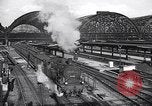
Repair of wrecked railroads, power plants, factories and coal mines at Ruhr Valley in Germany after World War II.
Wrecked railroads, Coal mines, power plants and factories being rebuilt and rehabilitated in Germany after World War 2. Railroad trains moving on tracks in Germany soon after World War 2. German civilian workers repair rails and tracks destroyed by Allied bombers. German workers in a tire factory build railway and automobile tires, in Munich. Trucks manufactured at a truck factory drive out of the factory. People lined to see some of the items produced for export. British occupied Ruhr Valley. Wrecked Krupp factories in Ruhr Valley. A German steel smelting plant in operation, workers pour molten steel. Coal cars leave Ruhr Valley. Animated charts show production and export of coal during 1937 and 1946. German miners enter and leave mines. Miners eat and take half of their food out to German children.
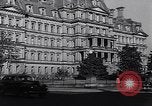
British, Soviet and U.S. officials meet and discuss industrial, agricultural and civil rebuilding of Germany after World War II.
Industrial, agricultural and civil rebuilding of Germany after World War II. State Department building in Washington DC. Secretory of States, James F. Byrnes dictates to secretary. General Luicius D Clay speaks to the members of British Occupational government. Ernest Bevin, Vyacheslav Molotov and James F. Byrnes pose for a group photograph. German farmers in an agricultural field. Men and woman plow farm by horse cart. Worker watches a factory kiln with molten metal. Cavaliers of American Military Police on horse back patrol on the streets in Germany with a destroyed cathedral in the background. They cross a bridge with sign Herkules Bridge. German workers make farm equipment and a German family with young children eats a meal.
Life of the poor German civilians,black market dealers and ex Nazi party members in Germany after World War II.
Activities of German civilians in Germany after World War II. American troops aboard a ship underway at sea. U.S. soldiers read,write letters,relax and play cards. Three soldiers discuss the amount of money spent on Germany and its black market. Damaged ships docked in a harbor. German civilians walk along streets. Damaged buildings in the background. German women cut trees for fuel. Woman cooks food and family members eat. Poor civilians stand in bread lines on streets. Civilians stop and watch at store windows on streets. Models pose in different outfits at a fashion show. Black market dealers and ex Nazi party members attend the show. Woman purchases an expensive hat. View of beautiful houses maintained by former Nazi party members. Black marketer sells soap and coffee to a housewife.
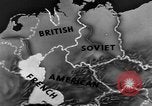
Marshal of France Alphonse Pierre Juin and staff at a conference in Germany after World War II.
French officers in Germany after World War II. Animated map focuses on French Zone of Germany. German countryside: Potsdam streets. Marshal of France Alphonse Pierre Juin and staff at a conference. German prisoners march out of courtyard and stand alongside their cells. French officers inspect the area.