


 Francais
 Deutsch
 Italiano
Refine Your Search
+"India" +1944 stock footage and images
- Showing 31 to 36 of 73 results more
more Hide
Hide
Indian people seated outside huts and working in Assam, India.
A training film on life of people of India during World War II. People walking across a field. Huts in the area. People seated outside the huts and working. A woman working and children sitting nearby.
Soldiers aboard a jeep moving along an area and are taught the use of parachutes in Assam, India.
A training film on life of people of India during World War II. Soldiers aboard a jeep moving across a field. Soldiers seated on the ground around a crate. They hold beer bottles in hands. They are taught the use of parachutes. Men on elephants moving along the area.
U.S. Lieutenant General Daniel Sultan explains Japanese aggression in China and need for troops in India and Burma during WW2
World War II film about the China, Burma, India (CBI) Theater of Operations. A soldier is seen filling out a form seeking information about him and inviting him to write in questions about anything he hadn't learned through normal information channels. Scene shifts to Information and Education Department of the Burma-India Command, where it is being processed by a soldier. Lieutenant General Dan I. Sultan, commander of Burma-India Theater, is seen next, seated at a desk, with wall map of the region behind him. He is appearing in an information film intended to inform troops under his command. He notes that more than half the troops who filled out the information form, asked why American troops were stationed in India and Burma. He refers to the recent recall of General Stillwell and the splitting of CBI into two theaters (China and India/Burma). He states that the purpose is a path toward Japan. An animated map shows China (that narrator notes has been fighting Japan since 1937). Animation shows Japan walling off China from the outside world, by seizing her ports, and then concentrating its grip on the Eastern part of the country. Without access by sea, the allies had only one option to assist China in the fight against Japan. That was to open the Burma Road. Film shifts to scenes of Japanese bombing of Shanghai and Chinese civilians abandoning the city in 1937 during Second Sino-Japanese War. Wounded and injured Chinese fighting fires while tending casualties in an open area. Glimpse of Chinese soldiers near one of their few large artillery pieces. A gun crew manning one of her few antiaircraft guns. Chinese jam road in trek to the unoccupied provinces of the country. Chinese carrying casualties on stretchers, making do without ambulances. Chinese coping in the face of all kinds of shortages. In contrast, well supplied Japanese troops are shown in formation. Japanese troops, military vehicles and equipment are seen. Japanese firing machine guns and heavy artillery against Chinese positions. Japanese armor and long lines of troops engaged against the Chinese, who continue to resist in spite of shortages and hardship. Chinese soldiers without shoes, marching in a column.

Journey of U.S. troops and supplies to observation posts in jungles of the China India Burma Theater during World War II.
A film titled 'Aerial supply to Burmese outposts' based on establishing and supplying observation posts of the Allies in jungles at Assam-Burma frontier during World War II. Animated map highlights China, Burma and Assam in India. The Patkai mountain range is highlighted on the map. A U.S. airplane in flight over the mountains. U.S. troops prepare for a journey to an observation post. Initial equipment are loaded on a jeep trailer. The jeep passes along a bamboo corduroy bridge built by Indian workers. Second stage of journey shows equipment loaded on elephants. The elephants are driven along a jungle road. Native people are employed to carry equipment further. The native people are inspected before they begin the journey. Men and women carry equipment on a hillside.
Chinese and American troops battle Japanese forces as they proceed along the Ledo road in the China-Burma-India theater of operations in World War II
On Christmas Eve, 1943,during World War 2, the Chinese 38th and 22nd Divisions are seen marching along a road toward North Burma. A regiment of Merrill's Marauders is seen joining the march from India through Burma. (Narrator says they will engage the Japanese 18th Division.) Along the line of march a road sign reads,"Shinbwiyang, Mile 110." Numerous views of troops struggling through jungles and natural obstacles. They employ pack animals that sometimes had difficulty in rough terrain. Animated map shows the route from Ledo, Assam, India, to the places of Chinese and American engagement with Japanese forces, in the Hukawng Valley. U.S. troops are seen moving under fire from Japanese enemy during active combat and returning fire with rifles, Browning M 1917, and M 1919 machine guns. Some of Merrill's Marauders wear standard M1 steel combat helmets, while others wear older M1917A1 "Kelly" helmets. One is seen firing a Bren gun with top-mounted curved box magazine. Others fire mortars. Chinese troops seen firing small artillery pieces. M3A3 Stuart light tanks of the joint Chinese-American 1st Provisional Tank Group (1st PTG) are seen with infantry walking behind them. Next, Allied casualties on litters are seen being placed in an ambulance. Numerous wounded are seen on the ground. Chinese troops carry a wounded on a litter. Views of Japanese soldiers being burned out of their hiding places by Chinese troops. Numerous views of dead Japanese soldiers. Scene shifts to air support by U.S. Army Air transport command providing aerial resupply from C-47 transport aircraft. C-47 aircraft seen flying over jungles. Monitors at a headquarters location are seen charting the changing positions of the Allied troops on the ground. View in a warehouse where air drop ready supplies are stored. Numerous views of supplies of all kinds being readied for air drop, including mail for the troops. Shipments being loaded aboard a transport airplane. C-47 airplane taxiing out after loading. Troops on the ground in radio contact with a transport plane. A long sequence ensues showing aerial resupply air drops from C-47 transport planes. After that, medical personnel are seen on the ground providing care to seriously wounded under difficult circumstances. Closeup of a surgeon tending to a patient. Many wounded seen on the ground awaiting attention and others in tents. A wounded on litters are transferred from an ambulance to an airplane. A woman nurse with other medics transferring patients. View inside an airplane set up for air evacuation. A nurse gives a wounded patient some water to drink. At a location unreachable by larger transport airplanes, a wounded soldier is placed aboard a single engine Stinson L-5 Sentinel liaison airplane which is then seen taking off and flying away. Animated map shows progress of Chinese troops on the Ledo road.
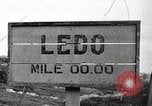
Construction and completion of the Ledo Road from India to China during World War II
Film opens showing road sign reading: "LEDO Mile 00.00." Scene shifts to rail lines at terminus of the Assam-Bengal railroad in the Indian Province of Assam. Surveyors are seen working in jungles. Engineers use machetes and construction machinery, like caterpillar tractors, to cut through the dense growth. Others saw and chop down trees and use explosives to clear the land. Explosives are seen detonating and tractors clearing the debris. Earth moving equipment and jack hammers being used to form a roadbed. View of two engineers setting and detonating a charge in a rock. A steam shovel loads earth into a dump truck. Road scrapers work in parallel to smooth the dirt roadbed. View of road after monsoon rains reduced one roadbed to a sea of mud and another inundated by water. To avoid these problems, rebuilding efforts begin by construction of causeways and bridges. Teams of workers lay planks for this. Closeup of worker tightening a clamp on a pontoon bridge under construction. Work gangs rolling and placing heavy logs as part of a bridge. Workers use a crane to lift segment onto a steel bridge under construction. Men bulding wooden and steel truss bridges. Aerial views from an airplane flying over various sections of the finished Ledo Road. A truck covered by a painted canvas reading: First Convoy over the Ledo Road, Pick's Pike Lifeline from India to China." Brigadier General Lewis A. Pick, Chief Engineer for the project, is seen, next, shaking hands with Lieutenant General Daniel Isom Sultan, Commander India-Burma theater, as he prepares to lead the convoy. View of the convoy starting out, led by the decorated truck. (Narrator states the road was now called, "The Stillwell Road." Views of the trucks proceeding and crossing causeways and bridges. Aerial view of the road twisting and turning across the high mountains. The convoy arriving in Kunming China greeted by Chinese troops and flags. Later, the convoy drives through the city streets of Kunming, with General Pick standing in a jeep, leading the way, and crowds of Chinese people cheering from the sidelines. In final scene, General Sultan states that the next project is a pipeline along the road.