


 Francais
 Deutsch
 Italiano
Refine Your Search
+"India" +1944 stock footage and images
- Showing 37 to 42 of 73 results more
more Hide
Hide
A Douglas C-47 Skytrain lands in India and takes off to go behind Japanese lines in Burma.
OSS (Office of Strategic Services) activities in Burma during World War II. A Douglas C-47 Skytrain with agents aboard lands in India. Men load supplies onto C-47. OSS personnel board the C-47. C-47 taxis and takes off to go behind Japanese lines in Burma. C-47 in flight. Aerial views of Burmese mountain terrain. Clouds on mountain. Views of rocky terrain. Supplies are dropped from plane. Parachutists jump from the plane.
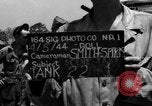
United States crew poses in front of a captured Japanese tank after running it through test exercises at a camp in India
Captured 1941 model Japanese light tank behind a U.S. Army tank crew who had just run the tank through various tests. The crew smiles for the camera. Close-up views of some parts of the tank, showing points of vulnerability and various measurements. Several slits marked in chalk with number "3/16 inches" are seen close-up.
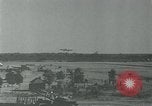
B-29 bombers of the 7th Bombardment Group, U.S. Army Air Force land at base after bombing in Burma during World War 2
China-Burma-India Theater during the World War II. B-29 bombers of the 7th Bombardment Group of the U.S. Army Air Force land one after the other at their base airfield in India. Landing after completing their mission of bombardment at the railroads in Burma. Taxi jeeps and people near the runway are visible. Puff of dust emerges as a B-29 lands on the runway.
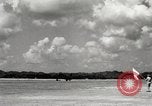
British General Orde Charles Wingate briefs British; Chindits; and 1st Air Commando Group, during World War II.
British forces along with the Chindits units in India as they plan for their operations in Burma during World War 2. A ground crewman holds a flag marking the place where an arriving American C-47A airplane should park on the Hailakandi Airfield, Assam, India. British Major General Orde Charles Wingate steps from the plane. He is greeted by U.S. Army Air Forces Colonel Philip Cochran, Co-Commander of the1st Air Commando Group, and other American and British officers. General Wingate, flanked by Colonel Cochran and another officer, gives a detailed briefing to Officers, about plans for Burma operations. Later, Colonel Cochran conducts an additional briefing for enlisted personnel of the 1st Air Commando Group. General Wingate inspects Chindits units. Wingate looks over map spread on hood of a jeep and discusses it with British staff.
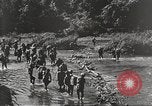
Preparation of parachute supplies to be dropped at observation posts in jungles of the China India Burma Theater.
A film titled 'Aerial supply to Burmese outposts' based on establishing and supplying observation posts of the Allies in jungles of Assam-Burma frontier during World War II. Native workers carry equipment and cross a river followed by U.S. soldiers. Troops reach a camp site and native workers are paid off by a soldier. Shacks are being built by a native labor. U.S. soldiers at camps in forward post bathing and shaving. Once the observation post is set up, the soldiers climb up a lookout post ladder on the top of which a warning system is maintained. Native laborers make baskets at a supply post which will be used as containers for parachute supplies dropped. Ration crates are being brought at an airfield depot from a quarter master depot for shipment. The crates are weighed and the containers are packed with straw. Parachutes are attached and the containers are ready for shipment. The material is taken to a U.S. Army Air Force C-47 Skytrain transport airplane and is loaded aboard. The pilot is briefed at a map which indicates the locations of the camps where the supplies are to be dropped.
A U.S. Army Air Force C-47 Skytrain drops parachute supplies at observation posts in jungles of China India Burma Theater.
A film based on supplying observation posts of the Allies in jungles of Assam-Burma frontier during World War II. U.S. soldiers on a lookout post in trees. U.S. troops wait for the supplies to be dropped by a U.S. Army Air Force C-47 Skytrain airplane. Native people look through binoculars. Signal crew lays a strip of white cloth. A man gives smoke signals. The C-47 lowers the altitude and drops parachute supplies. The airplane circles the area and more containers are released. Crates are gathered by men and supplies are taken to camps. The C-47 repeats the same procedure at the second and the third camp site.