


 Francais
 Deutsch
 Italiano
Refine Your Search
+"Indochina" +1944 stock footage and images
- Showing 1 to 4 of 4 results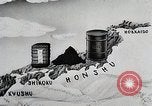
Japanese natural resources related to Second Sino-Japanese war and World War II
Animated map illustrating shortage of indigenous raw materials in Japan. As stockpiles vanish during Second Sino-Japanese war, Japan's domestic sources supply only 10% of the nation's needs for war. Animated sequence shows lack of steel, aluminum, copper, and power generation for the conduct of war. But one of the nation's greatest resources is the population of skilled Japanese workers, who are shown at various high tech jobs, as well as on the farms and in the fishing industry. Japanese workers are seen who work for the Zaibatsu (four ruling families of Japan). Banks of Japanese women typists and women in a factory. Young women painting faces on a "Kewpie doll." A Japanese family at dinner time. Women engaged in fabric spinning. Animated graphic illustrates Japan's war-related resources for World War 2, by showing a Japanese soldier standing astride map of Japan with lines extending to sources of needed raw materials from Japanese possessions in Korea, Manchuria,Formosa, China,Indochina,Malaya, and its network of Pacific Islands. Final scene displays copy of Los Angeles Times newspaper with headline reading: "Jap Supply Lines Blasted." It also features a story that appears to refer to the U.S. 6th Army invasion of Leyte in the Philippines, in October, 1944 (when General MacArthur waded ashore and stated,"I have returned"). (Note: Although produced during World War 2, this film shows prewar scenes of Japan. The animated illustrations and maps and, of course, the newspaper shown at the end, date from World War II.)
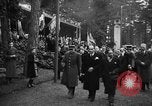
French military and government officials in Indochina, a buddhist temple in Indochina, and the Pasteur Institute
French military and government officials at a ceremony in Indochina on the ground of a Buddhist temple. The group gathered in an outdoor courtyard with a giant black cauldron or pot with steam coming from it. Shift to an indoor setting where a French official addresses the audience gathered from a lectern on a stage. Shift to an outdoor scene with a large group of monks entering the Wat Phnom Daun Penh temple by ascending the stairs in front. An arch bridge over a river. Cars on a road in Indochina. A steam locomotive pulling rail cars through a pass and racing toward camera position at high speed. An aqueduct in Indochina and a series of canals funneling water to rice fields, and a view of a farmer plowing on a wet field with the help of oxen. Views of the Pasteur Institute ("Institut Pasteur" over the doorway) in Indochina. Scientists in white lab coats working in the Institute with microscopes. Glass sample jars labeled "Cholera" being packed into boxes.
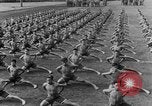
Training drills of colonized troops in French Indochina; General Charles De Gaulle speaks to audience assembled in Indochina (WW2)
Native, colonized armed forces in French Indochina performing calesthenics and training exercises. They march in formation with arms. Elephants stand nearby as the troops pass. French General Charles de Gaulle addresses a group of uniformed Indochinese military leaders and various civilians in a packed auditorium. A group of European men and women stand behind him on a staircase as he speaks to the gathering. The group applauds his speech. (World War II period)
Japanese soldiers advance with tanks and ammunition towards Mandalay in Burma (WW2)
Activities of Japanese soldiers in Southeast Asia during World War II. A relief map of India, China and Indochina shows the locations of Rangoon and Mandalay in Burma (Myanmar). Japanese soldiers march along a dirt road. Trucks parked along the side of a road. Japanese troops march. Burmese civilians standing on the side of a road wave flags. A Burmese civilian fill vessels with water for Japanese horses to drink. Burmese man give Japanese soldiers water to drink. The troops march in the background. Two Japanese soldiers drink water from canteens. Japanese soldiers and U.S. prisoners of war seated on the ground. A Japanese officer points to a piece of paper and discusses. The soldiers marching on a street move past a sign which reads: 'Mandalay 82 Mi-Rangoon 348 Mi'. A Japanese soldier pushes a dump truck up a steep grade on a road. Japanese officers and a car in the background. A photographer and a medium tank in the background. A Japanese soldier drives steel wedges into the ground behind a piece of field artillery. The Japanese fire the field artillery. A column of smoke rises. Japanese tanks drive down a dirt road. The field artillery being pulled by Japanese soldiers. The soldiers march carrying Japanese flags. Demolished buildings in the foreground. Freight cars on a siding, bomb crates near railroad tracks. Japanese medium tanks advance over the railroad tracks.