


 Francais
 Deutsch
 Italiano

Refine Your Search
+"Italy" +1944 stock footage and images
- Showing 19 to 24 of 650 results more
 Hide

Allied assaults against the German Gustav Line at Monte Cassino, Italy during World War II
Opening scene shows peaceful Italian mountains, including one snow-capped, in Spring, 1944, during World War 2. Camera focuses on the town of Monte Cassino and its historic Monastery, on a mountain above the town. (German forces held the Rapido-Gari, Liri and Garigliano valleys and some of the surrounding peaks and ridges that formed the heavily defended Gustav Line.) Animated relief map shows where, by mid January, 1944, American, Polish, and British forces had cleared the enemy from mountains east of Cassino and drawn up on the east side of the Rapido valley. Map shows progress of subsequent Allied attacks that finally reached Mount Castellone and then up Abbey Hill at Monte cassino, itself. Image of German soldier is superimposed on the scene, using binoculars on Abbey hilltop to observe Allied forces. (Narrator states: On February 9th, 75 yards from the abbey, we were stuck.") U.S. Army Air Forces Douglas A-20 Havoc aircraft are seen starting engines. Closeup of Fifth Army leaflet warning the local people to leave the Monte Cassino Abbey to avoid shelling and bombing. View of U.S. troops packing the leaflets into thin-skinned shells to deliver the warning by artillery fire. Next, 105 howitzer guns are seen under camouflage netting, firing bombardments of warning shells. Formation of A-20 aircraft taking off. Aerial view from high above, of B-25 bomber formation in flight. Formations of B-17s, B-24s, B-26s in flight enroute to bomb Monte Cassino. Bombs dropping from B-25 Mitchell bombers. Bombs exploding on Monte Cassino and the Abbey. Batteries of 155 mm guns firing. Formation of 6 B-25 bombers in formation. More bombs bursting on Monte Cassino. Animated map shows German forces taking up their earlier defenses again following the Allied artillery and air attacks. It also shows supplies streaming in to the German Green Devils Parachute Division (Luftwaffe’s 1st Fallschirmjaeger [Parachute-Hunter] division.) The map illustrates all the locations in the town that they occupied and would defend to the last man. Map also illustrates circling positions of Allied artillery batteries. Camera focuses on Polish troops and M4 Sherman tanks moving forward in an offensive. Glimpse of U.S. Army Air Forces mechanics working on a Douglas bomber engine. M4 prime movers towing 155mm howitzer guns. Gun crews camouflaging their positions with netting. Various views of A 240mm howitzer being put in place by a crane. Soldiers deploy detector microphones to locate enemy gunfire sources. They test them, and then enclose them in water-proof containers, bury and cover them. Sound from the microphones being recorded on film at a machine in the Command Post. The data being plotted on a map and corresponding grid locations phoned to Battalion headquarters. View of bombers resuming attacks again, on March 15, 1944. Formations of Douglas bombers, followed by B-25s, seen dropping bombs that explode in the town of Monte Cassino. Artillery firing. Formation of B-24 Liberator bombers in flight. Formation of B-17s dropping bombs. String of bombs exploding in a line on the town. More views of artillery barrages. More lines of bombs exploding. Allied forces storming the shattered town found German soldiers using destroyed structures as shelters to fire from and rubble obstructing the movements of Allied tanks, so the Allied advance was again stopped. Later, a newspaper headline reports resumption of Allied offensive.
Newsreel 'Refugees from Yugoslavia find haven in Italy'
Yugoslav refugees disembark at Italian port in 1944 during World War 2, fleeing German forces in World War 2. An animated map shows the positions of Yugoslavia and Italy. Refugee families with luggage get into trucks. Tents are erected at refugee camp. The refugees get food aid. Women and children in line at outdoor soup kitchen receiving bread and hot soup. Yugoslavian children are seen eating.
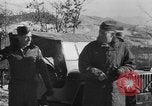
Lieutenant General Lucian K. Truscott assumes command of the 5th Army in Italy during World War II
On 10 December 1944, Lieutenant General Lucian K. Truscott, Jr. (newly appointed Commander of the 5th Army) arrives by jeep at a U.S. Army encampment in Italy during World War II. He is escorted the headquarters of II Corps, on the Apennine front below Bologna, where he is greeted by Major General Geoffrey T. Keyes. They walk together around a building. The next day General Truscott is seen saluting as he is escorted by Major General Willis D. Crittenberger, Commander 1V Corps. Next, General Truscott is seen at the headquarters of the Brazilian Expeditionary Forces contingent of the 5th Army, where he greets its Commander, General João Baptista Mascarenhas de Morais and his aides. As General Truscott leaves, his jeep passes a Brazilian honor of soldiers who salute him. Brigadier General, Donald Carlson. new Chief of Staff of the 5th Army, accompanies Generals Truscott and Crittenberger to a forward observation post near the village of Castelluccio. They observe from a bunker overlooking a valley, where white smoke is rising. (Narrator states that the smoke screen indicates the position of the Allied line of the IV Corps Sector on 11 December.) Next the three American officers are seen making their way up a mountain side, with smoke rising from the town of Vergato, in the background below, where heavy fighting is taking place. (World War II; WW II; World War 2; World War Two)
German armored vehicles,tanks and trucks destroyed by U.S. tactical aircraft supporting French forces in Italy
Destroyed German equipment, including some captured American armor, lines the edge of a road near Esperia, Italy during World War II. The German armored vehicles, tanks, antitank guns and trucks were destroyed by U.S. fighter bombers of the 12th Army Air Forces, on May 16, 1944, while supporting the French Expeditionary Force assault on the German Gustav line in that area. French troops stand on the side of a road. Troops examine some of the destroyed armor.
Various cities in Europe being liberated from Nazi occupation (WW2)
Allied campaign against the Axis powers in 1944 during World War II. People gathered outside the Colosseum (Piazza del Colosseo, 1, 00184 Roma RM, Italy) in Rome, Italy celebrate their liberation from occupation by Nazi Germany. Allied soldiers in trucks move past the cheering crowds. Pope Pius XII addresses the people from a balcony. Victory parade in Paris, France at the Arc de Triomphe (Pl. Charles de Gaulle, 75008 Paris, France) on August 26, 1944. French children clapping. People cheer as they carry banners. In Bucharest, Romania soldiers loaded onto trucks drive past crowds cheering after their liberation. On 3rd of September 1944 people cheer on the streets of Brussels, Belgium as Allied troops enter. A woman sits on top of a moving Jeep. In Belgrade, Yugoslavia on October 20, 1944 people celebrate their liberation. In Athens, Greece women carry a Greek flag and a flag being hoisted after their liberation.
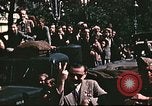
American soldiers greeted by celebrating civilians in Lyon, France, and Rome, Italy, during World War II
American soldiers in jeeps are part of a traffic jam in Lyon, France, following its liberation by French forces in September, 1944. An air of celebration permeates the scene, Several French women ride with U.S. soldiers in American jeeps. A Blue vehicle displaying "FFI Police" (Free French of the Interior) and the Cross of Lorraine, is caught in the jam. A small black sedan displays "FFI" in white letters.Local civilians crowd the streets and ride on every possible spot on the various vehicles. Crowds of pedestrian spectators are restrained behind rough wooden fences. Camera views from vehicle crossing the Rhone River, show the destroyed Wilson bridge, and parts of city in background. Complete change of sequence to Rome, Italy. The Flag of Italy flying on an official building. Italian women surround American soldiers, Sergeant Lester Koenig and another NCO as they sit in a jeep. They all laugh and talk. Several Italian soldiers (one a medic) and women pose for the camera.