


 Francais
 Deutsch
 Italiano

Refine Your Search
+"Italy" +1945 stock footage and images
- Showing 157 to 162 of 175 results more
 Hide
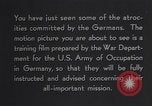
Training film for U.S. troops with the Army of occupation in Germany after world War II
Opens with bell tolling Victory against Germany in World War II. Next, a slate reads: "Victory Leads to Peace," and a farmer is seen with cattle pulling a plow. But narrator says "the problem now is future peace," and a map of Germany is shown overlaid with "Your Job in Germany." A cartoon of a soldier is superimposed on the map, along with one of a World War 1 American soldier and a figure of possible future soldier with similar mission. Camera focuses on parts of German aircraft in a jumbled heap. Closeups of weary defeated German soldiers at end ot World War II. Glimpse of Adolf Hitler speaking and haranguing an audience from a podium in an animated and forceful way. Swastika flags displayed from houses in a quaint German town. Joseph Goebbels, Nazi Reich Minister of Propaganda, at a microphone. Glimpse of a German concentration camp. But as they appear, each of the Nazi elements promptly disappears, showing the scenes without such Nazi symbols and persons. Skeleton remains of bombed buildings. Flower displays. Bucolic German rural countryside and quaint old villages in peaceful settings. Camera focuses on a book titled "German History." Chapter I, titled "Blood and Iron," shows Image of Otto von Bismarck. German troops march in a parade. Narrator states that "under Bismarck, the German empire was built." (He formed the German Empire in 1871, unifying Germany with himself as Imperial Chancellor, while retaining control of Prussia at the same time.) The film shows mounted German lancers as it alludes to Bismarck's campaigns against Denmark in 1867; Austria in 1866; and France, in 1870. Germany's leaders celebrating its status, in 1871, as the mightiest power in Europe. Troops marching and girls dancing nearby. Farmers plowing field with a horse and cow. Classic peaceful rural alpine scenes with local people in agricultural pursuits. A group of local German musicians playing folk music as village people dance outdoors. Back to the book, Kaiser Wilhelm II is shown on Chapter 2, entitled: "Deutschland über Alles." Gathering of German soldiers in Pickelhaube (spiked helmets). A German Big Bertha howitzer firing. German troops marching against Serbia; Russia; and France (with view of war damaged French cathedral). German invasion of Belgium in 1940 (with view of clock tower resting in rubble). German troops seen in Italy, walking past battle-damaged buildings. German Zeppelin dropping bombs on British targets and view of bombed out London neighborhood. Next scene shows a capsized ship with survivors running across its hull. Film slate labels the scene as United States, as if it is a U.S. ship attacked by Germany. (Actually, it is the Austro-Hungarian Battleship, SMS Szent Istvan, torpedoed, by Italian torpedo boats, during World War I.) Next, American soldiers in trench are seen going "over the top" and into "no man's land" on the western front of World War 1. Glimpse through a window of Kaiser Wilhelm II, after defeat of Germany, in 1918. View of Germans in a Beer Garden. Picturesque view of German town. A German orchestra performing. American soldiers marching out of Germany, with flags waving. Back to the history book,as chapter III is revealed, entitled "Today Germany, tomorrow, the world," and featuring Adolf Hitler. German troops invading Austria (where a civilian lies dead on the ground). German troops entering Czechoslovakia (where local people in tears render the Nazi salute). They march into Poland (where a girl weeps over someone, not seen, on the ground). They march into France (where a wounded, bandaged child cries in a bed). Next, is a scene from England, where a British child victim of bombing lies dead in the remains of a shelter. German troops invading Norway, Holland, Denmark, Belgium, Luxembourg and Russia (where a woman tries to rouse a dead woman). They invade Yugoslavia (where women sit near coffins of children) and Greece (where a woman rescues a naked child). A U.S. merchant ship explodes after being torpedoed by a German submarine (unseen). Scenes of destruction with people plucking dead victims from rubble of buildings. American troops invading Normandy, France on D-day, June 6, 1944. Several American soldiers fall to German gunfire on the beach. Wounded American soldiers being transported in jeeps on the battlefield and being placed on landing craft for evacuation. Americans walking past huge piles of destroyed aircraft parts. A landing craft filled with wounded American soldiers. American wounded and dead on a battlefield. Sailors abandoning a burning American ship by jumping into the sea. A sailor picked up in a life boat. A wounded American soldier being dragged from the beachhead at Normandy. Various wounds being treated by U.S. Medical Corps personnel. More scenes of American wounded being moved on stretchers. Scene shifts abruptly to German people folk dancing. Film concludes with question marks about the future.
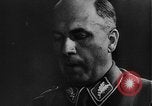
Nazi leaders speak. Faces of Allied soldiers. Nazi massacres. Victims mourned. German troops surrender. American life.
Nazi leaders in Germany giving speeches during World War 2. Soldiers from various countries like England, Poland, Greece, America and Norway. View of young boy soldiers in Germany at end of World War 2. Earlier scene of Nazi Waffen SS soldiers as they march with goosestep on parade. Victims executed in Nazi massacre in Italy shown with hands tied behind their backs. Nazi victims mourned in France. Bodies of women and children slain by the Nazi SS in Belgium. A large crowd of civilians gathered to pay homage to the dead in Lublin, Poland. Allied military vehicles and personnel trample and walk on Nazi flags and posters in Germany. A pile of Nazi flags burning in the street, as men, women and children walk past. German prisoners of war assembled in a large outdoor enclosure, and moving out in a line. German soldiers surrendering, with white flags displayed. American soldiers look at open mass graves of persons shot dead by Nazis. Emaciated boy children inmates of Buchenwald concentration camp stand behind barbed wire fence around the time of its liberation. The prior scenes are contrasted with ordinary life in the United States. A boy retrieves a ball from a pond, and throws it. Children play on see saws at a playground. A baby take first few faltering steps. A girl hangs from monkey bar. A man and two women share a newspaper article.
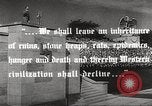
War devastation, rubble, people scavenging for food after World War 2 in Europe.
A film on the reconstruction of Europe after World War II. Image of Adolf Hitler speaking at a rally earlier in the war, with translation of some of his words superimposed on the image. Stone heaps in a European city following bombing in World War 2. A sign for Hazelaarstraat (area of Amsterdam, Netherlands.) Rubble of destroyed buildings. The ruins of a church. Closeup views of address numbers in a city, including 6, 24, and 40, each followed by scenes of rubble and twisted metal. Woman emerges from a cave dwelling with a young child. A sad woman holding a young child. Close-up view of a rat emerging from a hole in a wallboard, walking directly toward camera position. Person placing a blanket on a crying baby. A sign board on a street reads, "Danger: Typhus carried by lice." Children (possibly Italian) gathered with water vessels near a well, collecting what appears to be dirty water. A boy lying in a hospital bed, with images of Christ and Italian writing above bed. Hand taking down a hospital chart record. "Napoli" visible on chart implying Naples, Italy. Hungry men, women, and children in Greece, living in poverty, are seen scavenging for food from trash cans. Sign on wall behind reads, "ΚΟΣΜΙΚΟΝ." Arms of women holding water pitchers, standing in a group waiting for water. A desperate looking woman holding a half-clothed sleeping child in her arms. A young boy holding the leg of an adult and crying. A carriage of a undertaker or funeral service driving away on a street.

Pope Pius XII blesses crowds and various other officials display festive moods in separate events in the European Theater.
The film 'Two Down and One to Go' talks about the activities of the Axis powers Italy, Germany and Japan during World War II. United States Secretary of War Henry Lewis Stimson at a desk. Animation shows a swastika being exploded over Germany. Caricatures of the late Duce of the Italian Social Republic Benito Amilcare Andrea Mussolini, the late Chancellor of Germany Adolf Hitler and Hideki Tojo. A cross being superimposed on the two dictators. The head of the Roman Catholic Church, Pope Pius XII blesses the crowds in St. Peter's Square. 1st Military Governor of the American Occupation Zone in Germany Dwight David Eisenhower, the Prime Minister of the United Kingdom Winston Leonard Spencer-Churchill, the General Secretary of the Communist Party of the Soviet Union Joseph Stalin display festive moods in separate events. People cheer.
Animation and footage depict American strategies to attack the Nazis in the European Theater during World War II.
A film about U.S. response to the activities of the Axis powers Italy, Germany and Japan during World War II. U.S. Army Chief of Staff George Marshall praises the United States Military offensives in Europe and Africa. George Marshall narrates rest of the clip. Animation of a globe depicts the Allied forces in the middle east planning to isolate China and Russia. The animation depicts the German Forces crossing the British allies, joining Japan and then attacking America. It depicts U.S. plans to stop the collaboration of Germany and Japan. Scenes of American shipyards are shown, with workers building new war ships. Some workers welding. A sign reads, "Work must continue during launching. Positively." The animation depicts the shorter routes to the European Theater. Aerial footage of a large fleet of U.S. Navy Ships at sea, underway during World War 2. Next scenes shows smoke pouring from ships at Pearl Harbor in Hawaii following attack by Japan. View of Soviet Russian horse cavalry forces charging toward enemy German positions during a battle in World War 2. Scenes of Allied artillery being fired at night in North Africa. Animation depicts the need to establish American air bases closer to Japan before launching successful air attacks. Footage of U.S. soldiers running out of landing crafts and coming ashore at a beach head during World War 2. Animation depicts U.S. plan to defeat Japan. Animation depicts strong German Army. Animation depicts U.S. plan to defeat the Nazi and the Fascist power in Europe.

Engineers repair and check United States aircraft in the Mediterranean.
Animated map shows Italy and Yugoslavia. United States aircraft makes an emergency landing at an airfield. Airmen speak with the pilot. Engineer inspects aircraft wheel. Number of airplanes parked on the ground. Engineers check the aircraft engine. Yugoslavian ships bring food for the Yank Island. Soldiers unload goods from ship. Troops disembark from a B-47 aircraft. Man gives hand signals. (World War II period).