


 Francais
 Deutsch
 Italiano
Refine Your Search
+"Japan" +1934 stock footage and images
- Showing 7 to 12 of 35 results more
more Hide
Hide
Rice paddy field leveling and plowing in Japan
Rice farmer plows and levels rice field in Japan. A horse is used to level the rice paddies. Farmers leading horse as they plow the muddy field. Farmers use hoes to level the rice paddy. April 1934.

Farmers transplanting rice seedlings in rice fields in Japan
Farmers transplant rice seedlings into rice fields in Japan. Farmers crouch to pick rice seedlings from the seedling beds. A female Japanese farmer glances at the camera while picking seedlings. The farmers bundle their seedlings. A farmer transplant the seedlings into water logged rice fields. April 1934.
Spring Festival of Japan
Sakura cherry blossom viewing, or ‘hanami’, during springtime in Japan. Japanese women wearing kimonos visit a park with cherry blossoms in full bloom. One of the women is carrying an infant on her back. A paper lantern on display. Shinto priests and their attendants along with music and dance accompanied with other people parade through the street. Men playing Shamisen. Children enjoy the festivities. Some young boy children ride in a small amusement airplane ride as the operator turns a crank and the tiny aircraft planes rotate. April 1934.
Views of China and Japan in the period leading up to the 2nd Sino-Japanese war
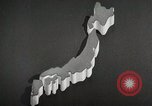
Film opens with outline map of Japan shown in contrast to 20 times larger China and figures representing China's 6 times greater population. Map of China is shown in pieces representing its numerous internal fiefdoms. In contrast, Japanese soldiers are shown marching in review before their singular leader, Emperor Hirohito and other national military leaders. Film shows contrasting 20th century characteristics of China and Japan. Sun Yat-sen, who figured prominently in post-Imperial China, and is considered the founding father of the Republic of China, is shown speaking to crowds. Narrator states that in 1911, this man fathered a peoples' revolution which brought to an end, China's ancient Imperial government. View of Chinese people marching and carrying flags and banners. Books are shown comparing China's Sun Yat-sen to America's George Washingon. Sun Yat-sen's political statement, shown in Chinese, contains words similar those in Abraham Lincoln's Gettysburg address. View of schools and colleges built in the new Republic of China. Chinese students shown in libraries. A couple dining in a Chinese hotel restaurant, overlooking other buildings. A tall clock tower looms at the same height outside their window. Steel being erected for a tall building. Architects at work. Scientist looking through a microscope. Technicians at work in a chemistry laboratory. Medical staff and patients in a modern hospital. Children in school under compulsory education program. Chinese people exercising their freedoms of expression and religion. The funeral of Sun Yat-sen, in 1925, attended by his successor, Chiang Kai-shek, and other Chinese leaders in military uniforms. Chinese people attending an outdoor ceremony. Examples of areas needing modernisation. Chinese workers using manually operated machinery to process fabrics. Commercial vessel plying a river using wind and sail only. Views of steam locomotives and trains being introduced to link parts of China. Trucks moving goods over roads (still unpaved). Miners working in open air mines, digging coal and iron. Molten tin being poured from a crucible. Machines performing complex tasks in a fabric mill and women tending spinning and knitting machines. School children engaged in collective outdoor games and exercise drills. Scene shifts to Japan, where Emperor Hirohito, on a white horse, leads military leaders in reviewing Japanese forces. A formation of Japanese Model 97 medium tanks passing in review, with tank commanders saluting from their turrets. Glimpse of Japanese steel mill. Headline in World-Telegram newspaper of 14 february, 1934, reads: "Tokyo House Passes Huge Arms Budget." A Los Angeles newspaper of 23 November, 1934, expands on the same story. New Orleans Times-Picayune, Sunday, 5, May, 1936, reports that Japan is strained by its huge arms costs.
A Japanese film describes her Empire ambitions in the early 1930s
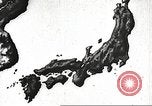
Film opens with animated map showing Japan and its nearby Asian mainland neighbors. Arrows from Japan point to areas and islands that Japan considers part of the Japanese empire. In addition to Pacific islands, they include Asian mainland places, Manchuria, and the Sakhalin Islands. The map shows the Northern limit of Japan's territorial reach with a line drawn on the map at about 47 degrees North latitude. The map shows the reach of Japan's empire extending South to include all of Manchuria and in the Pacific to encompass all the scattered islands in the Pacific accessible to Japan. The map begins drawing a circular boundary to the East encompassing all these areas of the Japanese Empire. Film shifts to Japanese navy warships patrolling the Eastern Pacific boundaries of the Empire, and bi-wing aircraft flying in formation overhead. Rising sun symbol seen on underwings of biplanes. Admiral Tōgō Heihachirō who was later Commander-in-Chief of the Combined Japanese Fleet during the Russo-Japanese War is seen seen as a young Admiral in 1895. Next, he is seen in 1934 at the age of 86, coming out of a barn and walking toward the camera. He is bent over and walks slowly, dressed in woolens and wearing thick eye glasses. (He died on May 30, 1934.)
Japan denounces Washington Naval Treaty of 1922; Also: Helen Richey becomes the first woman to fly mail in the U.S.
Japanese Ambassador to the United States Hiroshi Saito calls on U.S. Secretary of State Cordell Hull In December 1934 to inform that Japan will denounce the Washington Naval Treaty on 1922 which limited the size of the Japanese fleet. A close up of the ambassador Saito. He exits the State, War, and Navy Building (later the Executive Office Building) and gets in a car. Next segment: A female pilot Helen Richey becomes the first woman to fly mail in the United States. Richey stands in front of an aircraft and shakes hand with an official. Richey in the cockpit and the aircraft takes off. From a December 14, 1959 newsreel recounting events 25 years earlier.