


 Francais
 Deutsch
 Italiano
Refine Your Search
+"Japan" +1934 stock footage and images
- Showing 25 to 30 of 35 results more
more Hide
Hide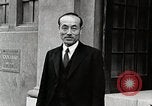
Methodist Mission's Hirosaki Boys School Activities including photograph shoot and studying
Students carrying trophies line up along the school principal for a photograph shoot at the Hirosaki Boys’ School in Aomori Prefecture, Japan (13-1 Minori-cho Hirosaki-shi, Aomori 036-8231). The Japanese school principal of the Methodist Mission's Hirosaki Boys school smiles on camera. The principal meets students. The principal and the students pump their arms in unison as they do the Banzai cheer together. activities everyday activities like study and discussion by teachers are shown. The Japanese principal in graduation gown stands by the doorway. Japanese boy at desk writing on a banner. The boy smiles at the camera. Shot approximately in 1934-35.
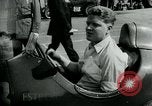
Japanese and French confer in Hanoi; war materiel supplies to China cutoff at Yunnan and Canton; British forces departing Shanhai
Clip opens with unrelated brief two second view of Frank Griswold, winner of 1940 New York World's Fair road race, waving from behind the wheel of his 1934 Alfa Romeo Tipo B after the race. Scene changes to views through the fertile countryside of French Indochina on a trip to Hanoi early in World War II. Narrator notes Hanoi is a principal supply hub for war materiel destined for General Chiang Kai-shek; supplies which the French have now interrupted at the request of Japanese authorities. A train arrives at station in Hanoi. People at the station. Views of downtown buildings of Hanoi and a market place. Street vendors selling foods and goods. A woman carrying a basket on her head. Rickshaw pullers at work behind several people seated at a street-side outdoor cafe. Narrator notes views are proceeding toward the central park where the residence of the head of the new government is located. Views of a couple in formal suit and dress strolling in the park. Major General Nishihara, head of the Japanese mission, is seen exiting a building following talks with the French Governor-General. Scene changes to Lao-Kai (or Lai Cai), a border station between French Indochina and China, where narrator says supply inspectors from Japan have traveled to examine the situation. View of the Yunnan railway with railroad tracks cut off by the French authorities, and guarded by local indigenous soldiers with conical hats (nón lá). Scene changes to the harbor at Canton China. Large ships anchored in harbor. Barrels or drums on the ground near docks, as narrator notes that large quantities of war supplies no lie idle and unusable on the port docks. Scene changes to Shanghai. A procession of forces from Great Britain on parade at a racecourse or stadium, and in the streets of the city, including uniformed bagpipers. Narrator notes it marks the end of British supremacy in China, with the first contingent of British troops departing Shanghai.
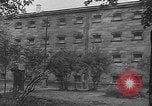
Post World War II trials of German and Japanese Leaders for war crimes
Film opens with exterior view of Nuremberg cell prison, just north of the Palace of Justice, holding war criminals for the Nuremberg Trials. Interior view showing cell bloick area and guards patrol the halls. Cell door with name Karl Doenitz on it. Views of German Admiral Doenitz and Admiral Erich Raeder, looking over war planning charts. Ships burning at sea in nighttime. Glimpse of German U Boat Captain observing through periscope. Back at Nuremberg Prison, an American soldier checks cell of Joachim von Ribbentrop. German Foreign Minister von Ribbentrop seen on steps of an airplane. Scene shifts to Nazi–sponsored so-called American Rally in Madison Square Garden, New York City, on February 20, 1939. A huge picture of George Washington dominates the stage where drummers play while flag-bearing marchers fill the stage. View of audience of 20 thousand persons, rendering Nazi salutes. Someone trying to interfere with the activity is quickly subdued on stage by men in military style uniforms. Scene shifts back to Nuremberg prison, where a soldier guard passes food through cell door to Julius Streicher (unseen). Closeup of Streicher speaking to crowd of people in Germany. Views of German Paramilitary Brown shirts (Storm troopers, or Sturmabteilung) during boycott preventing people from patronizing Jewish merchants. Next, victims liberated from Nazi concentration camp are seen being sprayed in delousing powder by American soldiers. Back at Nuremberg prison, a soldier stands outside the cell of Hermann Goering. Next, Goering is shwon in a scene eating at an outdoor table with other men, at a Nazi-sponsored public feeding event before World War 2. Brief view of German Chancellor, Heinrich Bruening, who fled Germany in 1934 as the Nazis were coming to power. A Graf Zeppelin airship, bearing Nazi Swastika insignia, is seen in flight over New York City. Crew member inside the Zeppelin, looking out a window as he plots a position on a chart. The Zeppelin casts a shadow over an ocean liner at sea, as it passes overhead. Back at Nuremberg cell prison, a guard opens a door with a key. Next seen shows several prisoners walking into a prison yard at an unidentified prison. A firing squad (unseen) is heard marching into position and firing their guns. Scene shifts to Japan, where a Japanese twin engine passenger plane is seen overhead, coming in for a landing. Official buildings are seen in Tokyo and jurists who will participate in war crimes trials. Scene shifts to war crimes trials authorized in Manila, by General Douglas MacArthur. Seen are Japanese General Tomoyuki Yamashita and another Japanese officer on trial at the High Commissioners Residence in Manila, in 1945. Views of ordinary Japanese soldiers. A court convening.
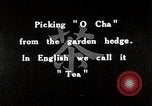
Women pick tea leaves in a Japanese tea garden
View of a typical Japanese tea garden. Women pick tea leaves (known as O Cha in Japanese). Baskets of tea leaves are seen behind the women. A young child accompanies the tea pickers. Closer view of a woman picking tea leaves from the shrubs. April 1934.
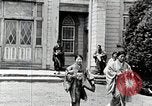
Young Japanese children play in school yard.
Small Japanese children play in school as their teachers look on. Exterior views of school house and some teachers or adminstrators. Children playing in school yard, wearing traditional Japanese clothing. Film shot in approximately 1934-35.
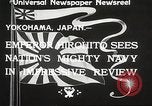
Japanese Emperor Hirohito reviews Japanese Naval battle fleet in Yokohama, Japan.
Japanese Emperor Hirohito reviews his battle fleet in Yokohama, Japan. Emperor Hirohito of Japan, dressed in Naval white uniform, and carrying a sword, walks past an honor guard of Japanese sailors who present arms in salute. The Emperor renders a hand salute. He is accompanied by high ranking military officers. Scene shifts to Crowds of Japanese civilians watching the proceedings from a stone bulwark at waters edge. Next, the Emperor and entourage descend a gangplank and board a Navy launch, displaying a large Naval Rising Sun ensign. Some large freighters and small boats are seen in the harbor. View from the dock as the launch pulls away. A sailor and a Marine are standing at attention in foreground. Closeup of the Japanese battleship Kirishima. View of the navy launch as sailors raise the Imperial flag of the Emperor on its bow. View from deck of the battleship Kirishima, where sailors in dress whites stand at attention while she fires a salute with one of her guns. View from her port side, as the Kirishima continues firing gun salutes. Gun smoke obscures the ship. back on shore, the embankment is filled with crowds of spectators. Many carry umbrellas. View of the battleship Kirishima from another ship, where sailors line the deck railing at attention. Japanese military aircraft fly overhead in formations above the Kirishima. Glimpse of a column of Japanese Navy capital ships.