


 Francais
 Deutsch
 Italiano
Refine Your Search
+"Japan" +1937 stock footage and images
- Showing 37 to 42 of 44 results more
more Hide
Hide
Japanese officers review the troops after their triumphal march into the city of Nanking.
Japanese troops fight outside the walls of Nanking in China during the Second Sino-Japane War. Triumphal march of Japanese troops into Nanking. Japanese troops march into the city. Buildings and hills in the background. Cars parked on the roadside. Soldiers with Japanese flags. Aircraft in flight over the city. A soldier atop a tank. Troops march on the streets. The military band marching. Soldiers with the Japan Empire and Imperial Japanese flags. Troops stand by the roadside as more troops march in. Soldiers on horses and on foot. They march past houses and shops. They line up at attention. Officers on horses march between the troops lined up on either side of the road. Wounded soldiers. Officers and troops salute.
Japanese institutions and buildings in China before the Sino-Japanese War.
Front entrance of the Academy of Oriental Culture Tokyo Institute. The Academy of Oriental Culture building with two Chinese guardian lions or shishi (stone lions) flanking the entrance. The Toa Dobunkai Foundation Japanese Society of Cultural Work for China building (1 Sannencho, Kojimachi-ku Tokyo Japan) designed by Shinichiro Okada in Tokyo, Japan. The Japanese-run Tung Wen College or Toa Dobun Shoin Hongqiao Road School Building in Shanghai, China. Entrance to the Sino-Japanese Educational Association. The main building of the Dojinkai or Japanese Society for Welfare Work in China. The T’ung Ren Hwei Hangkow Hospital in Wuhan (Hankou), China maintained by the Japanese Dojinkai. The Japanese Hospital, Tsingtao (Qingdao, Shandong, China). Kiang-han Middle School building in Wuhan. A sign in Chinese at the entrance of the Peking Library of Modern Scientific Research in Beijing. View of the Shanghai Science Institute, now the Shanghai Institutes for Biological Sciences - Chinese Academy of Sciences (500 Caobao Rd, Xuhui District, Shanghai, China), designed by Japanese architect Yoshikazu Uchida, at the French Concession, Shanghai.
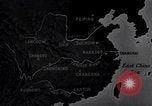
Bombing of Chungking (Chongqing), China, by Japan, in Second Sino-Japanese war
The Republic of China establishes its wartime capital at Chungking (Chongqing), China during the Second Sino-Japanese War. Animated map depicts areas of Japanese occupation and highlights cities including Lanchow (Lanzhou), Chengtu (Chengdu), and Kunming. It highlights Chungking (Chongqing) as the Nationalist Republic of China. Chiang Kai-Shek is seen leading a group of Chinese leaders as they walk through an arched gate in Chungking (Chongqing). A busy street with shops and apartment houses in a commercial district. Busy scene of pedestrians, cart traffic, and automobiles in the road center. Boats on the Yangtze River are seen below long steep steps leading up to the streets above. Houses along the cliffs. Chinese workers digging bomb shelters into the cliffs. View from inside a shelter being hollowed out of the rock. Back in the Japanese occupied area, a car brings a Japanese Air Force leader who addresses a large group of fliers at an airbase. Next, Japanese aviator crews are seen running to their aircraft from their camp on the airfield. They take off in Mitsubishi G3M bombers to attack Chungking (Chongqing). Nakajima Ki-27 airplanes take off from the field and join in large formations overhead. A formation of Chinese World War 1 era aircraft is seen in flight to engage incoming Japanese bombers. Japanese crew member in a bomber sees the Chinese fighters and gunners in the bombers get ready to fire on them. The Chinese fighter planes dive at the bombers but are intercepted by Nakajima Ki-27 airplanes flying cover. Dogfights ensue with Chinese aircraft being shot down, and the bombers continuing their way. Air raid sirens sound in Chungking (Chongqing) and people run to their shelters, including school children. Views of bomber crews at their stations and then of bombs falling with the Yangtze River below. Bombs exploding along the riverfront and inland, along the cliffs. View of machinery operating, and Chinese workers occupied in underground factories in Chungking (Chongqing). Fires burning throughout the city from the bombing, and Chinese fire fighters with hoses working to extinguish fires.
Imperial Japanese Navy cadets wake up and perform early morning exercise at the Tsuchiura Navy Air Corps
View of the training center at the Tsuchiura Navy Air Corps, Ibaraki Prefecture, Japan. Buildings in the Imperial Japanese Navy Flying Department Practice Club. Exterior of Japanese cadet barracks at early morning. Japanese Naval Air cadets sleeping in long lines of arranged hammocks. Loudspeaker sounding to wake cadets. A man makes an announcement through the siren. Navy cadets rise from their hammocks at reveille. Cadets rolling and tying their hammocks. They put their rolled hammocks back into place. Japanese naval cadets jogging on the grounds of the Tsuchiura Navy Air Corps. Japanese cadets in formation at morning quarters. Japanese officer on platform giving commands thru microphone. Japanese cadets in formation singing the national anthem, Kimigayo. Japanese calligraphy inscription. Cadets in formation; open formation for exercises. Hundreds or thousands of cadets doing early morning exercises (taisou). Japanese sailor ringing bell near barracks.
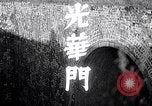
Japanese troops load and fire artillery near the Kwang-hwa Gate at the Nanking wall in China.
Japanese troops fight outside the walls of Nanking in China during the Second Sino-Japane War. Destruction and battle near the Kwang-hwa Gate. Japanese troops fire over the wall. The carry equipment and material up the wall. Troops atop the wall. Soldiers seated with artillery. Soldiers in a field. Smoke due to explosions. Destroyed buildings. Soldiers load and fire artillery. A white smoke cloud rises into the air due to the explosion. Soldiers fire through broken windows in destroyed buildings. Troops atop wall. Machine gun and artillery fire. Soldiers advance with rifles, cross a bridge, climb up the wall. A sword salute by the Japanse troops on the wall.
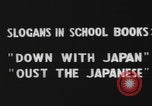
Pre- WWII Chinese anti-Japanese propaganda.
Nationalist Chinese school books with anti-Japanese propaganda. Slate reads “Slogans in school books: “Down with Japan” “Oust the Japanese””. Schoolbook depicts anti-Japanese propaganda. Illustration shows Japanese soldiers aiming their bayonets at the Chinese. Another children’s schoolbook. A cartoon with Japanese invaders depicted as tigers. Chinese men taming a Japanese tiger in bed. An anti-Japanese pamphlet circulating in China. Anti-Japanese newspaper headlines posted in public display case on sidewalk in China. Chinese men reading newspapers posted on outdoor display boards on sidewalk.