


 Francais
 Deutsch
 Italiano
Refine Your Search
+"Japan" +1944 stock footage and images
- Showing 97 to 102 of 106 results more
more Hide
Hide
Attack on Pearl Harbor,and U.S. Secretary of State Hull and Japanese Ambassador to U.S. Kichisaburo Nomura in the United States.
A film titled 'The war' about military activities in the United States during World War II. A bomb explosion on the Christmas eve. A wounded child cries. A blind man walks past the bombed houses. Soldiers present arms. People cry and walk as they are rendered homeless. The German troops march. People cry near the dead bodies. An animation of a globe depicting German,Italy and Japan occupation through out the world. The Japanese troops cheer. The United States Secretary of State Cordell Hull tries to stop the conflict. Newspapers stacked in a printing machine. The Japanese Ambassador to the United States Kichisaburo Nomura disembark from aircraft in Washington DC. The officials enter a building. The officials come out of a building. A Japanese aircraft carrier at sea. The Japanese aircraft bomb Pearl Harbor. A damaged aircraft. The dead bodies of the U.S. Navy men.
Private Snafu wastes food by taking too much at a battlefront (WW2)
Private Snafu in the U.S. Army during World War II. Animation shows supply of food and other things to soldiers. A bull and a cow get married. They enter a room. Nazi Germany and the Japan declare war at that time. Guns loaded on freight cars passing on railroads. A ship underway at sea. Periscopes of submarines emerging out of water. The bull aboard a ship and then a boat. It travels by a truck, a dog sled and then a camel. A snow covered area. A truck passing on a bridge. The bridge explodes. U.S. airplanes in flight overhead. Food and other supplies are dropped from the airplanes. Private Snafu seated on his bed in a barrack. A chow call for the soldiers. Private Snafu takes a large quantity of food. He sits near a tree and eats the food. He wastes some of the food and throws it in a dustbin.
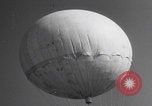
Parts of a Japanese Fu-Go paper balloon bomb (WW2)
A video explaining the components of a Japanese Fu-Go paper balloon bomb- a weapon launched by Japan to drop bombs on the United States during World War 2. A United States Navy personnel inspects the Fu-Go paper balloon on its ballast. Paper bags and sandbags tied to the ballast of the Fu-Go balloon bomb. Payload comprises of incendiaries and anti-personnel bombs. Inflated “Type B” Fu-Go balloon made of 5 ply “washi” rice paper. United States Navy personnel lets go of holding the ballast of balloon bomb. Man unfolds a piece of rice paper. Man ripping a piece of rice paper, demonstrating the durability of the material. Fu-Go bomb inflated with hydrogen gas. Man holding the escape valve of the Fu-Go balloon bomb. Escape valve is shown as made of pressed steel and has a rubber gasket. Pressure is exerted by the rubber ring the escape valve. Spider bracket of escape valve.
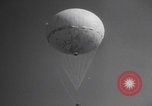
Parts of the so-called Brain Center of a Japanese Fu-Go paper balloon bomb (WW2)
A video explaining the components of the “Brain Center” of the Japanese Fu-Go paper balloon bomb- a weapon launched by Japan to drop bombs on the United States during World War 2. An inflated paper balloon bomb. A man with a pencil points to parts of the “Brain Center” of the balloon such as the electrical source (battery case), demolition block, barometer box, fused jacks, jack switches, blowout plugs, sandbags, and incendiary bombs. Man puts away his pencil. Man pulls back sandbags to show the central payload of the paper balloon bomb. Man demonstrates how ballast falls. Man demonstrates mechanism and release of the pay loads. A sandbag falls. Man attaches sandbag back to the ballast. Man shows a T-hook of the ballast. Man re-attaches a T-hook back in the ballast.
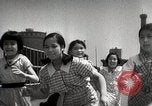
Japanese children practicing sports including martial arts like Kendo and swimming (WW2)
Small school girls play. Japanese children practice and compete in traditional Japanese martial arts Kendo with bamboo sticks. Japanese school children play tug of war and run through a line of showers on the way to a swimming pool to swim and play with a ball. (World War II period)
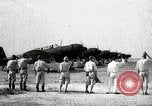
Japanese warplanes take off from an airfield in the Pacific. Pilots given big sendoff with waving flags.
Japanese Nakajima airplanes take off from an airfield on Japanese-held island in Pacific. Soldiers and people stand on the airfield. People watch the planes take off. Soldiers wave flags. Japanese officer waves hat on the platform. People in the background. Civilians wave at departing Japanese planes. (World War II period).