


 Francais
 Deutsch
 Italiano
Refine Your Search
+"Japan" +1945 stock footage and images
- Showing 823 to 828 of 1093 results more
more Hide
Hide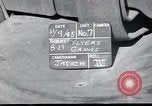
Grave of American pilots with Japanese markers at Japanese Military Sanadayama Cemetery in Osaka soon after World War II.
Japanese Military Sanadayama Army Cemetery in Osaka, Japan soon after World War II. Japanese markers on grave of American pilots in the cemetery. U.S. MP (Military Police) guards the graves.
Japanese clear wreckage of American bombers shot down over Kansai area, Tokyo, Kanagawa and Shiba prefectures. WWII
American bombers being shot down over Kansai, Japan during World War II. Japanese antiaircraft gun fire against American bombers in flight. Flak bursts in sky. American bombers are shot down. Wreckage of American bombers on ground. Japanese soldiers clear wreckage of American planes in Kansai area, Tokyo, Kanagawa and Shiba prefectures. Japanese soldiers inspect a bomb. They carry wrecked parts of planes. Piece of material, with words: "Life Raft Sail Fabric.Navy Aeronautical Specification M-551." Japanese soldiers hold part of aircraft as officer circles bullet and flak holes on it. Formation of American bombers. An American aircraft comes down in smoke. Smoke rises from a burning building after bombing. Japanese fire fighters hose down the building. Japanese soldiers around wreckage of American planes. Smoke rises from burning planes.
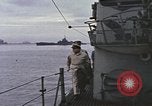
Japanese submarines, I-400 class, and battleship Nagato. U.S. Admiral Lockwood at Yokosuka Naval Base at end of World War II
U.S. Admiral Admiral Charles Andrews Lockwood,Commander Submarine Force Pacific,walking on deck of submarine with her captain behind him, right after end of World War 2. The Admiral boards his motor launch, flying a three-star pennant and proceeds across a bay at Yokosuka Naval Base, Japan. The Admiral's colors being hoisted aboard a Japanese submarine, that still flies the Japanese flag, beneath the American flag.Admiral Lockwood pacing the deck of the Japanese submarine. View of shore from launch moving away, with only its wake visible. A Japanese tender surrounded by submarines.Broadside view of the Japanese Battleship Nagato. Japanese military personnel standing on deck of Japanese submarine, I-400 class, tied up to the large tender.Several American sailors walking on the sub deck, as the Japanese board the tender. An American officer and several sailors inspect supplies piled up on deck of the sub. Deck of the tender is filled with American sailors watching the activity.View from deck of submarine filled with Japanese. A barge nearby filled with supplies.More views of the submarine deck filled with Japanese.
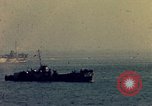
Landing Ship Medium (Rocket), Cruiser, Landing Craft Infantry shell Okinawa in Japan.
U.S. Navy ships bombarding Okinawa during World War II. At start of film, American warships are seen near the shore of Okinawa. Landing Ship Medium (Rocket), LSMR, Number 651, is firing rockets. A Cleveland class light cruiser is firing its guns to starboard. More scenes of rockets being fired from landing ships, leaving trails of smoke as they go.
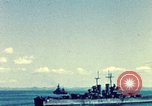
United States warships shell Okinawa, Japan, during World War II
U.S. Naval Task Force of warships bombarding Okinawa in World War 2. Light cruiser USS St. Louis, CL-49, in foreground in the background is the battleship USS Texas, BB-35 shelling Okinawa. Heavy cruiser USS Wichita, CA-45, using signal light communications. Foreground the stern of the USS St. Louis, USS Texas in background. LCI 370 (Landing Craft Infantry) approaches from the right with the USS Texas in the background. On right, the USS St. Louis has turned to port and is shelling Okinawa, a destroyer in the middle, and the USS Texas on left. Close up of the USS St. Louis's stern as she shells Okinawa. Close up of three gun turrent firing. USS Texas in close shelling a hillside Japanese strong point on Okinawa. Shell hits the top of a hill and beach. Explosions due to the shelling. Smoke rises from coastline of Okinawa. Smoke rises from hill on Okinawa and shells hit around base of hill.
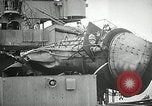
Damaged USS Louisville and men overhaul it in Okinawa, Japan.
Damaged USS Louisville (CA-28) hit by Japanese Kamikase in World War 2. Damaged forward stack of the ship. Float of its scout plane left on catapult, is jettisoned. Large stack of the USS Louisville knocked down. Engine of seaplane blown up by explosion on the signal bridge. Man welds in superstructure. View of other men working to repair damage to the Cruiser.. [Note: The following eyewitness account of the kamikaze attack was recorded by Seamen 1st Class, Enrico Trotta, who was a crew member on the USS Louisville (CA-28) from 1943 to 1946, "At 1923 (hours) two planes which were identified as friendly flew around and one kamikaze dove onto the battleship USS Mississippi BB 41. The other kamikaze plane turned to the Louisville and started to make a run on us. I was on No. #4 - 20 mm AA gun mount on the port side below #2 main battery and I fired 58 rounds to set the kamikaze plane on fire prior to hitting the Louisville’s front smoke stack bending and twisting it and killing 9 men on the 40 mm gun mount mounting on the forward superstructure tripod about 140 feet from our gun mount. The kamikaze also cut our sea plane off and left only the pontoon on the catapult. Three other 20 AA mm gun crews opened up firing 4, 11, and 20 rounds as well. We were not told to fire for we did it on our own. We were only manning the guns at the time and were not on general quarters. Later, the officers came by and said good job."]