


 Francais
 Deutsch
 Italiano
Refine Your Search
+"Japan" +1945 stock footage and images
- Showing 919 to 924 of 1093 results more
more Hide
Hide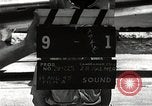
Captain Theodore J Van Kirk, navigator of B-29,'Enola Gay' interviewed at Tinian Island base, Marianas Islands in WW II
Atomic bombing mission in Japan by the United States Army Air Force, during World War II. U.S. military base in North Field, Tinian Island in Mariana Islands, South Pacific. Captain Theodore J. Van Kirk, the navigator of 'Enola Gay' (B-29 which dropped atomic bomb on Hiroshima) is asked about his experience, by Public Affairs Officer, Major John F. Moynahan (seen only from the back at very end of clip). Captain Van Kirk stands in front of Enola Gay and states his belief that the new bomb they carried would be a great help in shortening the war.
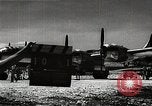
'Enola Gay,' the B-29 that dropped atomic bomb on Hiroshima,parked at North Field base,Tinian, Marianas Islands.
U.S. military base in North Field, Tinian Island in Marianas Islands, South Pacific. 'Enola Gay' the B-29 bomber that dropped the world's first atomic bomb on Hiroshima, Japan, parked on the ramp. The fuselage of Enola Gay. Name Enola Gay painted on its nose. (World War II period).
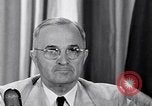
President Harry S Truman of United States thanks the Soviet Union for its efforts in World War II
President Harry S. Truman of the United States addresses the American people by radio, from Washington DC, following his return from the Potsdam Conference. President Truman at the White House giving his speech. He talks about the Berlin conference. He thanks the Soviet Union for its allied role against Germany and against Imperial Japan.
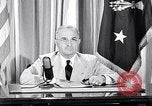
President Harry Truman of the United States speaks about dropping atom bomb on Hiroshima, hours before attack on Nagasaki.
President Harry S. Truman of United States addresses the United States following his return from the Potsdam Conference in Germany, during World War II. President sitting at a desk at the White House explains the choice of Hiroshima as a target for the atomic bomb due to its focus as an industrial rather than a residential center. (This speech is made on the same day as the dropping of the atomic bomb on Nagasaki, but either before the Nagasaki bombing occurred, or before it was confirmed and announced publicly). President Truman warns of additional atomic bomb attacks on more industries in Japan and says the Japanese can foresee what will happen in a future atomic bomb attack, based on what happened at Hiroshima. Truman reminds about the number of warnings issued to the Japanese by the US, Chinese and British governments and how the Japanese rejected them. In a foreshadowing of the attack on Nagasaki, Truman says "I urge Japanese civilians to leave industrial cities immediately, and save themselves from destruction."
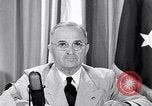
President Harry Truman of United States speaks about peaceful uses of atomic energy, following Potsdam Conference.
President Harry S. Truman of United States addresses the United States people after returning home from the Potsdam Conference, during World War II. President sitting at a desk and speaking into a microphone, talks about atom bombs. He says bombs were dropped against those guilty of the attack on Pearl Harbor, and those who have starved and beaten American Prisoners of Wars. Further he says that the atomic bomb has been used to shorten the duration of war, thereby saving numerous lives. He says the U.S. will continue to use the atomic bomb until Japan surrenders. He notes that the United States, Great Britain and Canada have the technology to produce atomic bomb, but that it will not be revealed until means have been found to control the bomb, so as to protect the world from total destruction. He talks of preventing the misuse of atomic power, and the importance of countries using it for the service and betterment of mankind. He describes it as an awful responsibility, and he thanks God that it has come to the United States and not to its enemies, and that the U.S. prays that God will guide it to use atomic power for His ways and His purposes.
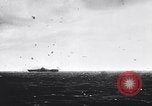
United States warships in the Pacific attacked by Kamikaze planes of Japanese Air Force, Pacific Theater of World War II.
The Pacific Theater of World War II. A United States Navy ship cruising towards Iwo Jima attacked by Kamikaze planes of Imperial Japan. Kamikaze planes dive bombing toward US Navy ships. Huge ship anti aircraft guns on warships fire at the Japanese planes. Explosions on the ships and in the ocean. View as kamikaze aircraft is hit by anti-aircraft fire but continues on its path and strikes the USS Saratoga (CV-3), causing large explosion and smoke billowing upward. US Navy sailors fight fires and try to extinguish fire.