


 Francais
 Deutsch
 Italiano
Refine Your Search
+"Japan" +1945 stock footage and images
- Showing 91 to 96 of 1093 results more
more Hide
Hide
Japanese government gold, silver and platinum removed from caches and hulks of ships at Kure harbor in Japan.
Japan after World War II. A view of Kure, Hiroshima, Japan after the war. Japanese women pulling ropes to move gold caches. Men pulling out baskets of cache from an underground hideout. A woman writing notes on site. Men retrieve cache of coins. Japanese government gold, silver and platinum are removed from the caches. The soldiers take out baskets filled with coins. The collected treasure is taken away from the caches by the soldiers on a military tank. Japanese civilians watch the treasures being taken. A view of the Kure Harbor in Hiroshima Prefecture, Japan. Hulks of wrecked Japanese ships at the harbor. Many wrecked ships in the harbor are seen.
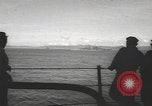
Ships of U.S. 3rd Fleet underway in Tokyo Bay off the coast of Japan during World War II.
United States 3rd Fleet underway in the Pacific Ocean off the coast of Japan during World War II. USS South Dakota off the coast. USS Missouri at anchor in Sagami-Wan into Tokyo Bay. War correspondent Norman Paige looks through binoculars. Ships of the 3rd Fleet ride at anchor off the coast of Japan. Main batteries of USS Iowa. American flag flies from the gaff of the ship. USS Missouri at anchor close to the shore of Japan. HMS Duke of York and HMS King George I underway at sea. Superstructure of USS Iowa as American flag flies from the gaff. Muzzles of a quad mount 40 inch gun. A signal plays on starboard yardarm. A gunnery officer uses a battle phone in the foreground.
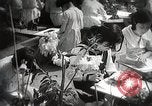
Students learn making ceramic products and music in arts class of school, Japan.
Japanese films show school activities to explain the school system and its deficiencies. The films emphasize the role of schools in developing nationalism, Japan. Students make drawings with colors and brushes in art class. Students seated around the teacher. Teacher teaches students to make natural scenery. Chart of objects displayed. Ceramic products have great importance in Japan and teachers impart their knowledge to students: Students make clay bodies. Clay objects displayed. A man takes clay product out from kiln. Students learn the national flag song in music class. Female teacher plays the musical instrument and teaches songs to children about nationalism and soldiers of country. (World War II period).

Children entertain audience, play and learn to care babies in school, Japan.
Japanese films show school activities to explain the school system and its deficiencies. The films emphasize the role of schools in developing nationalism, Japan. A school program for parents: Two girls play musical numbers on koto (2nd popular musical instrument in Japan) in a program. Young Japanese perform play to entertain the audience of parents. Audience gives huge round of applause. Banzai cheers on stage. Teacher is in black uniform and students are in native kimonos. Teacher teaches students to rock the babies when they cry. Students are told to bring infants or their young brother and sister to learn care of baby. Students learn to make babies sleep and take care of them. Babies are rocked to sleep in a poor school.
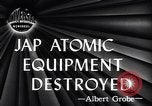
Japanese cyclotron and other atomic equipment being destroyed by American occupation troops in Japan
A newsreel titled "Jap atomic equipment destroyed" shows United States occupation troops looking at Japanese atomic research equipment in Japan a few months after the end of World War II. U.S. Army officers and soldiers tour the Nishina Laboratory of the Institute of Physical and Chemical Research, better known as the RIKEN Research Institute, at Komagome, in Tokyo, Japan. Laboratory director Dr. Yoshio Nishina is seen in the lab with the American forces. American soldiers are seen dismantling, destroying, and disposing of the the atom smasher cyclotron equipment. Occupation troops in an outdoor field rig demolition charges to some of the equipment and blow it up.
Carrier planes bomb transportation facilities and factories in Japan.
Carrier planes of U.S. Navy 3rd fleet strike Japan. Torpedo planes bomb Japanese fleet in a sea. Carrier planes strafe ships, airbases, railroads and factories in Japan. (World War II period).