


 Francais
 Deutsch
 Italiano

Refine Your Search
+"Japan" +1946 stock footage and images
- Showing 271 to 276 of 317 results more
 Hide
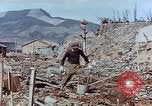
A Japanese uses a long handled ladle to pour fertilizers and seaweeds is laid onto concrete slabs to dry in Nagasaki.
A Japanese drying seaweeds after the atomic bombings in Nagasaki, Japan during the end of World War II . A Japanese stands on the ruins and debris. He uses a long handled ladle to pour some fertilizer into the ground. The seaweeds is laid onto concrete slabs to dry.
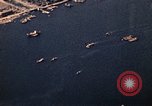
An aerial coverage of a harbor area and a river parallel to the Mitsubishi Small Arms Plant in Nagasaki after World War II.
An aerial coverage of Nagasaki, Japan to show the atomic bomb damage which occurred during World War II. Aerial views of a harbor area and a river parallel to the Mitsubishi Small Arms Plant and a new air strip. Ships anchored and a bridge over a river. Views of buildings and plants.

A patient with radiation poisoning effects on her entire back after due to atomic bomb in Hiroshima during World War II.
Victims of atomic bomb attack and radiation poisoning in Hiroshima Japan during World War 2. Japanese woman's entire back with variations of burn areas where kimono was doubled. Japanese medical doctor points out where kimono was doubled.

A patient shows radiation affects on the left side of his body after facing atomic attacks in Hiroshima during World War II.
Medical patients of atomic bomb attack carried out by the United States over Hiroshima, Japan during World War 2. A patient affected by atomic radiation shows the left side of his upper body. He moves slowly to show differences in skin tissue. The patient's lips and the left ear. His one hand is protected on which he was wearing a glove. The affected underside of the neck and the left shoulder.
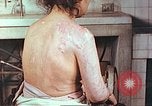
A female patient shows radiation affects on her body after facing atomic attacks in Hiroshima during World War II.
Medical care and review for victims of atomic bomb attack carried out by the United States over Hiroshima, Japan during World War 2. Radiation affects on the back and the right shoulder of a female patient. The right side of the right breast shows protection afforded by the right arm. The right shoulder and the breast position at the time of the blast.

Half a million laborers, agrarians and white collar workers march along the streets and demonstrate on May Day in Tokyo.
May Day demonstrations in Tokyo, Japan. Half a million laborers, agrarians and white collar workers demonstrate in front of the gates of the Imperial Palace and march on the streets of Tokyo. People march along a road and carry signs and banners.