


 Francais
 Deutsch
 Italiano
Refine Your Search
+"Leyte Philippines" +1944 stock footage and images
- Showing 1 to 6 of 43 results more
more Hide
Hide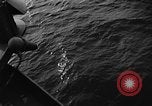
United States troops landing and fighting with Japanese troops in Leyte, Philippines (WW2)
U.S. Third Fleet underway at sea, heads for Leyte in October 1944 during World War II. Warships fire heavy guns at Leyte. Ships advance under naval bombardment. Explosions on ship. U.S. troops aboard landing crafts. Japanese troops and defense during the barrage. They take positions and begin to attack. U.S. landing crafts attacked. Dramatic close up views of faces and expressions of many U.S. soldiers as they prepare for the invasion. U.S. troops leave landing craft and wade through water on to beaches. Japanese troops firing at incoming American forces with rifles and machine gun fire. American soldier raises American flag on island. Artillery fired and U.S. Army tanks advance. Wounded U.S. soldiers carried on litters. U.S. Army soldiers staying low and crawling on beach to avoid enemy fire. U.S. Army soldiers advancing, using rifle fire, hand grenades, and flamethrowers to attack entrenched Japanese enemy positions. Dead Japanese soldiers. Smoke arising from explosions in jungle.
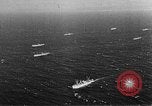
United States troops aboard ships heading for Leyte in Philippines.
U.S. Third Fleet underway at sea, heads for Leyte in October 1944. Sailor in ship's radio-telegraph room receives coded Top Secret message directing task force to change course and attack the Philippines. U.S. officer in room and men at typewriters. Officer marks positions on map. Marine Captain refers to map as he briefs about the planned assault at Leyte, Philippines. U.S. personnel aboard ship underway at sea. U.S. flag on aircraft carrier. U.S. personnel seated on flight deck pray and reflect during religious services on board ship. U.S. troops resting in staging areas. A soldier shaves, drinks beer, packs and writes letter. Waves crash on shores. Troops march. Troops aboard ships. Troops rest aboard ship. Aircraft lands on carrier's deck. (World War II period).

The Philippines gains independence from the United States on July 4, 1946; also scenes from 1941 Japanese invasion WW2
The Philippines are established as an independent nation. Crowds of Filipinos gathered at Rizal Park (Luneta Park) in Manila on the July 4, 1946. View of Independence Grandstand (a temporary structure built in front of the Rizal Monument) with American flag and Philippine flags on tall flag poles.. View looking down on General Douglas MacArthur at a podium, speaking into microphones. Camera pans over various segments of the audience. A map shows the Philippine Islands in context of its neighbors in the Pacific Ocean. Camera pans closeup across faces of many Filipinos gathered at the independence event. View of the Jones Bridge over the Pasig River in downtown Manila. Heacock’s Department Store on the Escolta. The Legislative Building. (later the National Museum of the Philippines). Ocean going ships in a harbor. Cargo being offloaded from a ship onto smaller boat. An industrial complex with eight tall smoke stacks emitting smoke. Steel and petroleum plants. Filipino workers in an assembly plant. The Legislative building with people coming and going. Air raid sirens sounding and people running in streets of Manila at onset of Japanese invasion of the Philippines in December, 1941, at start of World War 2, in the Pacific. People running across the Jones Bridge, seeking shelter. Others boarding a bus. Smoke rising from Japanese bombing. Glimpse of Japanese tanks entering Manila during attack and invasion. Japanese infantry climbing a hill. Bodies of persons killed during the Japanese invasion. Glimpse of Japanese troops occupying Corregidor. U.S. General Wainwright negotiating the surrender of Corregidor with Japanese General Homma. View of an American warship firing during the U.S. campaign to defeat the Japanese on islands in the Pacific. An American landing ship carrying U.S. troops who storm ashore. General Douglas MacArthur striding ashore with a retinue of officers, at Leyte, Philippines, on October 20, 1944. as he keeps his promise to return to the Philippines. Views, back again, to MacArthur speaking at the Independence Day ceremony in Manila on July 4, 1946. Also seen at the ceremony are: U.S. Senator Millard Tydings, (co-sponsor of the 1934 Tydings–McDuffie Act, which provided independence to the Philippines after a 10-year transition under a limited autonomy), and Paul V. McNutt, U.S. High Commissioner of the Philippines, who read President Truman's proclamation of Philippine Independence to the assembly. Camera pans over the gathering which includes many U.S. Service personnel in uniform. The oath of office is administered to the elected President of the Philippines, Manuel Roxas. At the conclusion, the American flag is lowered by Paul McNutt, as President Roxas raises that of the Republic of the Philippines. A celebratory parade in Manila includes a float with signs reading: "Let's Produce and Rebuild," among other things. Other floats represent "Mountain Province," and "The City of Manila," "The University of the Philippines," and "The Division of City Schools." One float, sponsored by the Chamber of Commerce, contains a huge replica machine gear, and models of an aircraft and a ship. It's message is about turning the gear that helps make the nation great. American and Filipino soldiers march, carrying their respective national flags. A white-helmeted military band plays for the marchers. Final scene shows large loose formation of military aircraft in flight very high above the Independence Grandstand, at Rizal Park.
United States 3rd Battalion, 19th Infantry Regiment troops bombard a shoreline in Leyte, Philippines.
The Philippine Operations in Leyte, Philippines. United States 3rd Battalion, 19th Infantry Regiment troops advance in landing crafts. The landing crafts are en route to Red Beach. The ships bombard a shoreline. A wounded soldier being carried on a stretcher. (World War II period).
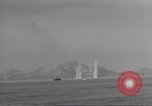
United States battleships fire at Japanese enemy on Palo Beach in Leyte,Philippines during World War II.
Battle of Leyte in the Pacific Campaign of World War II in Philippines. A convoy of United States ships arrives at Palo Beach in Leyte, Philippines. Smoke rise with an explosion on the beach. Battleships fire at Japanese enemy on the beach. A convoy of ships underway.
C-47 Skytrain aircraft in flight over water en route from Angaur to Leyte, Philippines. (WW2)
C-47 Skytrain aircraft in flight over water en route from Angaur to Leyte, Philippines. Aerial view of airstrips, ships offshore. Number of C-47 Skytrain fly in formation. (World War II period)