


 Francais
 Deutsch
 Italiano
Refine Your Search
+"Leyte Philippines" +1944 stock footage and images
- Showing 13 to 18 of 43 results more
more Hide
Hide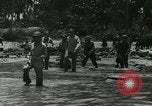
General Douglas MacArthur and entourage walk out into water to pose for famous "return" photographs (WW2)
General Douglas MacArthur and his entourage, at Leyte, Philippines during the Battle of Leyte in World War II. He leads them from land, out into the water to stage the famous "return to Philippines" photographs.
Burning Japanese planes crash into U.S. landing crafts off the coast of Leyte during World War II.
Japanese air attack on U.S. Task Force ships off the coast of Leyte, Philippines during World War II. Japanese plane falls, crashes in water. Many small crafts lay smoke screen. Two Japanese plane crash in water. One crashes into LCI (Landing Craft, Infantry). Wounded U.S. soldiers in LCM (Landing Craft, Mechanized) alongside ship. U.S. gun crew fire antiaircraft gun aboard destroyer. Bombs burst near ship. Two burning Japanese planes, one crashes into LCI.
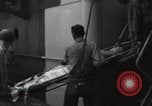
Small crafts of U.S. Task Force lay smoke screen and smoke pots off the coast of Leyte during World War II.
U.S. Task Force ships off the coast of Leyte, Philippines during World War II. Wounded U.S. soldiers are transferred in LCVP (Landing Craft, Vehicle, Personnel) alongside ship. LCI (Landing Craft, Infantry) lays smoke screen. Small crafts lay smoke screen and smoke pots in area. Smoke pots on water. 20MM gun crew at stations. LCVP approaches, lays smoke.
United States troops firing Long Tom inland, shoot down Kamikaze Japanese fighters during the Battle of Leyte Gulf (WWII)
United States troops secure the island of Leyte, Philippines from Japanese control during World War II. apprehend an injured Japanese soldier found in a jungle. The Japanese soldier is taken to a tent. Two semi-naked Japanese soldiers raise their arms upon surrendering. General Douglas MacArthur discussing plans to take over the rest of the Philippines from Japanese occupation. Map of the Philippines. Japanese soldiers arriving in Leyte, with scenes of Japanese troops climbing down ladders from a ship during landing. A hand points to a map as other soldiers surround it. Two soldiers sitting on the mud as they work. United States troops with 155mm Howitzer “Long Toms” firing at enemy positions. Coconut trees lined behind the artillery. Soldier uses a telephone. Artillery fire both at daytime and night. Soldiers cover their ears. Troops begin to move through the jungles of Leyte. Imperial Japanese Navy flag waving. A fleet of Japanese ships heading to Leyte Gulf. Soldiers with binoculars on the lookout. Animated map of the Philippines shows Japanese and United States fleet. United States Navy ships sailing to Leyte Gulf. United States Navy sailors at fire control station. Sailor opens valve. Gun crew removes gunpowder bags from magazine. Hand squeezes fire control trigger. Torpedo released into water. Naval artillery firing during the Battle of Leyte Gulf. United States troops reading maps and reports inland. A soldier talks on the telephone. A general (Likely General Walter Krueger) inspects a map while smoking a cigarette. A 155mm Howitzer “Long Tom” is taken to the shore. Shirtless soldiers adjust the position of the howitzer. Howitzer barrel moves upwards. United States carriers sail to Leyte Gulf. A soldier pointing while other uses binoculars. Japanese land-based bombers and fighters flying to participate in the Battle of Leyte Gulf. A Japanese aircraft is shot down, falling to the sea. Naval anti-aircraft guns firing at enemy bombers and kamikaze fighters. A shot down kamikaze Japanese fighter bursts into flames. Inferno of shot-down Japanese aircraft burning. Anti-aircraft guns strafing at Japanese fighters. Thick smoke rises from bombed United States aircraft carriers on Leyte Gulf. Two United States fighters still flying with little gas. A Grumman F4F “Wildcat” fighter struggles to land on wet runway of Leyte airfield. The F4F stumbles and turns upside down. Another F4F skids off the runway and crashes into another aircraft. Medics carry a wounded pilot on a stretcher.
Vice Admiral Thomas C. Kinkaid and Lieutenant General Walter Krueger during the Philippine Operations (WW2)
The World War II Philippine Operations near Palo, Leyte, Philippines. Vice Admiral Thomas C. Kinkaid speaks with Lieutenant General Walter Krueger on the bridge of a ship. Lieutenant General Krueger looks through binoculars. They watch the operations. A convoy of ships at a harbor near Palo.
Blood donated in United States for wounded soldiers in Pacific Theater.
United States troops receive whole blood from home in Pacific Theater. An animated map shows boxes of blood flown from San Francisco to Pearl Harbor, Guam, and Leyte. Vehicles parked outside a Red Cross center. A woman donates blood. A nurse sits near her. Blood is kept in portable refrigerators. 'Human blood' written on the boxes. Plane lands in Pearl Harbor, Hawaii. The boxes are unloaded. The crew loads the boxes onto another plane. The boxes arrive in planes Guam. The blood boxes arrive at Base Hospital and are kept in refrigerators. Wounded soldier receives blood in Leyte, Philippines. (World War II period).