


 Francais
 Deutsch
 Italiano
Refine Your Search
+"Mariana Islands" +1944 stock footage and images
- Showing 313 to 318 of 370 results more
more Hide
Hide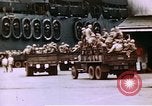
U.S. Marines go aboard AP (transport) during invasion of Saipan at Eniwetok, Marshall Islands.
U.S. Marines during invasion of Saipan, Mariana Islands. They arrive in trucks at dock in Eniwetok, Marshall Islands. Marines work on dock and go aboard AP (transport) alongside. Convoy of AP underway. Transport area shows auxiliary ships and landing craft. Landing crafts underway lay smoke screen. Waves of landing craft underway to beach.
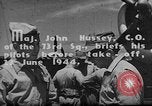
U.S. Army Air Force P-47 aircraft take off from USS Manila Bay, underway off the coast of Saipan, during World War II.
Pacific campaign of World War II in Mariana Islands. Major John Hussey, Commanding Officer of the Army Air Force 73rd Fighter Squadron, 318th Fighter Group briefs his pilots before take off from the Escort Carrier, USS Manila Bay (CVE-61), for their flight to Aslito Field (Isley Field) Saipan. Pilots standing or in kneeling position grouped around the Major as he conducts briefing. Two mechanics as they haul a belly tank out and attach it to the underside of P-47 Thunderbolt aircraft. Naval and Air Force men prepare the planes for take off. Pilots grouped around, talking and smiling. Lt. Joseph J. DeVona stands on wing of his P47D # 31 "Empire Express" while maintenance personnel work on ammunition located in wing. Signal operator for the carrier signaling a P-47 to pull out in position for catapulting. Navy starter gives signal to the pilot for take off. P-47 is moved up into position on catapult, catapult attached to underside of P-47, and plane is readied for catapulting. Navy personnel as they give the various hand signals concerning the movement of plane to fit it into the right position for take off from carrier. Starter as he signals to the pilot and plane is catapulted from the carrier. Lt. Alford Babcock is seen in the cockpit of his P-47 named: "My Baby" as it is catapulted from the carrier. Several other P-47s are seen being catapulted from the Manila Bay. Several flights of P-47s are seen and a large formation of 12 P-47s in flight over water.
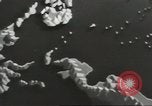
Allied amphibious assault against Japanese held Island in the Pacific, during World War II
Film opens with animated map of the Pacific theater of operations in World War 2. It illustrates Allied advances through network of islands supporting supply lines of Japan. View from an Allied ship in an invasion task force headed to a Japanese occupied island (probably in the Mariana Islands) during World War 2. U.S. troops descend rope net from their transport ship to board landing craft. Numerous landing craft making way in loose formation. Warships in the task force bombard the target island. Huge black explosion occurs. B-25 Mitchell bombers displaying "Z" on tails, are seen briefly in flight. Landing craft maneuvering and approaching the shore where numerous shells are bursting from the naval bombardment. Landing craft number 25, from the USS Bolivar (APA-34) is seen in the water. Troops rush across the sand after leaving their landing craft. Closeups of U.S. troops using small arms and flame throwers to drive Japanese defenders from their caves, blockhouses and other fortifications. Dead Japanese soldiers beside their defensive positions. At the beachhead, several large Landing Craft Infantry LCI(L) 334, 330,335, and 336 are unloading troops into the surf. Closeup front view of troops wading ashore from LCI(L)335. Troops carrying boxes of supplies ashore. At the beachhead, troops are unloading a large truck, while in the background, a Landing Vehicle Tracked is driving away from Landing Ship Tank (LST-47). Her deck is crowded with troops. A tractor drives off a nearby landing craft. Wide view of beachhead jammed with troops and equipment.

U.S. Marines using flame throwers against Japanese, Chinese troops during Sino-Japanese War, aftermath mass suicide of Japanese
A film titled 'The San Jose Project' gives an introduction of chemical warfare tests carried out by U.S. Army on San Jose Island, Panama during World War II. Film opens with scenes of U.S. troops battling Japanese on Pacific islands during World War II. Tank mounted flamethrower being used to burn Japanese from caves. Backpack style handheld flamethrower being used by U.S. Marine at mouth of a cave. A Japanese soldier emerges from a cave and is shot by American soldiers. Scene changes to China, where Chinese troops march near fields during the Sino-Japanese War before World War II. A wounded soldier carried by Chinese troops. Scene changes again to Mariana Islands during World War 2. Piles of bodies of Japanese civilians and soldiers at base of a cliff from which they jumped to commit suicide rather than be captured or killed by American forces. A Japanese civilian jumping off of a cliff. Japanese civilians at waters edge jumping into water.
A U.S. aircraft takes off from an aircraft carrier and Japanese bombers drop bombs on U.S. ships underway in the Pacific Ocean.
The Battle of Saipan during World War II. An aircraft in flight over Saipan, Mariana Islands . An aircraft carrier underway in the Pacific Ocean. U.S. aircraft on the deck. A signal officer gives a signal. The aircraft taxi and take off one after the other. The aircraft in flight. Japanese bombers drop bombs and attack a task force. The bombers drop bombs over U.S. ships. Smoke rises due to bombardment. A smoke screen is formed. The aircraft carrier underway. A bomber aircraft drops bombs. The deck of the carrier. A U.S. aircraft crashes while landing on the deck. Crew members run and approach the aircraft.
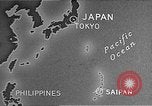
USAAF B-29 Superfortress heavy bombers drop bombs over target areas in Tokyo, Japan during World War II.
Tokyo bombings during World War II. A map shows a flight path from Saipan island, Mariana Islands to Tokyo, Japan. Several United States Army Air Force B-29 Superfortress heavy bombers in flight on their way to Tokyo. Aerial view of buildings in Tokyo. A B-29 drops bombs over target areas in the city. Aerial view of the city shows explosions occurring and smoke rising. The B-29s in flight. View of the sun on the horizon.