


 Francais
 Deutsch
 Italiano
Refine Your Search
+"New Guinea" +1942 stock footage and images
- Showing 1 to 6 of 24 results more
more Hide
Hide
A 1942-1943 film report to the American public about the progress of World War II in Europe and the Pacific.
Opening slate at start of film reads: "1942--1943 The Turn of the Tide." A column of British armor enters Bengazi, Libya, led by several troops in tankettes. Next seen are a Lee Medium Tank, M3 followed by an infantry tank, a jeep, another infantry tank and another Lee M3 Medium tank. Closeup of local people greeting the troops with upraised hands giving the "V" for victory sign. Another Lee M3 tank passes close by the camera. Black smoke is rising in the background. Scene changes to a half sunken ship near another burning in the harbor. Another view of this from further away above port buildings. Closeup of three smiling British soldiers leaning over a cartoon on a tank, of Winston Churchill (As a bulldog smoking a cigar and wearing a cap with the word "Victory" written on it). A crumpled captured flag with swastika on it. British Field Marshal Bernard Montgomery stands atop a vehicle (unseen) and looks through binoculars. Below, a column of British supply vehicles is making its way along a path in the desert. Two tanks coming toward the camera through sand. Animated map shows Nazi territory being threatened by the Allies from the Mediterranean, the USSR, and the English Channel. Views of Soviet infantry advancing against German forces in the snow of winter on the eastern front. Soviet troops firing updated 76-mm divisional gun model 1902 hidden in woods. Shells exploding in snow-covered field as Soviet BT series tanks advance. Various Soviet artillery firing from fixed gun batteries and from woods. A shell striking in distance. Fallen German soldiers lying on snowy field. Makeshift battlefield crosses marking graves of fallen German soldiers. German steel helmets lined up in the snow. A sign, posted on a birch tree, lists the names and birth dates of 16 German soldiers from the 3rd Panzer Division (3Pz-Pi-BH.39) buried at this site on November 28, 1941. Scene shifts to Joseph Stalin addressing Soviet troops in Red Square, Moscow, Russia. All the soldiers in formation seem to be singing (unheard). Film switches to animated map again. This time delineating the Eastern front being pressed by the USSR, and showing area of the 2nd Soviet winter offensive in 1943. Change of scene from Europe to the War in Asia, against Japan, shows General Douglas MacArthur after arriving by a B-17 bomber at a Pacific island American base. He ascends a steep hill in a jungle area, accompanied by other officers. Closeup of MacArthur. American infantry moving in single file in New Guinea, as a field piece fires a round in the direction they are headed. U.S. artillerymen load shells into a 105mm howitzer gun. A fire burns as mop-up operations begin on New Guinea. An Australian soldier is seen firing a Bren gun in jungles. Other Australian soldiers fire a mortar that explodes, raising earth and dust. More views of shells exploding near Allied soldier advancing. A soldier with fixed bayonet makes a fake charge toward the camera. Views of Japanese prisoners of war guarded in an outdoor compound. Japanese dead soldiers on Guadalcanal. An animated map shows new battle lines in the Pacific, closing in on Japan, with pressure from China, the USSR, and the Pacific islands being captured by the U.S. Arrows are added showing new pressure from American naval fleets and from British and American bombers out of Australia and captured islands.
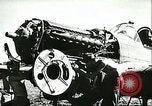
Mechanics repair and refuel Curtiss P-40 aircraft on New Guinea during World War II.
Mechanics servicing P-40 fighter aircraft on what is most likely 4-mile Strip on New Guinea. Date is probably late 1942. "Scatterbrain" was the name painted a P-40 flown by Captain George Manning of the 7th Fighter Squadron, which was based at Rogers Airfield, Port Moresby, New Guinea, during 1942-43, during World War Two.

Footage of the Japanese South Seas Force on New Guinea following the dual invasions of Lae and Salamaua, in World War II.
Scenes from the Japanese South Seas Force invasion of coastal New Guinea in March 1942, during World War 2. Stern of a ship. Smoke rising from a ship in the far background. Japanese warships underway at sea, mountains in the background. A Japanese man on deck of warship, paints picture of historic naval victory. Animated map showing Northern Australia and New Guinea, with animated bombs falling on Port Moresby and flags showing Japanese-held positions at Lae and Salamaua on the coast of the Solomon Sea, to the North. A view of the coastline on the Solomon Sea. Japanese troops are seen in a column making their way through the jungles.They stand with the rising sun battle flag and proceed further, pulling field pieces and carrying other war materiel. View from inside a dwelling, as the Japanese troops enter town of Lae. Destroyed hangars and aircraft at the Lae airfield, which the Japanese bombed on January 21, 1942. The Japanese rising sun flag flying on a tall flag pole. Japanese ships in harbor.

Preparation of supplies and drops executed by soldiers from airplanes in Papua New Guinea.
Documentary titled 'The Biscuit Bomber - The Story of Dropping' about the development of aerial supply techniques by the Troop Carrier Command in New Guinea, 1942-43. A fighter formation of U.S. Douglas C-47 Skytrains and P-38 Lightning fighters of the 54th Troop Carrier Wing with fighter escorts in flight. Soldiers with supplies on the plane. U.S. and Australian troops fighting in the jungles of New Guinea. Soldiers amidst heavy firing and bombardment. Natives on foot carry heavy supplies on their shoulders and backs. Soldiers and natives make their way across the rough terrain. A village with huts and army vehicles. A map shows the area of conflict. Soldiers gather and wrap supplies in blankets and rags, load them into planes. Plane taxis and takes off from field. Soldiers on the ground give a smoke signal. Soldiers in the plane drop the supplies over the drop area. Inadequate wrapping and packing of supplies and the failure to use parachutes damages the supplies during the drops over Goodview. (World War II period).
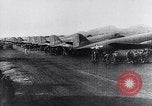
American and Australian troops advance during the New Guinea Campaign.
1942-43: U.S. transport planes parked on an airstrip during the New Guinea Campaign in Papua New Guinea. Paratroopers board the planes and they take off. Supplies are parachuted from U.S. transport planes to Australian troops in the jungles. Australian troops advance amidst heavy fire in the jungles. Machine gun nests. Machine gunners and riflemen load and fire at the enemy. Natives carry wounded soldiers on stretchers. A soldier helps another wounded comrade across a stream. (World War II period).

American and Australian troops fight the Japanese in Papua New Guinea.
Screen Magazine film 'Aussies and Yanks' about American and Australian troops in Papua New Guinea. 1942-43: U.S. 5th AAF B-24 Liberators flying over Port Moresby towards Salamaua. A destroyed ship in the water. Australian troops advance through the thick jungles. U.S. C-47 Skytrains drop supplies with parachutes over target areas. Native bearers collect the supplies and carry them to the front. Troops prepare and eat hot food at a camp in the jungle. Soldiers advance through the jungle amidst enemy fire. They capture Japanese machine gun nests. Load shells and fire anti aircraft guns and machine guns. Dead Japanese soldiers. The wounded Allied soldiers are taken to safety on stretchers across the Francisco River by the natives. An Australian soldier leads a another who is wounded and blinded with his eyes bandaged. They cross a stream and slog through deep mud in the jungles. Wounded soldiers board a plane at an emergency air field to take them to a hospital. Australian soldiers in rain gear,with heads bowed, hold a funeral service at a battlefield cemetery for fallen comrades. A chaplain reads from a prayer book. Soldiers read from a Bible at a grave for their comrades. Reinforcements and supplies are loaded into a C-47 plane at Moresby. Closeup of an American pilot and an Australian co-pilot in the cockpit. View of the aircraft taking off. Closeup view of a C-46 transport in flight. A C-46 making a wheels up landing on a jungle airstrip. If skids along the runway and when it stops, Australian troops exit quickly through its large portside cargo doors and walk about. It is clear that no one was injured during the event. American and Australian soldiers moving through jungles and firing mortars and Browning M1919 machine guns from set positions in the foliage. (World War II period).