


 Francais
 Deutsch
 Italiano
Refine Your Search
+"New Guinea" +1942 stock footage and images
- Showing 7 to 12 of 24 results more
more Hide
Hide
World War II Japanese attack on troop convoy at Port Moresby New Guinea; also Battle of Midway scenes aboard USS Yorktown.
American and Australian troop convoy underway at sea, and then arriving at Port Moresby, New Guinea. A Hudson bomber of the Royal Australian Air Force flys by the troop ship escorting them into the harbor. U.S. and Australian troops unloading men and supplies at Port Moresby. Japanese planes attack the dock area and troop convoy. Elevated land-based views of the harbor with explosions and smoke during the bombing. Anti aircraft guns fired at enemy planes. Soldiers and sailors on ships at harbor open fire on the Japanese aircraft overhead. Planes drop bombs and explosions occur. Complete change of scene to the USS Yorktown (CV-5) during the Battle of Midway on June 4, 1942. United States Navy sailors fighting fires aboard the USS Yorktown. Japanese airplanes overhead during the Battle of Midway attacking the Yorktown. Patterns of tracer bullets seen fired from the Yorktown. Japanese torpedo bomber aircraft is hit by gunners on the USS Yorktown.
2nd Sino-Japanese war, precursor to World War II in the Pacific. Pearl Harbor attack. Early phase of Pacific conflict between Japan and the U.S.
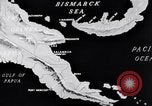
The film 'Sea power in the Pacific' showing Japanese dominance in China and at start of World War 2. Then it chronicles U.S. efforts to build Navy and fight back on sea and in the air. Opening scene shows Japanese Mitsubishi G3M (Type 96) bombers high overhead, and then closeup in formation. View from bomber of bomb bays open with bombs falling and view from ground of explosions and destruction. Overlay on film says: "China---1931." (This is not correct. The G3M bomber was not yet in service.) This film depicts Japanese attacks during second Sino-Japanese War, commencing 1937, Chinese civilians running to escape Japanese bombing of Singapore. Buildings destroyed and on fire. Next, Japanese troops, carrying the Rising Sun flag, are seen establishing a beachhead in an Amphibious assault. More scenes of Japanese infantry advancing through Singapore, ad it is being destroyed and burned. Soldiers charging along an alleyway, with pagoda in background. Next, Japanese soldiers are seen attacking Nanking, and committing atrocities and killing Chinese during the so-called "Rape of Nanking," in December, 1937. Chinese civilians being summarily shot and dumped into a large open grave after execution. Two Chinese prisoners with hands bound, being executed by rifle fire. Jubilant Japanese troops celebrating their victory. Map shows areas of China occupied during second Sino-Japanese war and the East Indies to the South. View of oil tanks; an open pit tin mine; a native cutting rubber tree bark to collect latex. Flags on map show regions of English, French, and Dutch colonial interest. It also shows Islands to the East, fortified by the Japanese. Cartoon shows Japanese soldier opposed by and American sailor (representing U.S. Sea Power). Next, famous images of the Japanese attack on Pearl Harbor, Hawaii, December 7, 1941, are shown, including the USS Arizona burning and sinking. Hawaii, Midway, Wake, and the Philippines Islands, are highlighted on a map and Japanese control of the Pacific is illustrated. Japanese soldiers are seen displaying a captured American flag. U.S. Lieutenant General Jonathan M. Wainwright is seen surrendering the garrison at Corregidor, on May 6, 1942. View of Japanese General Masahara Homma discussing surrender terms with Wainright. Map shows interlocking web of Japanese fortified bases in Pacific and need for seapower to oppose it. View of American shipyard with hundreds of workers, employed to build ships for the war effort, in World War 2. Views welding, metal fabrication, and other shipbuilding activity. A new ship going down the ways and a woman christening a new ship with splash from bottle of champagne. A new "Liberty Ship," the Richard Bassett, going down the ways at Bethlehem-Fairfield Shipyard Inc. Baltimore, Maryland. Closeup view as the stern of another ship enters the water upon launching. View of it from a distance. Shipyard workers knock supports from under what may be a landing craft, as it is launched. Japanese warships underway in the Pacific and firing their naval guns. Explosions on a shoreline from naval bombardment. Japanese infantry wading ashore during an amphibious assault. Map shows where Japanese forces attempt an amphibious assault on Southern New Guinea, thwarted by the U.S. Navy in the battle of the Coral Sea of May, 1942. In June, 1942, a Japanese attempt against Midway Island, was again checked by the U.S. Navy in the Battle of Midway. View of USS Wasp (CV-7) carrier deck filled with airplanes, including Grumman F4F Wildcats. A Douglas SBD Dauntless dive bomber being cleared for takeoff from the Wasp. Gun camera film showing Japanese airplanes being shot down by pursuing U.S. aircraft.
Soldiers and natives pack and prepare to deliver biscuits to Australian and American troops during the Buna Campaign.
American and Australian soldiers during the Buna-Gona Campaign in Papua New Guinea. A map of the conflict area. Soldiers amidst firing in the fields and forests. A tank moves through the forest area. Planes in the sky. Soldiers under heavy camouflage among the bushes. A military storage facility. Soldiers and natives pack and prepare to deliver biscuits to troops. Papuan natives put a box into a sack. Soldiers at tables make requisitions for a supply of blankets. Blankets are transferred from a truck to a warehouse. A soldier calculates the supply of European and native ration supplies to the troops during the Buna Campaign in October - November 1942. A plane in the sky, and then lands. A U.S. Airman explains the process of, and dangers involved in the dropping of supplies from airplanes. Soldiers fight the enemy in the forest. Wounded Japanese soldiers are carried on stretchers. A dead soldier on the ground. Australian and American soldiers celebrate their victory. The soldiers sit and rest, smiling and smoking cigarettes. Soldiers pay their respects at graves of comrades in a makeshift cemetery. (World War II period).
Pacific campaigns in World War 2; U.S. ships under kamikaze attack by Japanese aircraft during the Battle of Midway.
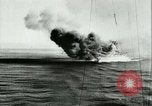
Pictures taken by military and news cameramen during World War II. The Battle of Midway, June 1942: A fleet of U.S. warships underway off the Midway Island. U.S. aircraft bomb the Island. A Japanese ship is hit. The ship on fire. Black smoke rises from the wreckage. U.S. soldiers fire deck guns at Japanese aircraft. Pacific Theater: U.S. Army Air Force C-47 Skytrains or Dakotas in flight over the battlefield. Allied parachute troops and supplies dropped from the aircraft in New Guinea. Parachute troops descend towards the ground. Allied aircraft carriers underway. U.S. aircraft on a carrier deck. Airmen prepare the aircraft for take off. The aircraft taxi and take off. U.S. B-24 Liberators drop bombs. Explosions as deck guns are fired. Explosions near a ship in the water. A U.S. carrier under kamikaze attack by a Japanese aircraft. The hit aircraft descends towards the ship and into the water.
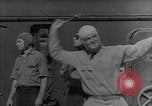
The USS Lexington entering World War II in the Pacific Theater and unrelated scenes of aircraft carrier warfare
A newsreel compilation of several unrelated shots. A P-40 of the 57th Fighter Group takes off from deck of the USS Ranger (CV-4). In an unrelated shot, a view looking back past tail of an aircraft after takeoff, with the USS Enterprise behind. A Douglas SBD Dauntless airplane takes off from a Yorktown class carrier. View back past its tail in a pre-war shot as an airplane leaves the Lexington behind. On Feb. 20, 1942, during World War 2, while en route to attack Rabaul,in New Guinea, the Lexington is attacked by eighteen Japanese planes. She shoots down several of them. Machine gunners firing. Bombs bursting in water near the ship. An F4F with collapsed landing gear near edge of flight deck. Black smoke rising from burning Japanese plane in water. Sky blackened with flak. Machine gun tracer bullets visible. Inserted scenes show the stern of a British carrier, and views of a bombing attack in the Mediterranean against a British Illustrious class carrier. Another inserted scene shows a lone sailor running the length of the flight deck on the USS Enterprise in the Battle of Santa Cruz. A Japanese airplane bursts into flames. Another is struck and dives trailing smoke.( An inserted view of U.S. Douglas TBD Devastators peeling off and launching torpedoes.) Douglas Dauntless aircraft recovering back on the Lexington. Flight deck full of aircraft as the Lexington makes way in the Pacific. Animated segment showing numerous drawings of aircraft carriers and airplanes headed toward Japan. (Inserted view of Four U.S. aircraft carriers, USS Lexington, USS Ranger, USS Yorktown, and USS Enterprise seen together in prewar maneuvers.)
Japanese forces capture Corregidor, Philippines; Bataan Death March; Pacific supply lines to allies in Australia in World War II
Japanese forces fire artillery at Corregidor Island, during Japanese occupation of Philippines during World War II. Smoke rising from Corregidor under bombardment. Japanese troops land on Corregidor, the Philippines, on May 5 1942. A soldier watches enemies' action through binoculars. Soldiers fire artillery in the field. General Wainwright surrenders. He sits with other officers and Japanese officers and discusses. Japanese soldiers lower the American flag. Japanese troops Banzai cheer and celebrate their victory. They raise the Japanese flag. Captured Americans and Filipino prisoners of war departing Mariveles during the Bataan Death March, under Japanese guard. Map shows Japanese targets for invasion in other areas like Malay, Borneo, and New Guinea. Close up view of Japanese soldier's face. Briefing documents labeled Secret are opened and reviewed. Airplanes on the ground. U.S. And Australian troops march in Australia. Animated globe shows different countries. View of armament and artillery production factory operation in the United States supplying war materiel. Close up views of faces of war production workers. Animation and models show a supply line through which supplies are transferred to Australia. Lockheed P-38 Lightning wrapped in camouflage is lowered onto a transport ship deck. U.S. Army tank loaded onto ship and American troops go ashore in Australia. United States planes bomb and sink Japanese ships in the Bismarck Sea on March 2, 1943. View of American machine gunner firing machine gun from aircraft in flight toward enemy Japanese ships. Cockpit point of view shot out of American aircraft as it bombs and strafes Japanese ship. Bombs away view as U.S. aircraft release bombs. Smoke rises from the burning Japanese ships. General Douglas MacArthur and Admiral Chester W. Nimitz meet and discuss strategy and review maps. Animation shows different potential routes for American forces to return to the Philippines.